
Table of Contents
- Rotors from 160 to 220 m: Wind engineering challenges
- Wind turbine bladedesign engineering: Materials, fatigue, and recyclability
- Materials, fatigue, and recyclability in design
- Digitalization in wind farm operations
- Wind farm optimization and industrialized O&M
- Wind innovation: Floating offshore, and bladeless turbines
- Future trends in wind turbine engineering
- Conclusions
- References
- Frequently Asked Questions (FAQs) about wind energy technology
In the last decade, wind turbines have evolved from being simply “large” Wind turbineinto highly complex mechatronic and digital systems, with rotors exceeding 220 meters in diameter and commercial power ratings of 14–15 MW in offshore wind farms. For project engineers, this translates into very high power density per tower position, with direct implications for CAPEX (Capital Expenditure), foundation design, marine logistics, and EPC (Engineering, Procurement, and Construction) contracts.
The current challenge is no longer just producing more energy, but doing so with high availability, lower OPEX (Operational Expenditure), and an acceptable risk profile for asset owners, insurers, and grid operators.
Rotors from 160 to 220 m: Wind engineering challenges
Major manufacturers have driven this scale increase with turbines that have evolved from rotor diameters of 160–170 meters to machines exceeding 220 meters, incorporating power-boost functions that allow temporary operation above nominal capacity under controlled conditions.
From an engineering perspective, this means operating near design limits in terms of fatigue loads, stresses on main bearings, yaw and pitch systems, and tower and transition structures. Consequently, modern turbine design is increasingly oriented toward lifetime management and load control, rather than relying on large static safety margins.
The downside of this scale becomes evident in logistics and social acceptance, particularly in onshore projects in Latin America and Spain. Transporting blades longer than 80–90 meters through mountainous roads, urban areas, or rural regions with limited infrastructure becomes a critical feasibility factor.
Additionally, noise, shadow flicker, and visual impact require more detailed environmental and social assessments. This combination is accelerating interest in offshore solutions, floating turbines in deep waters, and hybrid systems (wind + solar + storage) that allow better resource utilization with less land use conflict.

Wind turbine bladedesign engineering: Materials, fatigue, and recyclability
Aerodynamic engineering and mechanical design
The design of wind turbine blades is one of the most critical aspects of wind turbine engineering, as it directly determines the efficiency of converting wind kinetic energy into mechanical energy. The image illustrates several aerodynamic and geometric principles that guide this design process, where each parameter—airfoil profile, chord, twist, and load distribution—is optimized to maximize energy capture while ensuring rotor structural integrity.
One of the fundamental aspects is the airfoil profile of the blade. Similar to an aircraft wing, the airflow moving across the upper and lower surfaces creates a pressure difference that generates the lift force responsible for rotor rotation. The airfoil design must balance lift and aerodynamic drag to maintain high efficiency across different wind speeds. The following figure presents a representative image of the aerodynamic geometry of wind turbine blades.
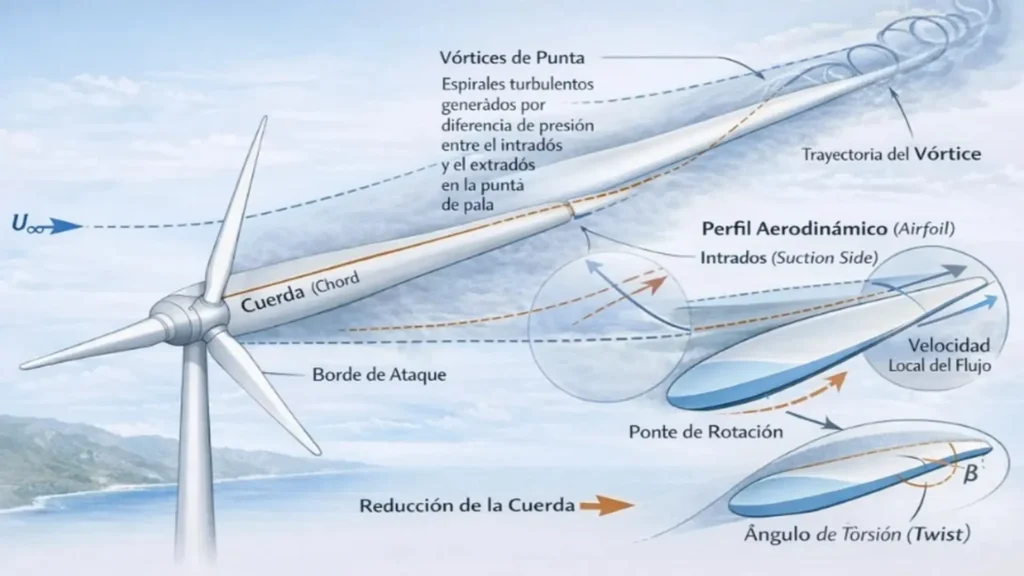
Along the blade length, there is also a variation in chord length. Near the hub, the chord is larger to support higher structural loads and generate sufficient starting torque. Toward the blade tip, the chord gradually decreases to reduce aerodynamic drag and optimize load distribution along the rotor. This geometric transition allows adequate aerodynamic performance without excessively increasing the structural weight.
Another key parameter is the twist angle. Because tangential velocity increases from the blade root to the tip, the optimal angle of attack of the airfoil changes along its length. To compensate for this effect, blades are designed with gradual twist to maintain the most efficient aerodynamic angle of attack in each section. This feature is essential for maximizing energy production and avoiding losses caused by flow separation or excessive turbulence.
At the blade tip, tip vortices are generated due to the pressure difference between the upper and lower surfaces. These vortices represent an aerodynamic loss because they dissipate part of the airflow energy. Therefore, modern blade design aims to minimize this phenomenon through geometric optimization, specialized profiles, and even solutions inspired by aircraft aerodynamics.
From the perspective of wind turbine design engineering, all these elements, airfoil profile, chord distribution, twist, and vortex control, are integrated through advanced aeroelastic simulations that simultaneously consider aerodynamics, structural dynamics, and operating conditions. The ultimate goal is to achieve longer, lighter, and more efficient blades capable of operating for decades under severe cyclic loads without compromising turbine safety or reliability.
Materials, fatigue, and recyclability in design
Modern wind turbine blade design relies on advanced composite materials that allow long structures to be built with an optimal balance between stiffness, strength, and weight. Current configurations mainly combine fiberglass and carbon fiber with lightweight structural cores, such as polymer foams or sandwich-type materials, and high-performance thermoset or thermoplastic polymer matrices.
This structural architecture makes it possible to manufacture longer and more aerodynamically efficient blades without significantly increasing rotor mass. This balance is essential in engineering design, since rotor weight directly affects loads transmitted to the drivetrain, main bearings, and tower structure.
In addition to structural optimization, a distinctive feature of the new generation of wind turbines is the integration of recyclability criteria into the design phase. In commercial offshore projects, solutions based on modified resins or specially formulated polymer matrices are being implemented, allowing the separation of the matrix from reinforcing fibers at the end of the blade’s service life. This approach facilitates the recovery of glass or carbon fibers under suitable conditions for industrial reuse, reducing the environmental impact associated with dismantling large composite components.
At the same time, the development of segmented blades has emerged as a response to logistical constraints faced by many onshore projects. These configurations allow shorter sections to be transported and assembled on site, mitigating road infrastructure limitations associated with transporting components longer than 80 or 90 meters, especially in mountainous regions or rural areas with limited access.
From a structural design perspective, one of the most critical challenges is fatigue behavior. During their operational lifetime, blades are subjected to millions of load cycles caused by variations in wind speed, turbulence, and changes in turbine operating conditions. Therefore, modern blade design incorporates advanced aeroelastic models, optimization of composite laminates, and deformation control to manage cyclic loads and limit maximum stresses during transient events or extreme operating conditions.
In this context, the wind turbine blade of the future is expected to become a highly optimized and modular structure, manufactured with lower environmental footprint composite materials, equipped with embedded sensors for continuous Structural Health Monitoring (SHM), and designed with recycling strategies defined from the engineering phase, integrating energy efficiency, structural durability, and sustainability in next-generation wind turbine design.
Digitalization in wind farm operations
Digitalization has transformed wind turbines into data intensive systems, creating new opportunities for operational optimization and condition-based maintenance. In modern wind farms, each turbine acts as an information node continuously feeding monitoring and control systems.
Sensors measuring vibration, temperature, structural deformation, environmental conditions, and power quality are connected to Supervisory Control and Data Acquisition (SCADA) systems. The integration of these devices generates large volumes of data that, when processed using artificial intelligence and advanced data analytics techniques, enable the transition from corrective or preventive maintenance strategies to predictive condition-based models.
In this context, the digital twin emerges as a virtual representation of the wind turbine or wind farm that is continuously updated with real operational data. This model combines physical simulations—such as aeroelastic, structural, and electrical models—with machine learning algorithms trained with historical operational and failure data.
Thanks to this integration, engineers can simulate load scenarios, evaluate control strategies, and estimate the remaining life of critical components such as bearings, gearboxes, or power converters. This allows maintenance interventions to be prioritized, spare parts management to be optimized, and travel to remote sites to be reduced.
Today, these capabilities are integrated into remote operation centers that monitor fleets of wind turbines distributed across multiple wind farms. In these environments, engineers analyze performance indicators, three-dimensional turbine models, geospatial maps, and wind forecasts to support decision-making in near real time.
The next stage of technological evolution aims to integrate digital twins with grid management and energy markets, allowing wind farms to actively participate in frequency regulation, voltage control, and production optimization throughout the asset life cycle.
Wind farm optimization and industrialized O&M
Beyond hardware and data, process improvements in wind farm operations are shifting the focus from individual turbines to the wind farm as an integrated system.
Traditionally, each turbine operated to maximize its own power coefficient as an isolated unit. However, the interaction between turbines through wake effects generates significant downstream losses. Recent wake control strategies adjust yaw and, in some cases, pitch angles to manage these wakes, slightly reducing the production of some turbines in order to increase the overall energy output of the entire wind farm.
Combined with load mitigation controllers, this approach reduces fatigue in critical components, extends equipment lifetime, and decreases unplanned shutdowns. In the maintenance field, the trend is moving toward industrialized O&M (Operation and Maintenance), incorporating drones with computer vision, automated damage classification, cluster-based inspection campaigns, and performance-based service contracts.
These improvements minimize logistical and safety risks in remote sites, transforming each turbine from an isolated asset into part of a deeply integrated cyber-physical system.
Wind innovation: Floating offshore, and bladeless turbines
To overcome site limitations, land-use conflicts, and saturation of onshore locations, new concepts are expanding the wind energy landscape.
Floating offshore wind enables the installation of large-scale turbines in deep waters, where winds are stronger and more consistent, far from coastal and environmental constraints. For countries such as Chile, Spain, and emerging markets, this represents a new frontier for wind energy development.
At the opposite end of the scale, micro wind turbines are designed for rural microgrids, industrial environments, and urban areas, operating under low and turbulent wind conditions. Combined with local storage and photovoltaic systems, they enable hybrid generation schemes for mining operations, agroindustry, and remote communities.
Finally, concepts such as bladeless turbines and wind walls explore innovative ways of interacting with wind through vortex-induced oscillations, opening opportunities in locations where visual impact, noise, or wildlife considerations make traditional turbines impractical. These bladeless turbines represent a new generation of wind technology, characterized by lower noise levels, greater operational efficiency, lower costs, and a smaller environmental footprint.
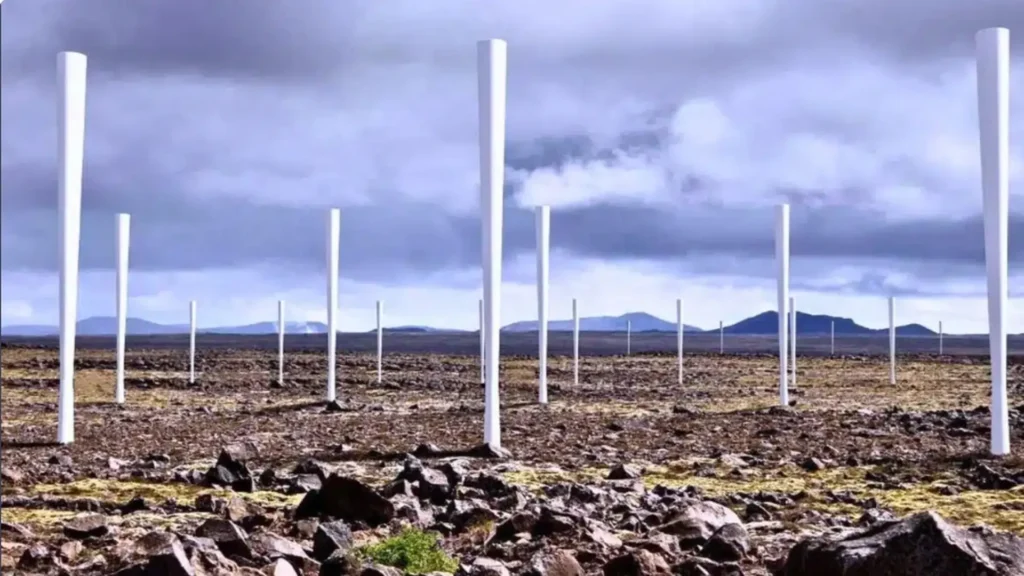
Looking ahead, the wind energy landscape will likely combine large offshore wind farms, optimized onshore parks, and small-scale solutions integrated into microgrids, maximizing efficiency and sustainability.
Future trends in wind turbine engineering
Recent developments in wind energy show that turbine advancement no longer depends solely on increasing size or improving isolated components. The future of the sector is moving toward multidisciplinary integration, where advanced aerodynamics, new composite materials, digitalization, artificial intelligence, and sustainability criteria converge from the design stage.
Next-generation wind turbines will combine large-diameter rotors, blades optimized for fatigue resistance, partially recyclable materials, and real-time structural monitoring systems. This will be complemented by digital twins, advanced analytics, and artificial intelligence, enabling optimized operation, early failure detection, and extended asset lifetime.
Meanwhile, the growth of offshore projects, the development of floating turbines, and the integration of wind farms with hybrid generation and energy storage systems are expanding the technological scope of the industry.
In this context, wind engineering is moving toward a model in which energy efficiency, structural reliability, and life-cycle sustainability become the central pillars of wind farm design and operation.
Conclusions
The evolution of the wind turbine reflects the rapid advancement of renewable energy technologies, combining larger rotor diameters, advanced materials, and digital monitoring systems to achieve higher efficiency and reliability in modern wind farms.
From an engineering perspective, optimizing the design and operation of each wind turbine is essential to maximize energy production, reduce maintenance costs, and improve the overall performance of utility-scale wind power systems.
As the global transition toward low-carbon energy accelerates, the wind turbine continues to play a critical role in sustainable power generation, supporting decarbonization goals while strengthening the resilience of modern energy infrastructures.
References
- International Energy Agency. (2023). Renewables 2023: Analysis and forecast to 2028. IEA Publishing.
- Manwell, J. F., McGowan, J. G., & Rogers, A. L. (2021). Wind energy explained: Theory, design and application (3rd ed.). Wiley.
- Global Wind Energy Council. (2024). Global wind report 2024. GWEC.
Frequently Asked Questions (FAQs) about wind energy technology
Why are modern wind turbines growing so much in size?
Because larger rotors capture more wind energy, increasing electricity generation and reducing the levelized cost of energy (LCOE).
What materials are used in wind turbine blades?
They are mainly made of fiberglass and carbon fiber composites combined with polymer resins and lightweight cores to achieve high strength with low weight.
What is a digital twin in a wind farm?
It is a virtual replica of the turbine or the wind farm that uses operational data and simulation models to optimize operation and anticipate failures.