
Table of Contents
- What does a geodesic dome bring to the tank?
- Structural design of geodesic domes on tanks
- Technical standards for geodesic domes on tanks
- Operational risks in geodesic domes
- How do geodesic domes reduce emissions?
- Interaction between the dome, IFR, and vapor control
- When is it advisable to install geodesic domes as a retrofit?
- Limitations of geodesic domes
- Tank reliability with geodesic domes
- Why geodesic domes are returning to the technical debate
- Conclusions
- References
- Frequently Asked Questions (FAQs)
Geodesic domes have transitioned from being a construction solution to addressing recurring operational problems in storage tanks, such as water ingress, accelerated corrosion, and loss of reliability in service.
In assets exposed to severe weather conditions, the upper roof ceases to be a passive element and begins to directly influence system performance.
When these conditions are not controlled, the impact transcends physical deterioration. Corrective interventions increase, product quality is compromised, and operational costs rise, affecting the overall efficiency of the asset.
What does a geodesic dome bring to the tank?
Geodesic domes provide tanks with a more controlled environment by reducing exposure to rain, humidity, and atmospheric agents. Their function is not limited to the top enclosure; it influences system reliability by limiting water ingress, protecting internal components, and stabilizing operating conditions.
In a dome-roof tank, this behavior translates into more stable operating conditions. From an engineering standpoint, its value lies in reducing factors that increase maintenance, degradation, and operational variability.
This difference can be analyzed comparatively:
Table 1. Functional comparison of geodesic domes on tanks
| Aspect | Without geodesic dome | With geodesic dome |
| Rain exposure | High | Controlled |
| Water ingress | Frequent | Reduced |
| Corrosion | Accelerated | Mitigated |
| Operational variability | High | Stable |
| Maintenance | More frequent | More controlled |
| Product protection | Limited | Improved |
Structural and operational function of the dome
The primary function of the dome is to protect the upper part of the tank from external agents. However, its impact goes beyond the physical enclosure and is directly reflected in operational variables. By limiting contact with rain and contaminants, it helps preserve better conditions in the upper zone of the asset and reduces events that affect maintenance or availability.
In industrial applications, this becomes more relevant when the tank operates under strict continuity criteria. A well-specified dome favors more stable conditions and helps organize the asset’s conservation strategy.
Contribution to integrity and in-service performance
Mechanical integrity in storage tanks depends not only on the structural condition but also on how factors such as water, humidity, and atmospheric exposure are managed. In this context, geodesic domes add value by reducing direct interaction with the environment.
This does not replace inspection or maintenance, but it does help sustain more stable operating conditions, especially in aging assets or in modernization processes.
Structural design of geodesic domes on tanks
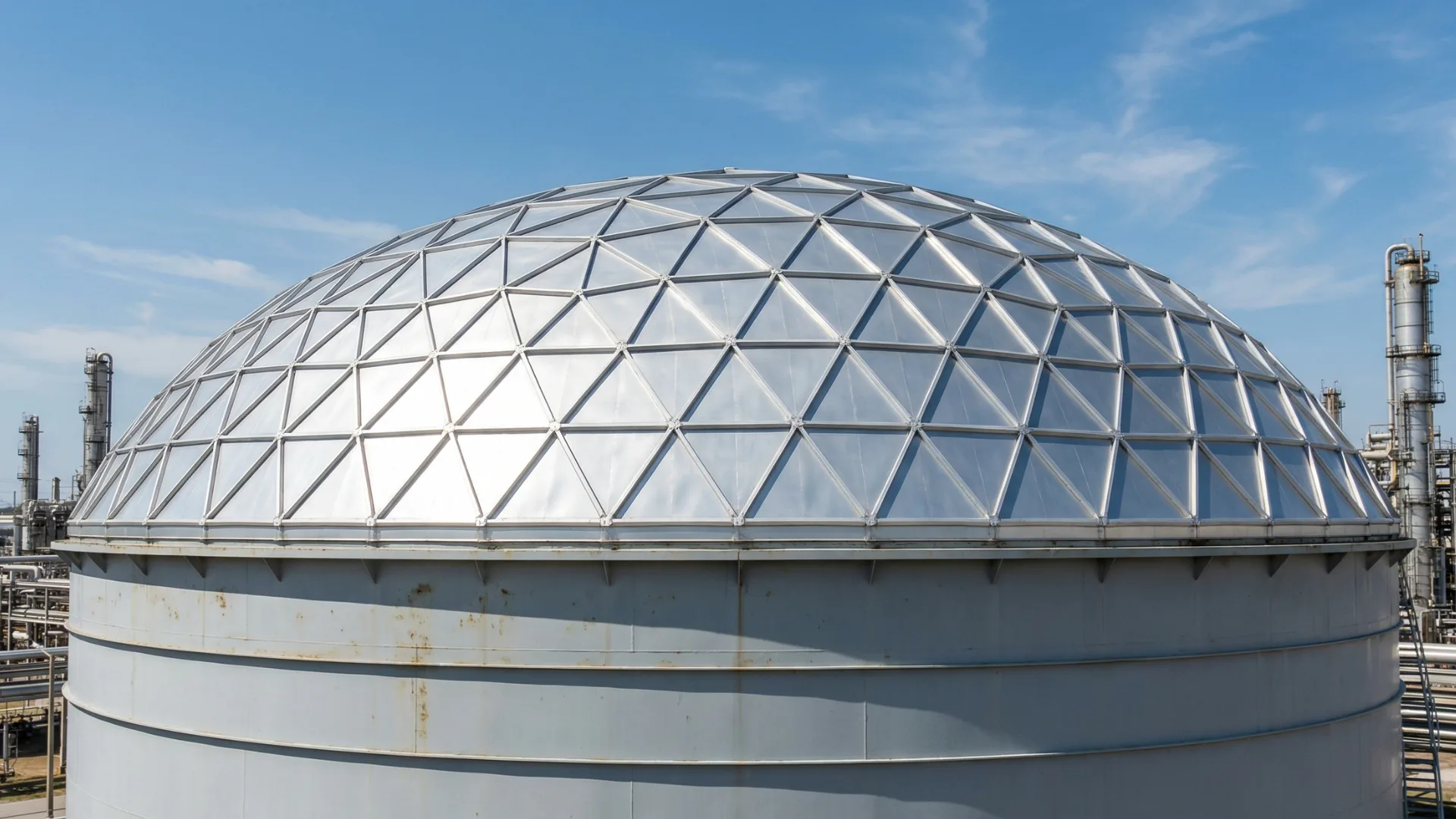
The behavior of geodesic domes responds to a structural logic based on triangulated geometry, which allows for efficient load distribution and a reduction in stress concentrations. In a geodesic dome roof, this geometry allows for spanning large clearings with stable structural behavior, making it easier to cover large diameters with lower structural weight.
In the current technical offering, HMT LLC describes its aluminum domes for tanks as lightweight, corrosion-resistant systems designed to protect aboveground storage assets. This characterization matches the value the sector assigns to roofs that combine low weight, durability, and environmental performance.
This comprehensive approach to the tank can be observed in the following content, part of Inspenet’s “The Voices of the Industry” series, where sector specialists share their experience, solutions, and technical vision:
Geometry and efficient load distribution
Triangulation is the foundation of geodesic dome roof performance. Unlike simpler configurations, the geometric network distributes stresses along multiple paths and improves the overall stability of the roof.
In practice, this allows for a better response to gravitational actions and environmental loads according to ASCE 7, especially when the tank operates with considerable diameters.
For the designer, this represents an advantage because it allows obtaining stiffness and strength with a favorable weight-to-performance ratio. For the operator, it translates into a superior structure that can provide safety, less internal interference, and better long-term behavior if integrated correctly into the existing tank.
Advantages of the aluminum dome roof
The aluminum dome roof offers two widely valued advantages: low weight and natural corrosion resistance. This combination reduces demands on the tank structure and improves system behavior in environments where humidity, rain, and atmospheric exposure accelerate deterioration.
HMT LLC presents its domes precisely under that logic: lightweight aluminum, tank protection, and corrosion resistance for aboveground storage applications.
In addition to environmental performance, the lower weight of the material can favor scenarios for adapting existing tanks.
In retrofit projects, this matters because the roof must not be evaluated solely for its own strength, but also for the additional load it introduces to an asset that already has an operational history, previous inspections, and structural restrictions that must be respected.
What a clear-span roof means
The clear-span concept describes a roof without internal columns. This facilitates inspection, maintenance, and compatibility with internal systems such as internal floating roofs, improving the operability of the tank.
Technical standards for geodesic domes on tanks
The design and evaluation of geodesic domes must align with recognized technical standards that establish safety, structural integrity, and operating criteria. The main references include:
Table 2. Technical standards for geodesic domes on tanks
| Standard | Scope | Application in geodesic domes |
| API 650 | Design and construction of welded tanks | Baseline reference for tank structural integrity |
| API 653 | Inspection, repair, and alteration | Evaluation in retrofit and in-service integrity |
| API 620 | Low-pressure tanks | Applicable in certain special designs |
| ASCE 7 | Design loads (wind, snow, etc.) | Calculation of loads on the dome |
| AWWA D100 | Welded carbon steel water tanks | Reference in specific applications |
| OSHA / local regulations | Industrial safety | Access, maintenance, and safe operation |
Operational risks in geodesic domes
Geodesic domes help control operational risks associated with water ingress, environmental exposure, and corrosion. If these factors are not properly managed, they can accelerate asset deterioration and affect its reliability.
From the standpoint of mechanical integrity, the dome does not eliminate risks, but it does reduce conditions that favor recurring failures. The performance of the geodesic dome roof in this context allows for better control over critical variables in the operating environment.
- Control of water ingress and contamination: Reduces water ingress, preventing product degradation and conditions favorable to corrosion.
- Environmental exposure and accelerated corrosion: Decreases direct exposure to humidity and atmospheric agents, slowing down deterioration.
- Corrective maintenance and unplanned downtime: Reduces the frequency of corrective interventions and improves operational continuity.
- Operational variability and loss of system control: Enables more stable operating conditions by minimizing the influence of the environment.
How do geodesic domes reduce emissions?
Emission control in industrial tanks is one of the most sensitive topics regarding geodesic dome storage tanks. In this context, the aluminum dome roof is integrated as an element that contributes to environmental control within the system.
However, simplifications should be avoided. A dome should not be presented as a unique or absolute solution. Its contribution must be understood as part of a comprehensive strategy that can include tank configuration, sealing, internal systems, operational practices, and regulatory criteria.
Contribution of the top enclosure to environmental control
The value of the top enclosure lies in helping to create a more controlled environment. In combination with other measures, this can favor strategies aimed at reducing losses and improving the overall environmental performance of the tank.
The actual contribution will depend on the asset’s configuration, the stored product, and the way the roof and internal components interact.
The technical wording here must be precise: geodesic domes contribute, support, and help control. They do not “eliminate” emissions on their own. This nuance protects the credibility of the article and better aligns the content with the operational reality of the sector.
Value of retrofitting for emissions, rain, and integrity
Retrofitting becomes attractive when the asset retains structural viability but needs to modernize its performance. In that scenario, aluminum geodesic dome roofs can simultaneously provide protection against rain, better conditions for integrity, and support for environmental strategies.
The actual performance will depend on the asset’s configuration, the stored product, and how the roof and internal components interact.
This comprehensive approach explains why the current discussion on domes is not limited to new construction. Today, both the ability to adapt existing tanks and the possibility of improving reliability and environmental performance without immediately resorting to full tank replacement are of interest.
Compatibility with internal floating roofs
Compatibility with internal floating roofs is an important technical variable. When the tank operates with configurations designed to support vapor control or improve system performance, the top roof must integrate without compromising functionality, accessibility, or safety.
Therefore, the analysis of a retrofit dome must consider not only the roof as an independent element, but its interaction with the entire system. This reading is what allows correctly evaluating whether the solution fits the asset’s emissions, operation, and reliability objectives.
Interaction between the dome, IFR, and vapor control
The performance of the geodesic dome should not be analyzed in isolation, but in conjunction with the tank’s internal systems, especially internal floating roofs (IFR) and sealing systems. This interaction is key to vapor control and effective emission reduction.
In these configurations, the dome acts as a barrier against the environment, while the IFR directly controls the surface of the product. The combination of both systems improves the stability of the internal environment and reduces evaporation losses, provided there is adequate compatibility.
This integration can be better understood through the main elements of the system:
Table 3. Integration of the dome with internal tank systems
| System | Main function | Relationship with the dome |
| IFR (Internal Floating Roof) | Surface vapor control | Complements the environmental control of the dome |
| Sealing system | Minimizes evaporation losses | Works in conjunction with the dome |
| Ventilation | Internal pressure balance | Must be integrated to prevent overpressure |
| Internal accesses | Inspection and maintenance | Requires compatibility with the structure |
However, the benefit does not depend solely on the presence of these elements, but on their proper compatibility. Factors such as mechanical interference, inspection access, ventilation, and operating conditions must be evaluated to ensure coordinated and safe operation.
From an engineering standpoint, this integration defines the true contribution of the dome within environmental control strategies, as its effect is enhanced when it forms part of a comprehensive solution aimed at emissions, reliability, and operational performance.
When is it advisable to install geodesic domes as a retrofit?
The decision to install geodesic domes as a retrofit should not arise from a technological fad. In particular, using an aluminum geodesic dome can represent an efficient solution when it is necessary to improve protection and performance without significantly increasing structural loads.
In practice, it must respond to specific signals from the asset, assessed through industrial asset integrity evaluation processes, an operational need, and a technical evaluation that compares cost, risk, integrity, and future performance.
Signs that the tank requires modernization
There are clear signs that the tank’s roof needs to be inspected. These include recurring water leaks, deterioration of the existing roof, severe exposure to the elements, stricter environmental performance requirements, and the need to improve reliability.
When these factors converge, continuing to operate with a more exposed configuration can increase vulnerability and the total cost of maintenance.
This decision can be evaluated considering the following technical variables:
Table 4. Criteria for evaluating retrofit domes
| Variable | Technical evaluation |
| Structural condition | Verify top ring capacity |
| Design loads | Evaluate wind, weight, and environmental conditions |
| Operational objective | Reliability, emissions, or protection |
| Internal compatibility | IFR, seals, accesses, and maintenance |
| Environmental exposure | Rain, humidity, and corrosive atmosphere |
| Cost-benefit analysis | Investment vs. operational improvement ratio |
Adaptation of existing tanks
The adaptation of existing tanks is usually the most reasonable technical path when the tank remains structurally viable. In those cases, retrofitting with an aluminum geodesic dome can add value without requiring a full replacement of the asset.
HMT LLC, for example, presents its geodesic domes as engineering solutions to modernize aboveground storage tanks, featuring attributes of lightness and corrosion resistance.
This does not imply that retrofitting is automatic. It implies that there is a technically consistent alternative for assets that need to elevate performance and reliability with a focused intervention.
Limitations of geodesic domes
Although geodesic domes offer clear advantages, their implementation requires rigorous technical evaluation. In a retrofit, incorporating the dome introduces new load conditions that must be verified on the tank structure.
Furthermore, they do not replace specific emission control systems, so their performance depends on their integration with the complete system. Poor specification can limit the expected benefits.
From a technical-economic perspective, it is also necessary to evaluate the relationship between investment, risk reduction, and operational improvement.
Tank reliability with geodesic domes
Asset reliability depends on multiple factors, but the upper roof is one of them. Geodesic domes acquire strategic weight when analyzed as a tool to stabilize service conditions, protect the system, and support a more robust integrity strategy.
In a dome-roof tank, this stability translates into better conditions to preserve operational reliability over time.
Asset protection and operational lifespan
When geodesic domes limit exposure to rain, humidity, and weather, the tank operates in a more favorable environment. That protection can help decrease cumulative deterioration and better sustain the asset’s operational lifespan.
The behavior of the geodesic dome roof in this context favors more stable conditions for tank operation. It is not about promising automatic durability, but recognizing that superior design influences the aging of the system.
Relationship between roof, inspection, and maintenance
The relationship between roof and maintenance is closer than is usually recognized. Accessibility, visibility, interior space, interferences, and the environmental state of the tank impact the planning of inspections and the type of intervention the asset requires.
A well-integrated clear-span roof can facilitate this dynamic and reduce operational complications.
The dome as an integrated engineering decision
Evaluating geodesic domes solely by their shape or material would be an incomplete reading. Their value appears when design, risk, retrofitting, environmental protection, and integrity converge into a single decision.
Therefore, the dome must be treated as an engineering solution integrated into the performance of the tank, and not as a simple construction improvement.
Why geodesic domes are returning to the technical debate
The current interest in geodesic domes reflects a broader need in the sector: modernizing tanks to simultaneously address integrity, climate, emissions, and reliability. That convergence has led the technical conversation to gain visibility in specialized spaces.
The current conversation on emissions and integrity
Today, operators are looking for solutions capable of adding simultaneous value in structural protection, environmental control, and operational resilience. That is one of the reasons why geodesic domes have returned to the center of the discussion, especially in contexts where retrofitting offers a viable route to extend asset performance.
NISTM 2026 and The Modern Day Dome as context
NISTM will present its 28th Annual International Aboveground Storage Tank Conference & Trade Show in Orlando, taking place from April 28 to 30, 2026, with pre-activities on April 27, which confirms the relevance of the debate on tank storage, design, and modernization.
In parallel, HMT LLC maintains an active offering of aluminum domes for aboveground tanks, associated with protection, lightness, and corrosion resistance. Within this framework, “The Modern Day Dome” serves as a sign of technical relevance, not as a substitute for the specific analysis each tank requires.
Conclusions
Geodesic domes must be understood as an engineering decision that directly impacts the reliability, integrity, and operational performance of the tank. Their value becomes evident when they respond to real problems of the asset, such as water ingress, environmental exposure, corrosion, and the need to stabilize service conditions.
In retrofit scenarios, geodesic domes allow for improving tank behavior without resorting to full replacements, provided an adequate technical evaluation exists. However, their effectiveness depends on their correct integration with the entire system, including internal components, operational criteria, and environmental control objectives.
In a context where the industry demands greater control over risks, emissions, and availability, the analysis of the top roof acquires a strategic role within the asset’s lifecycle. Before defining a modernization or retrofit strategy, it is advisable to analyze how the roof design influences integrity, environmental control, and the real reliability of the tank.
From its editorial approach, Inspenet continues to provide independent technical analysis that helps better understand these interactions and supports more informed engineering decisions.
References
- American Petroleum Institute. API Standard 650: Welded tanks for oil storage (13th ed.). API Publishing.
- American Petroleum Institute. API Standard 653: Tank inspection, repair, alteration, and reconstruction (5th ed.). API Publishing.
- American Petroleum Institute. API Standard 620: Design and construction of large, welded, low-pressure storage tanks (12th ed.). API Publishing.
- American Society of Civil Engineers. Minimum design loads and associated criteria for buildings and other structures (ASCE/SEI 7-22). ASCE.
- HMT LLC. (2024). Geodesic dome roofs for storage tanks. https://www.hmtllc.com
- National Institute for Storage Tank Management. (2026). 28th Annual International Aboveground Storage Tank Conference & Trade Show. https://www.nistm.org
- Occupational Safety and Health Administration. (n.d.). Process safety management of highly hazardous chemicals. https://www.osha.gov
- American Water Works Association. AWWA D100: Welded carbon steel tanks for water storage. AWWA.
Frequently Asked Questions (FAQs)
What do geodesic domes bring to the tank?
Provides top protection, rain control, less exposure to weather, and better conditions to preserve the integrity and reliability of the system in service.
How does an aluminum dome reduce emissions?
It contributes to environmental control as part of an integrated system. Its effect depends on the tank configuration, the retrofit applied, and the interaction with internal systems.
When is the best time to install retrofit geodesic domes?
When the tank is leaking, the lining is deteriorating, modernization is needed, environmental pressure is increasing, or there is a clear goal to improve reliability.
What risks do modern geodesic domes mitigate?
It helps control water ingress, weather exposure, conditions conducive to corrosion, and factors that increase the need for corrective maintenance or operational vulnerability.
Is it compatible with internal suspended ceilings?
This may be the case, provided that the technical assessment takes into account the tank’s complete configuration, its operational objectives, and its integrity strategy.