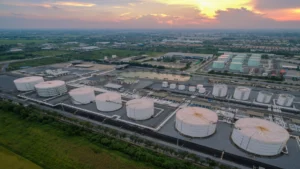
The midstream oil & gas sector links production with market distribution through transportation, compression, storage, and transfer of liquid and gaseous hydrocarbons. Its role in the energy value chain is to ensure the continuous, safe, and traceable movement of crude oil, natural gas, and intermediary products.
Midstream infrastructure (pipelines, terminals, pumping stations, storage caverns, offshore systems) supports supply reliability across the United States, Latin America, and Europe. Its relevance stems from the operational, technical, and economic impact that these systems have on market stability, asset integrity, and regional energy security.
What you’ll find in this section
This category offers applied technical content for professionals seeking deeper insight into midstream operations. Key topics include:
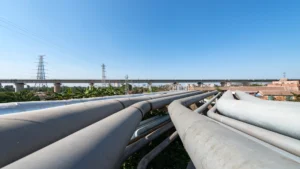
- Pipeline transportation: pumping, compression, hydraulics, and operational control.
- Mechanical integrity: inspection programs, RBI, internal/external corrosion, cathodic protection, and monitoring systems.
- Stations and terminals: measurement, custody transfer, loading/unloading systems, and SCADA architectures.
- Regulations and standards: API 1160, API 1173, PHMSA requirements, and pipeline safety management systems.
- Risk management: threat assessment, defect evaluation, geotechnical integrity, emergency response.
- Innovation and digitalization: IIoT, sensors, digital twins, and predictive analytics.
- Environment and safety: emissions control, spill prevention, compliance, and operational continuity.

The section includes technical articles, case studies, insights, and trend analysis that influence performance and reliability across midstream operations.
Midstream ensures that produced energy reaches markets safely, efficiently, and with full operational traceability. Its main challenges—corrosion, leaks, operational stresses, geotechnical threats, and regulatory compliance—demand applied knowledge and data-driven decision-making.