
Table of Contents
- When to Implement Risk-Based Inspection (RBI)?
- SPM Inspection and Maintenance Plan
- Maintenance of Floating and Submarine Hoses
- Review of the Pivot Swivel
- Technical Regulations and International Best Practices
- The Role of Specialized Companies in Offshore Equipment
- Future Trends in SPM Integrity Management
- Conclusions
- References
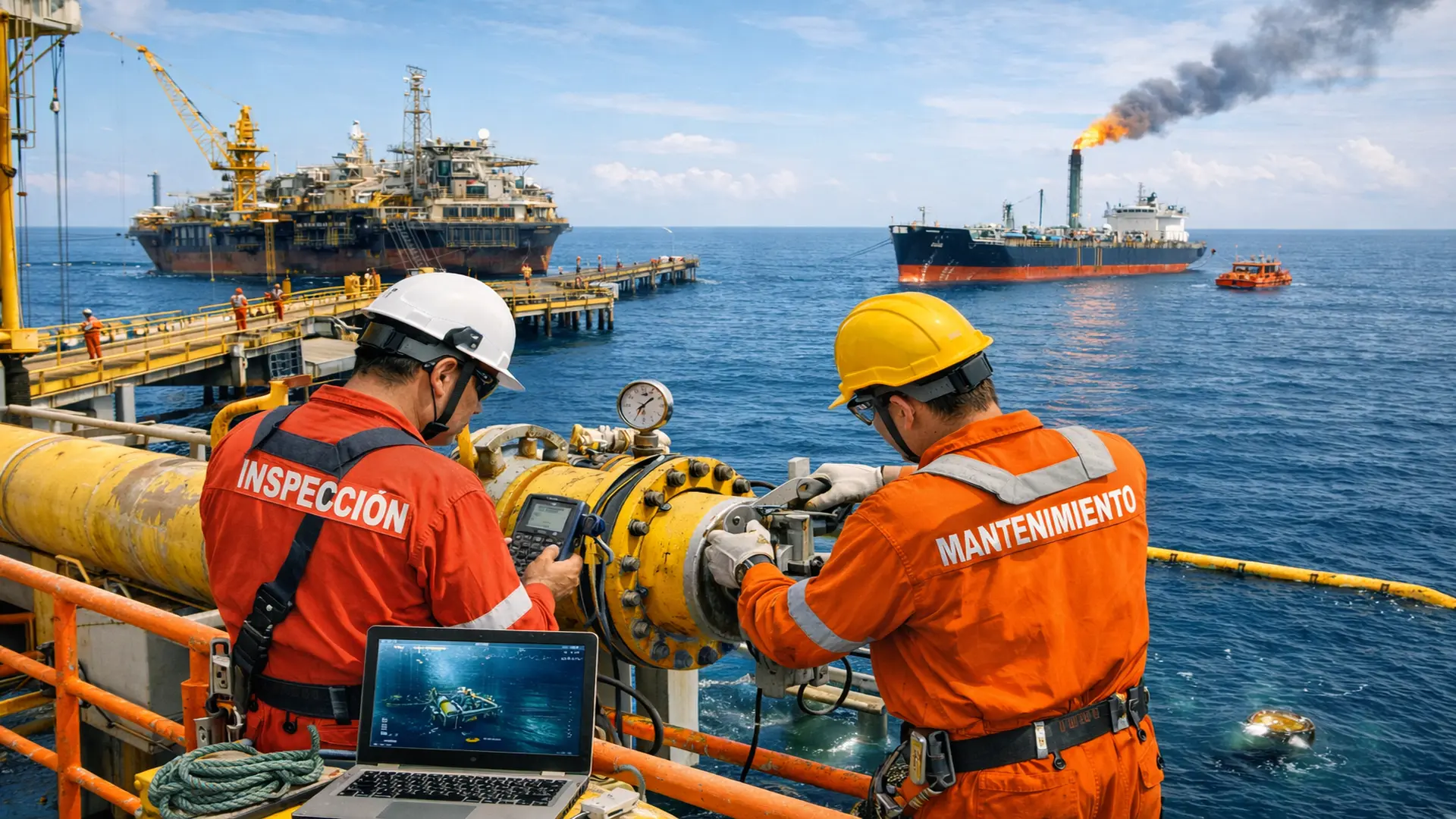
Offshore Single Point Mooring (SPM) terminals operate in some of the most hostile environments on the planet: accelerated marine corrosion, constant multiaxial cyclic loads, exposure to aggressive hydrocarbons, and extreme weather conditions. According to structural integrity management studies, 73% of premature failures in SPM systems are directly linked to insufficient or poorly executed inspection programs.
The primary documented causes include: accelerated degradation of metallic components due to galvanic corrosion and contact fatigue, deterioration of floating hoses from UV exposure and mechanical abrasion, loss of capacity in mooring systems due to seabed movement, and critical wear on swivels that compromises safe rotation capacity.
A rarely discussed but technically relevant aspect is the phenomenon of hydrogen embrittlement in sour environments. SPM terminals operating with heavy crudes containing H₂S (hydrogen sulfide) experience corrosion rates up to 4.3 times higher compared to sweet environments. This critical variable is frequently underestimated in conventional maintenance programs, resulting in unforeseen failures of structural components.
When to Implement Risk-Based Inspection (RBI)?
The API RP 2MIM (Mooring Integrity Management) standard establishes specific criteria for transitioning from prescriptive strategies toward risk-based methodologies. This evolution is particularly relevant for SPM facilities with more than 10 years of operation or those subjected to load conditions not contemplated in the original design.
Risk-based inspection allows for resource optimization by prioritizing components based on their probability of failure and operational consequences. For SPM systems, this means developing specific risk matrices that integrate: documented degradation history through previous inspections, cumulative fatigue analysis based on real load records, consequence evaluation considering proximity to critical infrastructure, and predictive corrosion models calibrated with field measurements.
A relevant technical fact: SPM terminals equipped with advanced telemetry systems can reduce inspection intervals by up to 35% without compromising integrity management, by replacing fixed intervals with thresholds based on real-time conditions. Modern systems, such as those provided by specialized companies, allow real-time monitoring of loads on mooring lines (hawsers), floating hose integrity, buoy excursion, and metocean conditions.
SPM Inspection and Maintenance Plan
Inspection of Mooring Systems and Chains
The mooring system constitutes the structural foundation of any SPM terminal. Mooring chains operate under extreme conditions: permanently submerged in seawater, subjected to multiaxial cyclic loads, and frequently in contact with the seabed where severe abrasion and accelerated corrosion occur.
The API RP 2I (In-service Inspection of Mooring Hardware for Floating Structures) standard establishes precise technical criteria that do not allow for subjective interpretations. The fundamental criterion limits the reduction in strength to no more than 10% of the original component’s Minimum Breaking Strength (MBS). This threshold has been validated by more than two decades of safe operation in the industry.
Critical elements to evaluate during inspections include:
- Link deterioration: Precise measurement of the steel diameter at multiple points using specialized calipers. Reductions greater than 12.5% relative to the nominal diameter indicate mandatory link discard. This seemingly simple measurement requires certified technicians, as incorrect readings can lead to catastrophic decisions.
- Loose or missing studs: A link without studs experiences flexural stress increases of up to 280% compared to the design. The absence of studs creates stress concentrations that drastically reduce fatigue life. Chains with more than 3% loose studs in a 400-foot section require immediate intervention.
- Localized corrosion: Particularly critical in the splash zone (air-water interface) and the ground chain (the section in contact with the seabed). Cross-sectional losses greater than 8% at localized points constitute discard criteria, regardless of the overall condition of the chain.
- Connectors and shackles: These components concentrate stresses and represent critical failure points. The API standard limits the number of connectors to one per 400 feet of length, with a maximum of 10 total connectors excluding the anchor point. This restriction is not arbitrary: every connection introduces metallurgical discontinuities that act as initiators for fatigue cracks.
Inspection technology has evolved significantly. Remotely Operated Vehicles (ROVs) equipped with phased array ultrasonic sensors allow for the complete inspection of submerged chains without the need for recovery, achieving effective integrity management.
This technology reduces operating costs by 40–60% compared to traditional methods that require hauling chains for visual inspection, though it demands considerable initial investment and highly trained personnel for data interpretation.
Maintenance of Floating and Submarine Hoses
Product transfer hoses represent the most operationally complex component in SPM terminals. They function simultaneously as structural elements (supporting their own weight and hydrodynamic loads) and as primary containment systems for hydrocarbons.
OCIMF (Oil Companies International Marine Forum) guidelines establish that no marine hose should remain in service for more than 10 years from its date of manufacture, regardless of its appearance or inspection results. This absolute limit recognizes that the degradation of elastomeric materials due to UV, ozone, and cyclic bending occurs at a molecular level and is not always detectable through visual inspection.
The comprehensive hose inventory management program must include:
- Full traceability: Each hose must have a detailed record: date of manufacture, supplier, technical specifications, installation history, service pressure logs, environmental operating conditions, and the results of every inspection performed. Leading companies like SKS Group Heavy Engineering, specialized in offshore oil sector components including SPM buoys, provide integrated documentary integrity management systems that facilitate this traceability.
- Periodic visual inspections: Conducted before and after every loading/unloading operation. These inspections detect: surface abrasion in contact zones, exposure of metallic reinforcements, permanent deformations, cracks on the external surface, and signs of chemical degradation of the elastomer.
- Annual hydrostatictests: Subjecting the hose to a pressure 1.5 times higher than the Maximum Working Pressure (MWP). A minimum duration of 30 minutes without a pressure loss exceeding 5% is required. Any detectable leak constitutes an absolute criterion for rejection.
- Dimensional analysis: Measurement of length, external diameter, and ovalization. Length increases of more than 3% relative to original dimensions indicate irreversible structural degradation, generally associated with the delamination of internal layers.
A frequently ignored technical aspect: storage temperature dramatically affects the service life of uninstalled hoses. Hoses stored at temperatures above 35°C experience accelerated degradation rates of the elastomeric material, potentially reducing their service life by up to 40%. Facilities in tropical regions must implement climate-controlled storage systems for spare inventory.
Review of the Pivot Swivel
The swivel is the most mechanically sophisticated component of the SPM system. It allows for the 360° rotation of the moored vessel without transmitting torsion to the product transfer lines, operating simultaneously as a structural element that transmits axial loads and as a secondary containment barrier.
Modern swivels incorporate multiple vital elements: large-diameter bearings that support radial and axial loads, dynamic mechanical seals that contain product under pressure while allowing rotation, lubrication systems that maintain functionality in a marine environment, and structures that transmit loads between the rotating and stationary sections.
Swivel integrity management demands:
- Rotation torque monitoring: Increases of more than 25% relative to reference values indicate bearing degradation or contaminant accumulation. Telemetry systems allow for continuous monitoring and the generation of predictive alarms.
- Mechanical seal inspection: Seals represent a critical failure point. Inspections must detect: micro-leaks of product (indicative of initial wear), degradation of elastomeric materials due to chemical compatibility, and misalignments that generate accelerated wear. Acoustic emission technology allows for the early detection of incipient seal failures without disassembly.
- Lubricant analysis: Quarterly sampling with spectrometric analysis to detect metallic particles indicative of internal component wear. The presence of iron, chromium, or nickel in concentrations exceeding manufacturer-established thresholds requires immediate corrective intervention.
- Structural verification: Inspection using dye penetrants or magnetic particles in critical areas of high stress concentration: flanged joints, bearing supports, and connections between rotating and stationary sections. Surface cracks can propagate rapidly under cyclic loads.
A relevant technical fact: precise alignment between swivel sections is critical. Misalignments greater than 0.003 radians generate non-uniform loads on bearings, reducing service life by up to 70%. Installation and maintenance procedures must include laser alignment verification with tolerances of ±0.001 radians.
Technical Regulations and International Best Practices
The regulatory framework for SPM integrity management has evolved significantly over the last decade. The fourth edition of API RP 2SK (Design and Analysis of Stationkeeping Systems for Floating Offshore Structures), published in February 2024, introduces updated methodologies for deterministic analysis and establishes differentiated criteria for permanent versus mobile moorings.
Key elements of API RP 2SK include:
- Defined return periods: 5 years for facilities far from critical infrastructure, 10 years for proximity to platforms or subsea pipelines. This differentiation recognizes that failure consequences scale exponentially when adjacent assets exist.
- Time-domain dynamic analysis: For complex systems or severe environmental conditions, quasi-static analyses are insufficient. Time-domain methodologies capture dynamic effects: resonances, coupling between vessel movements and mooring system response, and non-linear behavior of components.
- Calibrated safety factors: These are not uniform for all components. Chains typically require a factor of 2.0, synthetic ropes a factor of 1.67 (recognizing greater uncertainty in polymeric material properties), and anchors a factor of 1.5–2.0 depending on site geotechnical conditions.
The API RP 2MIM (Mooring Integrity Management) standard complements 2SK by establishing systematic processes for the operational phase: definition of inspection philosophy, damage evaluation procedures, fitness-for-service assessment methodologies, and risk reduction protocols.
A critical aspect frequently omitted: API 2MIM requires periodic updates of design analysis incorporating real operational data. Systems operating for 10+ years under environmental conditions different from those assumed in the original design must undergo a full re-analysis using updated metocean statistics. This re-evaluation may reveal inadequate safety margins that require component reinforcement or operational restrictions.
The Role of Specialized Companies in Offshore Equipment
The technical complexity of SPM terminals demands close collaboration with specialized providers that master both the manufacturing of critical components and the integration of complete systems. SKS Group Heavy Engineering represents an example of a company with comprehensive capabilities in the offshore sector, specializing in high-quality components for both onshore and offshore petroleum facilities.
Their experience ranges from complete SPM buoys to cement-coated subsea pipelines—components that require extreme manufacturing precision and rigorous quality control. The selection of providers for critical components must consider: quality certifications (ISO 9001, API Q1), full material traceability with metallurgical test certificates, manufacturing capacity that meets specified tolerances, and technical support during installation and operation.
A differentiating aspect of leading providers is their capacity for value engineering: proposing technical alternatives that maintain or improve performance while optimizing costs. This may include: selecting materials with superior resistance to the specific corrosion of the operating environment, designs that facilitate inspection and maintenance, and modular components that allow for replacement without a complete system dismantle.
The trend toward full digitalization implies that modern providers do not just deliver hardware, but complete ecosystems: components instrumented with IoT sensors, data management platforms, and predictive analysis services. This vertical integration generates substantial added value by allowing effective integrity management for the continuous optimization of the asset’s life cycle.
Future Trends in SPM Integrity Management
The offshore industry is transitioning toward operational models where artificial intelligence and automation play leading roles. Emerging developments include:
- Continuous autonomous inspection: Resident subsea drones that permanently patrol the SPM system, performing visual and ultrasonic inspections without human intervention. Computer vision algorithms detect anomalies automatically, generating alerts only when deviations exceed established thresholds.
- Advanced predictive maintenance: Machine learning models trained with decades of operational data from multiple facilities predict failures 6–8 weeks in advance, allowing for optimal planning of interventions and efficient management of critical spare parts inventories.
- Advanced materials: Alloys with superior corrosion resistance (super duplex, nickel-base alloys), ultra-high molecular weight polymers for hoses with a 50% longer service life, and nano-structured coatings that virtually eliminate marine corrosion.
- Self-diagnostic systems: Critical components (swivels, connectors, instrumented chains) equipped with embedded sensors that continuously monitor their structural state and generate real-time remaining life predictions.
The convergence of these technologies promises to transform integrity management from a reactive-preventive model toward a genuinely predictive paradigm where unexpected failures are virtually eliminated.
Conclusions
Effective integrity management in offshore SPM terminals requires the sophisticated integration of: rigorous technical regulations (API RP 2SK, API RP 2I, API RP 2MIM), advanced inspection and monitoring technologies, engineering analysis based on the system’s real condition, and collaboration with specialized providers of critical components.
Facilities that implement comprehensive programs document tangible benefits: operational availability exceeding 98%, a 20–35% reduction in maintenance costs, asset life extension of 15–25 years beyond the original design, and the virtual elimination of environmental incidents associated with containment failures.
The future belongs to operators who adopt a holistic view of the life cycle: from material selection and design for maintainability, through data-driven operation and artificial intelligence, to planned and responsible decommissioning. In this context, integrity management transcends its technical function to become a strategic competitive advantage.
References
- www.api.org
- API Recommended Practice 2SK. https://www.api.org/2sk_add.pdf