
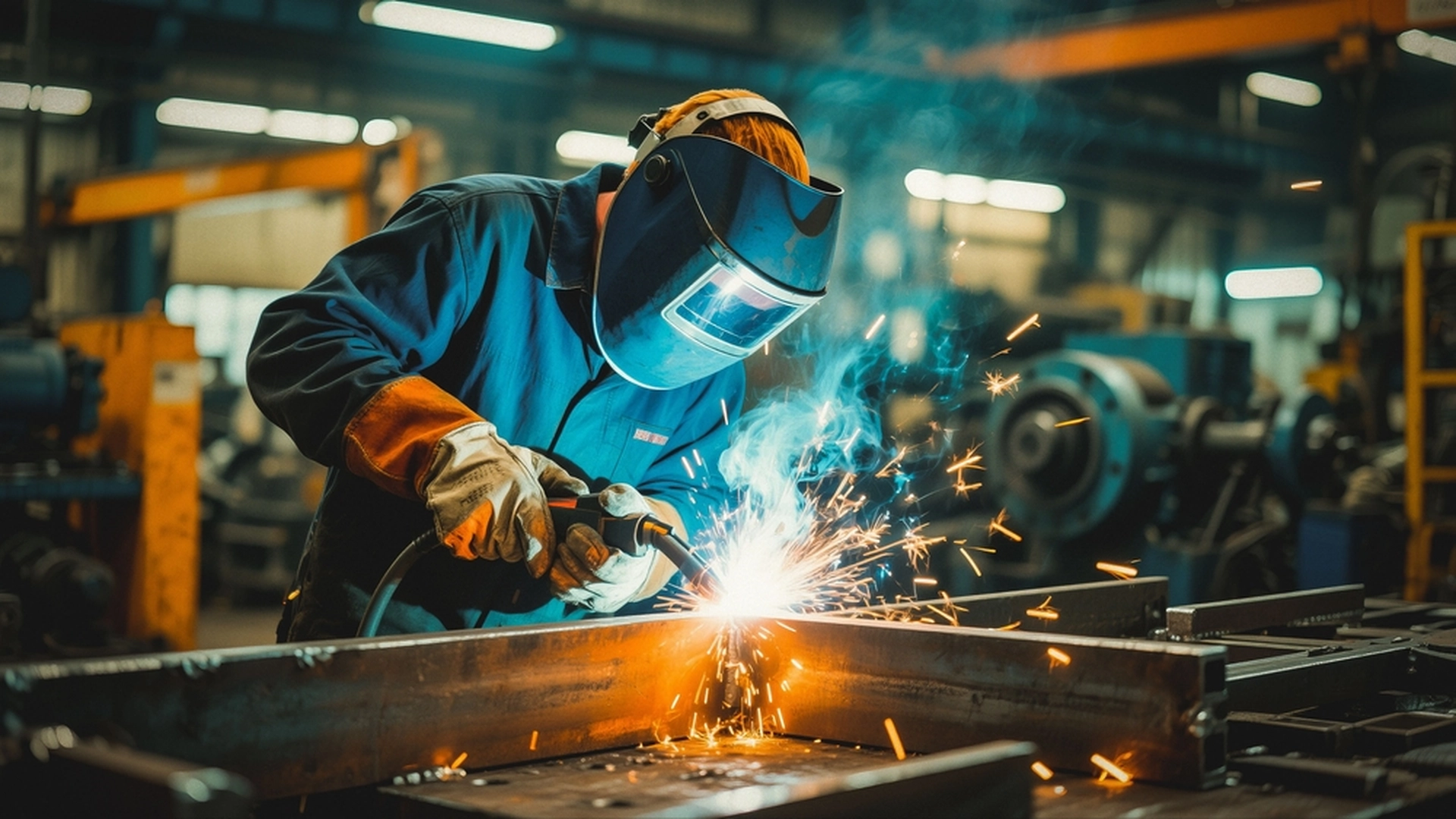
Welding is a key process in the operation and development of different strategic sectors; therefore, it is necessary to ensure the quality and reliability of a welded joint. However, to achieve the correct execution of the weld bead, the welding position is essential.
The spatial orientation of the joint directly influences control of the molten pool, penetration, bead formation, and the appearance of potential discontinuities. For this reason, understanding welding positions improves work quality while also making it possible to comply with qualification, safety, and performance requirements demanded in industrial environments.
A technical fundamentals–based approach to the different welding positions, their standardized designations, and their best practices provides a solid foundation for understanding how proper selection and execution of the welding position contributes to obtaining reliable, safe, and high-quality joints.
What are welding positions and why do they matter?
Welding positions are defined as the different spatial orientations in which a weld bead is deposited on a specific metallic joint, considering both the location of the workpiece and the direction of process travel. These positions directly affect the behavior of the molten metal, penetration, bead shape, and control of the weld pool.
In general terms, four fundamental positions are recognized: flat, horizontal, vertical, and overhead, which cover most configurations found in industrial applications.
Proper selection and mastery of the welding position directly influence the final quality of the joint, as they determine critical parameters such as electrode angle, travel speed, and heat input.
Knowledge of welding positions is essential to ensure operational versatility, achieve structurally reliable welds, and comply with the requirements established by technical standards such as those of AWS and ASME. These standards require welders to demonstrate competence in specific positions through qualification tests, especially in regulated work or applications involving high structural responsibility.
Types of welding positions
Flat welding
Flat welding is a welding position in which the joint is made with the workpiece arranged horizontally, so that the weld bead is deposited on the upper surface of the joint. This position, identified by standards as 1F for fillet welds and 1G for groove welds, is considered the most favorable from an operational and metallurgical standpoint, as the welder does not work against gravity.
In flat welding, the molten pool remains stable and fluid, facilitating proper wetting of the joint edges and uniform penetration of the molten metal. This condition allows for higher heat inputs and elevated deposition rates without compromising control of the weld pool. As a result, productivity is increased and the likelihood of defects such as lack of fusion or slag entrapment is reduced, provided that correct techniques are applied.
All welding processes can be performed in this position, although control of the work and electrode angles is critical. Proper alignment ensures concentration of heat along the joint line, guaranteeing a continuous, homogeneous weld of high structural quality. For these reasons, flat welding is often used as a reference in welder training, qualification, and technical evaluation processes.
Horizontal welding
Horizontal welding is a welding position in which the axis of the weld bead is oriented approximately horizontally, while the joint surface lies in a vertical or inclined plane. It is classified by standards as 2F for fillet welds and 2G for groove welds and is considered an out-of-position weld due to the direct influence of gravity on the molten pool.
From a technical perspective, horizontal welding shares similarities with flat welding; however, control of the weld pool is more complex. In particular, in horizontal groove welding (2G), the molten metal tends to flow toward the lower edge of the joint, requiring precise adjustment of the work angle to favor the upper edge and ensure uniform penetration. In the case of horizontal fillet welding (2F), the bead is deposited at the intersection of a vertical and a horizontal surface, requiring an approximate 45° angle to concentrate heat at the root of the joint.
Thermal control is a critical factor, as excessive heat can cause loss of molten pool stability and bead deformation. Although all welding processes can be applied in this position, horizontal welding demands greater technical skill, coordination, and parameter control to ensure joints of adequate structural and geometric quality.
Vertical welding
Vertical welding is a welding position in which the axis of the weld bead is oriented perpendicular to the ground, and filler metal is deposited on a vertically oriented surface. This position is fundamental in industrial applications where structures cannot be repositioned, such as steel beams, pipelines, tanks, and ship hulls. It is identified as 3G for groove welds and 3F for fillet welds, depending on the type of joint being made.
The main technical complexity of vertical welding lies in the action of gravity on the molten pool, which tends to flow downward, making control difficult and increasing the risk of defects such as lack of fusion, slag inclusions, or molten metal dripping. Therefore, the welder must precisely regulate heat input, travel speed, and electrode angle, adapting the technique depending on whether welding is performed in an upward or downward progression.
Unlike flat welding, vertical welding requires greater skill and operational control, as the balance between penetration and molten pool stability is critical to ensuring the mechanical strength of the joint. Mastery of this position is indispensable in structural steel construction and industrial fabrication sectors, where reliable joints are required in fixed structures with high structural responsibility.
Overhead welding
Overhead welding is a welding position in which the weld bead is deposited from the underside of the joint, with the metal components located above the welder. It is classified as 4G for groove welds and 4F for fillet welds and is mainly used in fixed structures or equipment that cannot be moved, such as industrial facilities, steel structures, and support systems.
From a technical standpoint, this position is considered the most complex due to the direct action of gravity on the molten pool, which tends to detach from the joint. To counteract this effect, it is essential to maintain a small and stable weld pool and to reduce heat input through proper adjustment of process parameters. The techniques used are similar to those of vertical welding, including controlled electrode manipulation and slight oscillations to ensure proper penetration and fusion at the root.
Overhead welding requires a high level of skill, coordination, and thermal control, as well as an appropriate working posture that allows precision and safety. Due to the constant falling of sparks and spatter, the use of reinforced personal protective equipment is indispensable. Mastery of this position is essential in industrial assembly and maintenance applications where structural quality and operational safety are critical.
Standards and codes governing welding positions
- AWS D1.1 – Structural Welding Code (Steel): This standard governs the welding of steel structures, establishing criteria for joint design, welding procedures, and inspection methods. It defines requirements for welder qualification in different welding positions, ensuring that joints meet the levels of strength, safety, and structural performance required in civil and industrial applications.
- AWS D1.2 – Structural Welding Code (Aluminum): Oriented toward the welding of aluminum structures, this code considers the specific properties of aluminum alloys. It establishes requirements for procedure and welder qualification in various positions, as well as visual inspection and non-destructive testing criteria to ensure material structural integrity.
- ASME Section IX – Welding and Brazing Qualifications: Defines guidelines for the qualification of welding procedures (WPS) and welder performance (WPQ). Welding positions form an essential part of the tests, especially in high-criticality industries such as pressure vessels, boilers, and nuclear systems.
- ISO 3834 – Quality requirements for fusion welding: This standard integrates welding into a quality management system, establishing requirements for personnel competence, process planning, and execution control in different welding positions, with emphasis on repeatability and final product quality.
- API 1104 – Welding of pipelines and related facilities: Applicable to the oil and gas industry, it regulates the qualification of procedures and welders for pipeline welding, considering positions representative of real field conditions. It establishes inspection and acceptance criteria to ensure the safety and reliability of fluid transportation systems.
Best practices for proper welding
- Evaluation of job requirements and joint accessibility: It is essential to analyze real environmental conditions, such as height, available space, and type of structure, to plan the procedure and minimize welding in unfavorable positions.
- Matching welder skill level: Personnel must be qualified for the required positions according to applicable standards. Welder assignment should be based on certification and experience in specific positions.
- Joint design and configuration: Joint geometry directly influences the required position and execution technique and should therefore be considered from the design stage.
- Control of heat input according to material thickness: Base metal thickness determines heat input, number of passes, and bead stability, especially in out-of-position welds.
- Regulatory compliance: Welding positions must be clearly defined in the procedure, ensuring that the welder and the parameters used are properly qualified.
- Strict application of safety measures: The use of personal protective equipment appropriate for each position is mandatory to prevent burns, electric shock, and radiation exposure.
- Optimization of welder posture and technique: Proper body positioning, good visibility, adequate lighting, and precise adjustment of amperage, voltage, travel speed, and work angles are key to achieving high-quality, repeatable welds.
Conclusions
The spatial orientation of the joint represents a critical variable that directly influences control of the molten pool, penetration, bead geometry, and the appearance of discontinuities. Each position presents particular operating conditions that require specific techniques, precise parameter adjustments, and a high level of competence from the welder.
Likewise, the importance of compliance with international standards and codes that establish clear criteria for procedure and personnel qualification is highlighted, ensuring that welds performed in different positions meet mechanical strength and structural performance requirements. Complementarily, the development of good practices allows for repeatable and reliable results.
Mastering welding positions improves the technical quality of the work and also represents an essential requirement for competitiveness, operational safety, and structural integrity in modern industry.
References
- https://eziil.com/welding-positions/
- https://primeweld.com/blogs/news/guide-to-welding-positions