
Table of Contents
- Aluminum welding: Metallurgical properties of the material
- How to TIG weld aluminum and achieve industrial quality
- Adjustments for TIG welding aluminum
- Technical selection of TIG filler metal
- Steps for TIG welding aluminum
- Defect prevention: crater cracking and porosity
- Best practices for industrial applications
- Conclusions
- References
- Frequently Asked Questions (FAQs)
TIG welding aluminum does not usually fail due to “operator skill”; it commonly fails because of physics and metallurgy: aluminum dissipates heat very rapidly, its surface oxide behaves differently from the base metal, and even minimal contamination turns into porosity or lack of fusion.
For this reason, achieving a “uniform” weld bead does not always mean achieving a reliable one. In this guide you will find an industrial-oriented approach to what happens within the material, how to prepare it, which TIG welding adjustments are required for aluminum, and which techniques help reduce repetitive defects in production.
Aluminum welding: Metallurgical properties of the material
In aluminum welding, the primary critical factor is the oxide layer (Al₂O₃): its melting point is approximately 2060 °C, while the aluminum base metal melts around 660 °C. If oxide is incorporated into the weld pool, it acts as a wettability barrier and can cause lack of fusion, inclusions, and loss of strength.
These are thermophysical properties of the material; unlike steel, aluminum has high thermal conductivity and a refractory oxide layer that demands absolute precision in arc control. Success in aluminum welding begins with understanding its metallurgy.
Metallurgically, many aluminum alloys do not melt at a single point but over a solidification range. A wide range increases the time the material remains in a “mushy” state, raising susceptibility to hot cracking, especially at weld terminations and craters due to solidification shrinkage and localized stresses.
Aluminum also exhibits high thermal conductivity and a high coefficient of expansion, requiring higher initial energy input and increasing the risk of distortion. In heat-treatable alloys (e.g., 6xxx and 7xxx), the thermal cycle may alter strengthening precipitates, causing softening in the HAZ even when the weld bead appears visually acceptable.
How to TIG weld aluminum and achieve industrial quality
For industrial quality, aluminum TIG welding relies on three factors: AC process, stable gas shielding, and true cleanliness (not “apparent” cleanliness). As a baseline, AC TIG is the typical process for aluminum; the primary shielding gas is usually argon, and for thick sections, argon/helium mixtures or helium may be used to increase heat input and penetration.
Joint preparation and cleaning
Cleaning is not cosmetic: oxide can trap contaminants and affect weld quality; therefore, manual cleaning is recommended before relying on electrical adjustment as a “last defense.” Good practices include:
- Degreasing (with compatible solvent) and dedicated brushing for aluminum.
- Avoid touching prepared edges with bare hands.
- Keep consumables dry and protected; even filler wire can carry moisture or contaminants.
Shielding gas and flow rate
Argon is the most common gas: economical, good arc cleaning, and clean weld bead; for industrial quality, high-purity argon is recommended (typically 99.99% or higher depending on specification/supplier). Adding helium increases the thermal conductivity of the gas and transfers more heat to the base metal. Key operational points include:
- Avoid turbulence (excessive flow) and leaks.
- Protect the weld pool until solidification (adequate postflow).
- If shielding is interrupted, atmospheric moisture may enter the arc and introduce hydrogen into the weld pool.
Tungsten electrode and preparation
The tungsten electrode defines arc stability and weld pool control. For AC aluminum welding, zirconiated (white) tungsten is a robust option due to its current-carrying capacity and arc stability. Geometry and technique should include:
Short, consistent arc: a practical reference is keeping the tungsten-to-work distance close to the tungsten diameter (up to ~1/4”).
- Control torch angle (slight inclination of 5–15°) for stability and visibility of the weld pool.
- The following audiovisual reference shows why aluminum TIG welding requires control of critical variables such as surface oxide, high heat dissipation, and sensitivity to porosity.
The following audiovisual support, courtesy of Weldingtipsandtricks, shows why TIG welding aluminum requires control of critical variables such as surface oxide, high heat dissipation, and sensitivity to porosity.

Adjustments for TIG welding aluminum
Current, AC balance, AC frequency, gas, and timing form the starting point of the process; validate these values using test coupons and industry acceptance criteria before moving to production.
Base parameters and amperage rule
Practical rule for sizing power: ~1 A per 0.001” of thickness (e.g., 1/4” ≈ 250 A). Use this as an initial estimate and fine-tune with a pedal or remote control. Recommended starting points include:
- AC TIG, 100% argon for most jobs.
- On “pure” aluminum, seek weld pool stability and reduce amperage as the part heats up (aluminum accelerates heating as welding progresses).
AC frequency and cleaning control
- AC frequency: On typical machines the range may be 20–250 Hz; lowering frequency produces a wider bead/pool, while increasing frequency narrows and focuses the arc (better directionality).
- AC balance (EN/EP): More time in EN increases penetration, reduces etched zone, and improves tungsten life; more EP provides greater oxide-cleaning action. On modern inverters, a starting range on clean parts may be approximately 65–80% EN (adjust according to oxide level, setup, and weld pool appearance). The positive half-cycle provides cathodic cleaning that breaks oxide, while the negative half-cycle delivers penetration.
- Industrial visual objective: a minimal etched zone along the weld toes is usually sufficient; a narrow band along the toes is commonly referenced.
Preflow, postflow, and pulsing
- Preflow: Purges the immediate area and aids consistent arc starts.
- Postflow: Cools tungsten and weld, preventing contamination; if tungsten or bead appears darkened, increase postflow.
- Pulse: Useful for controlling bead width, heat input, and solidification; improves pool control on thin sections or critical geometries.
Technical selection of TIG filler metal
In aluminum welding, the filler wire determines more than “compatibility”: it affects strength, crack susceptibility, and weld behavior during anodizing and at service temperature. In TIG aluminum welding, improper selection can produce visually acceptable joints that fail repeatedly in production or service.
ER4043 vs ER5356: industrial criteria
Two common fillers are ER4043 (Al-Si) and ER5356 (Al-Mg). Selection must be based on functional requirements (service conditions, corrosion, finish, temperature) and the base alloy.
The ER4043 and ER5356 designations correspond to standardized aluminum welding consumables. Their classification and requirements (chemical composition and associated properties) are defined in AWS A5.10/A5.10M and ISO 18273, which should be referenced when defining filler metal in a WPS.
| Criterion | ER4043 (Al-Si) | ER5356 (Al-Mg) |
|---|---|---|
| Key element | Si (~5%) | Mg (~5%) |
| Wettability / Flow | Very high | Good |
| Hot cracking | Lower | Moderate* |
| Anodizing (color) | Tends to darken | Better match |
| Weld strength | Medium | High |
| Service >150 °F | Suitable | Not recommended |
| Common base metal | 6xxx / castings | 5xxx / 6xxx |
| Best for | General / finish | Structural / marine |
*Depends on base alloy and restraint.
Quick TIG filler checklist (4043/5356)
- Will the part be anodized and is color critical?
- Does service temperature exceed 150 °F?
- Is there a history of cracking in this alloy/joint?
- Corrosive/marine environment?
- Is the requirement strength/corrosion or surface finish?
Steps for TIG welding aluminum
This general step-by-step approach applies to shop, maintenance, and fabrication, with a focus on repeatability:
- Define alloy, joint, and filler: Select compatible filler (see 4043/5356 section) and prepare the joint.
- Cleaning and preparation: Degrease, brush, and protect edges; avoid recontamination.
- Equipment setup: AC TIG + argon as baseline. Set preflow/postflow and start with moderate balance/frequency.
- Practice torch and pool control: Control hand support, 5–15° angle, and short arc; aluminum “steals” heat and pool control governs quality.
- Deposit filler with steady rhythm: Coordinate torch and filler; introduce filler at the leading edge of the pool to avoid tungsten contamination.
- Manage heat during travel: Reduce pedal input as the part heats to avoid washout and loss of control.
- Terminate weld without crater: Apply downslope or final fill technique to minimize crater cracking (see next section).
Defect prevention: crater cracking and porosity
Crater control and weld termination
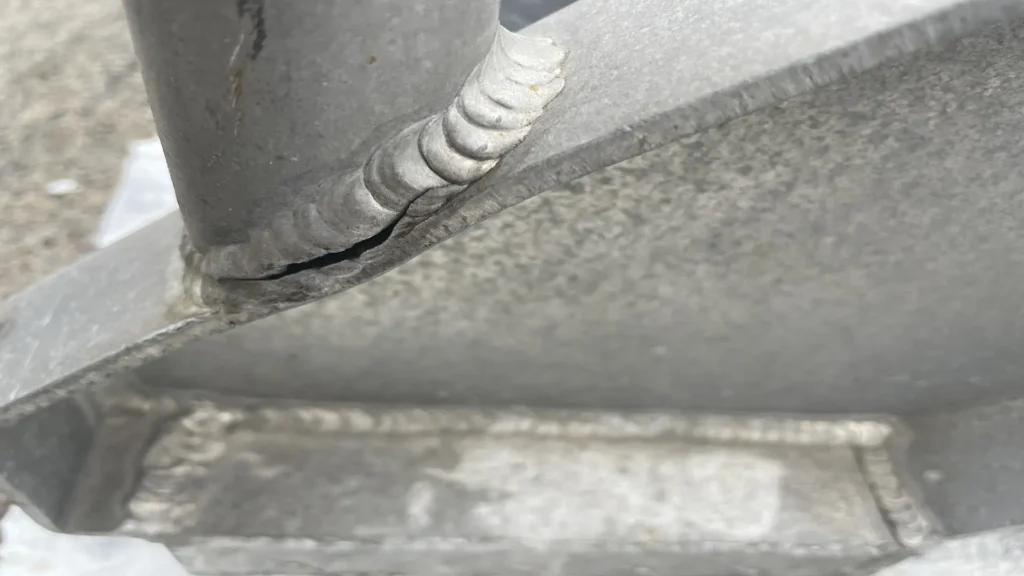
Many cracks originate at the weld end. Applying downslope and crater control is especially important in crack-sensitive materials or when crater elimination is required. Practical actions include:
- Gradually reduce current (do not stop abruptly).
- Add a final small amount of filler to fill the crater.
Hydrogen porosity: causes and actions
Priority is reducing available hydrogen in the weld pool: control moisture, clean thoroughly, and avoid gas interruptions. Anti-porosity checklist:
- Dry, clean consumables; filler wire ideally kept packaged and cleaned if exposed.
- Stable shielding gas; avoid drafts and dirty nozzles.
- If gas flow is interrupted, atmospheric moisture may enter the arc and increase hydrogen absorption.
Best practices for industrial applications
Quality, documentation, and traceability
- Record internal WPS: amperage range, balance, frequency, gas, tungsten and filler diameter. Include filler designation per AWS A5.10 or ISO 18273 to ensure traceability.
- Use coupons before production: parameters are approximate and must be validated against your specification.
Inspection and weld verification
- Visual inspection: controlled etched zone, no excessive “pepper” appearance (indicates need for more cleaning/EP action).
- When applicable: PT/RT based on criticality (internal porosity is common in aluminum when hygiene fails).
Conclusions
Aluminum TIG welding requires control of high-melting-point oxide, high thermal dissipation, and sensitivity to hydrogen porosity. With strict preparation, correct tungsten selection, stable gas shielding, and well-grounded TIG aluminum welding parameters (AC balance and frequency), a “delicate” process can be transformed into a repeatable and auditable one.
Start from base parameters, validate with coupons, and document ranges: that discipline makes the difference between shop-acceptable beads and welds reliable in industrial service. The final goal: joints with superior metallurgical integrity.
References
- Zuo, X.; Lv, Z.; Wang, Y.; Chen, X.; Qi, W. (2025). Proquest. Microstructural Organization and Mechanical Properties of 5356 Aluminum Alloy Wire Arc Additive Manufacturing Under Low Heat Input Conditions. Metals, Basel, Vol. 15, No. 2 (2025): 116. DOI:10.3390/met15020116
- Guide for Aluminum Welding. https://www.hobartbrothers.com/wp-content/uploads/2020/09/Aluminum_Welding_Guide.pdf
Frequently Asked Questions (FAQs)
What parameters are used to TIG weld aluminum?
As an industrial baseline: AC TIG + argon; size amperage using the ~1 A per 0.001” rule and adjust with remote control; balance and frequency are fine-tuned based on oxide condition, thickness, and directionality.
What frequency is used to weld aluminum?
It depends on the objective. In typical equipment, AC frequency can be adjusted over wide ranges (e.g., 20–250 Hz); lower frequency widens the bead, while higher frequency focuses the arc for directional control.
At what amperage should aluminum be welded?
A practical starting point is ~1 A per 0.001” of thickness (1/4” ≈ 250 A). Amperage is then modulated during travel because aluminum heats more rapidly as welding progresses.