
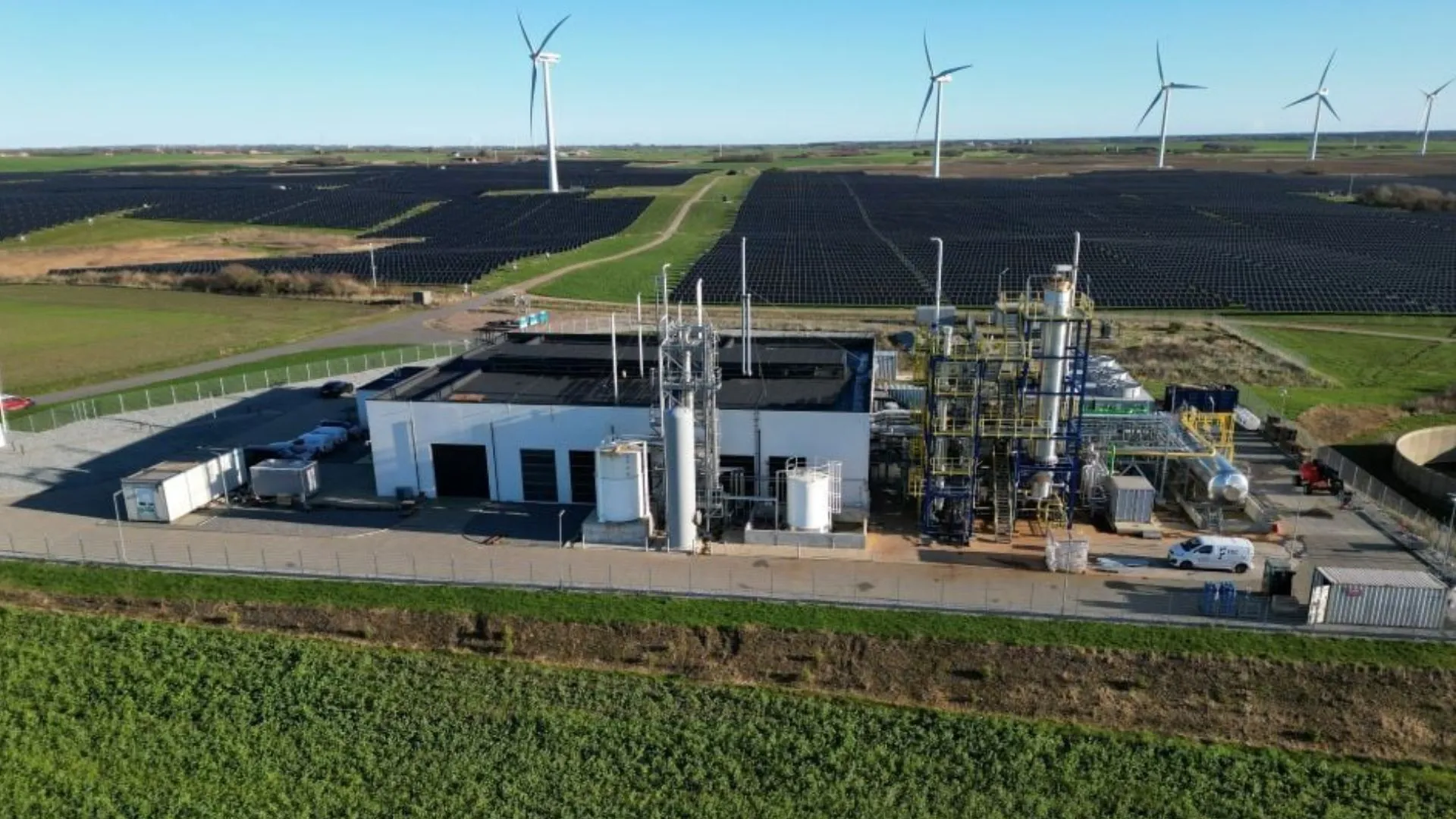
A partnership between Skovgaard Energy, Topsoe and Vestas has made history in northwest Jutland with the start of operations of the world’s first green ammonia plant, with technical capabilities to operate dynamically, i.e. adjusting in real time to the variability of renewable sources.
Green ammonia plant and its production without hydrogen storage
The facility is located in Ramme, Denmark, and uses wind and solar energy to directly power the electrolyzers and synthesize ammonia, without the need for hydrogen storage systems. This configuration reduces operating costs and demonstrates efficient integration between renewables and industrial chemical processes.
With an estimated annual production capacity of 5,000 tons, this plant is expected to avoid the emission of about 9,600 tons of CO₂ each year. The model demonstrates the feasibility of dynamic Power-to-X schemes that optimize intermittent energy resources without resorting to costly backup solutions.
Topsoe has applied its expertise in industrial decarbonization solutions. Vestas is providing the wind infrastructure, while Skovgaard Energy, with three decades in the industry, is leading the local development of the project.
The initiative has been funded by the Danish Energy Technology Development and Demonstration Program(EUDP), with support equivalent to 11 million euros.
Green ammonia is positioned as a resource in the energy transition, with applications ranging from fuel for maritime transport to fertilizers for agriculture, in addition to serving as a hydrogen carrier. The plant demonstrates that it is possible to integrate the production of this compound in areas where climate variability is a challenge.
Source and photo: Topsoe