
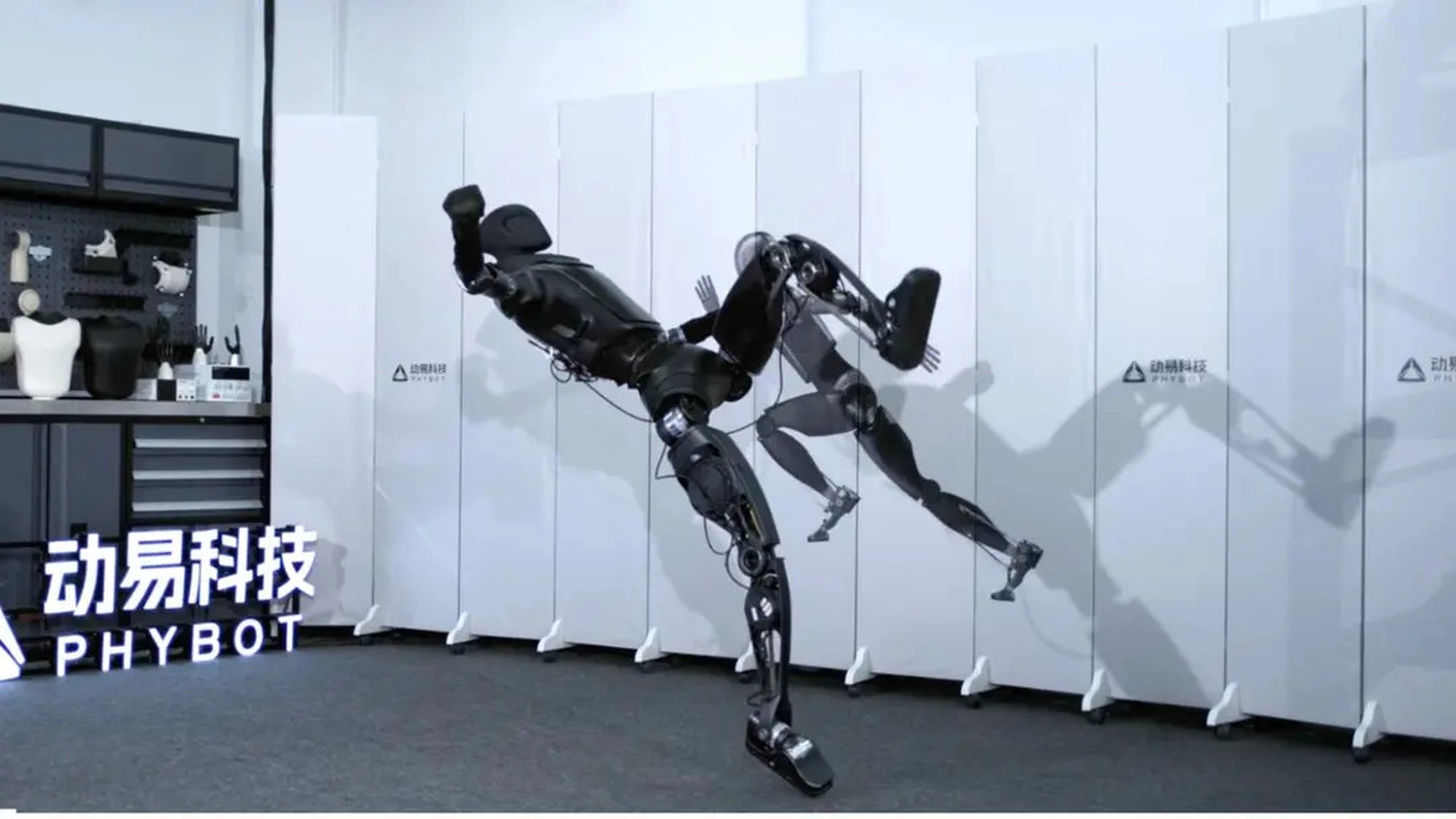
With an inverted spin captured on video and a flare in hand, the PHYBOT M1 made its triumphant entry into the humanoid robot market. Developed by a Chinese startup led by Tsinghua University alumni, this life-size electric humanoid challenges global benchmarks such as Atlas, Optimus and H1.
The somersault executed by the M1 was not just an acrobatic demonstration: it was a technical statement. The robot is designed to generate more than 10 kilowatts of instantaneous power, allowing it to take off from a static position and land with precision, thanks to its joints with up to 530 N-m torque.
Internal architecture without shortcuts
Unlike other proposals on the market, the M1 does not rely on open source frameworks. Its control architecture is based on a hybrid processing system that integrates an Nvidia Jetson Orin chip with an Intel Core i7 processor. This combination allows the robot to process data in real time and adapt to complex environments.
For its spatial perception, it relies on sensors such as 3D LiDAR, stereo cameras and an IMU that ensures stability during dynamic movements. The company emphasizes that its system was developed entirely in-house, highlighting its technological independence.
PHYBOT M1: Compact power and functional focus
At 172 centimeters tall and weighing less than 60 kilograms, the M1 was designed with a torque density of 200 N-m/kg, making it one of the humanoids with the best power-to-weight ratio on the market.
Beyond acrobatics, the robot is geared towards physical work. It can carry objects weighing up to 20 kg with its arms and transport more than 50 kg thanks to a modular backpack system. With an autonomy of up to 2 hours, it is shaping up to be a robust tool for real tasks.
Competition is intensifying
While Boston Dynamics prioritizes agility and Tesla refines the dexterity of its Optimus OptimusPHYBOT bets on strength as a competitive differential. In a market where each new model seeks to stand out with increasingly human movements, the M1 proposes a new metric: performance per joint.
At a target price of less than $42,000, PHYBOT is looking to make the M1 a viable competitor for both laboratory and industrial environments. And with every leap it takes, the competition gets more demanding.
Source and photo: Interesting Engineering