During the NISTM 2025 event, Rob Lunder, president of WBI Energy Corrosion Services, shared his vision on the current challenges in cathodic protection within the energy product storage and transportation industry. Drawing on his experience, he discussed best practices, effective materials, and the most relevant technical challenges facing companies in the sector.
Lunder explained that, in the case of storage tanks, the most common corrosion mechanisms are divided between internal corrosion (inside the tank) and external corrosion, which mainly affects the bottom of the tank. For both scenarios, WBI designs specific solutions that are adapted to the site conditions and the type of product stored.
In internal systems, the anodes are suspended from the top of the tank, while in external protection they are installed under the bottom. The choice of system depends on the structural design and available access.
To evaluate the effectiveness of the installed systems, inspections follow the criteria established by NACE International, the technical authority on corrosion. The process includes taking electrical potentials to verify that cathodic protection levels are within the required range.
"We measure potentials to see if the structure meets the protection criteria. If it doesn't, we know we need to take action,"
explained Lunder.
This approach allows areas at risk of corrosion to be detected before the damage progresses, facilitating timely and effective intervention.
Among the most common materials used in cathodic protection are impressed current systems, which operate using electrical rectifiers, and galvanic systems, which use sacrificial anodes. The choice between one or the other depends on the size of the structure, soil conditions, and site operational constraints.
Lunder explained that for large tanks or those with high current demands, impressed current systems are ideal. On the other hand, for smaller or isolated structures, a galvanic system may be sufficient.
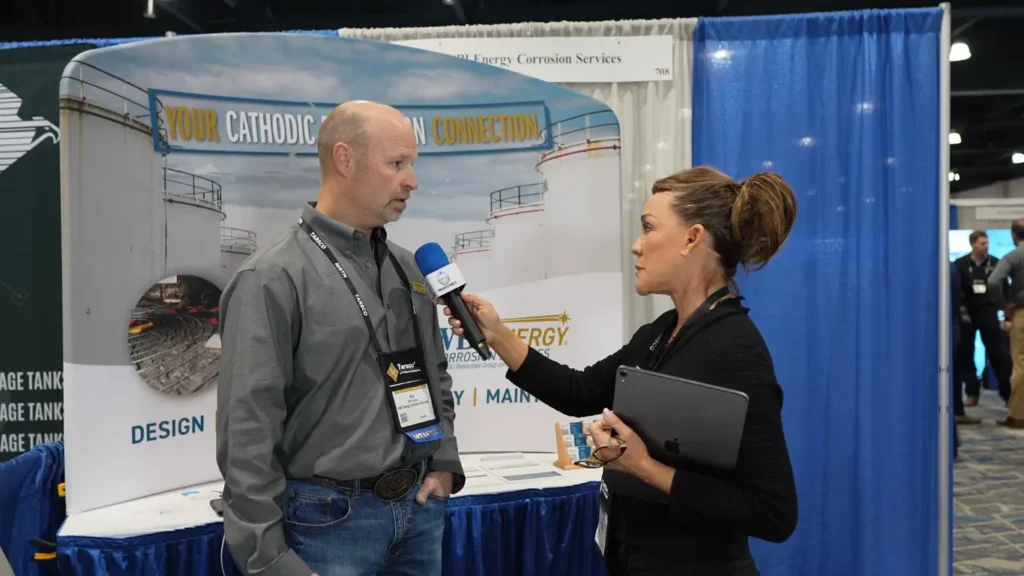
Regarding coatings, the executive mentioned that epoxies are proving highly effective, especially in internal systems. Many new tanks are already coated at the factory, which improves resistance to aggressive industrial environments. However, it is important to note that the bottom of tanks is often left uncoated, making the application of cathodic protection in that area even more critical.
The frequency of inspection depends on the tank's contents and whether it is regulated by state or federal regulations. In some cases, inspections must be performed at specific intervals. In others, greater flexibility is allowed. "It all varies depending on what is stored. There are different regulations for regulated and unregulated tanks," Lunder said.
This regulatory approach requires companies to adapt their maintenance and audit plans according to the type of operation and its geographic location.
One of the biggest challenges mentioned by the president of WBI is the design of systems in existing tanks, especially during retrofit or bottom replacement projects. These situations impose physical constraints that make traditional anode or cable installation difficult.
"When retrofitting, the tank is already there. Sometimes you have to cut the bottom. That's where the challenge of designing a system that works within the existing hull comes in."
In these cases, technical expertise and adaptability are crucial to finding viable solutions without compromising the integrity of the asset.
With a comprehensive offering that includes engineering, installation, and monitoring, WBI Energy Corrosion Services positions itself as a strategic ally for companies seeking to extend the useful life of their metal assets.
Under the leadership of Rob Lunder, the company continues to innovate in a field where corrosion prevention is not only a technical issue, but also an essential factor for safety and operational continuity.
For more content on NISTM 2025, visit our LinkedIn profile.
Source: Inspenet.