
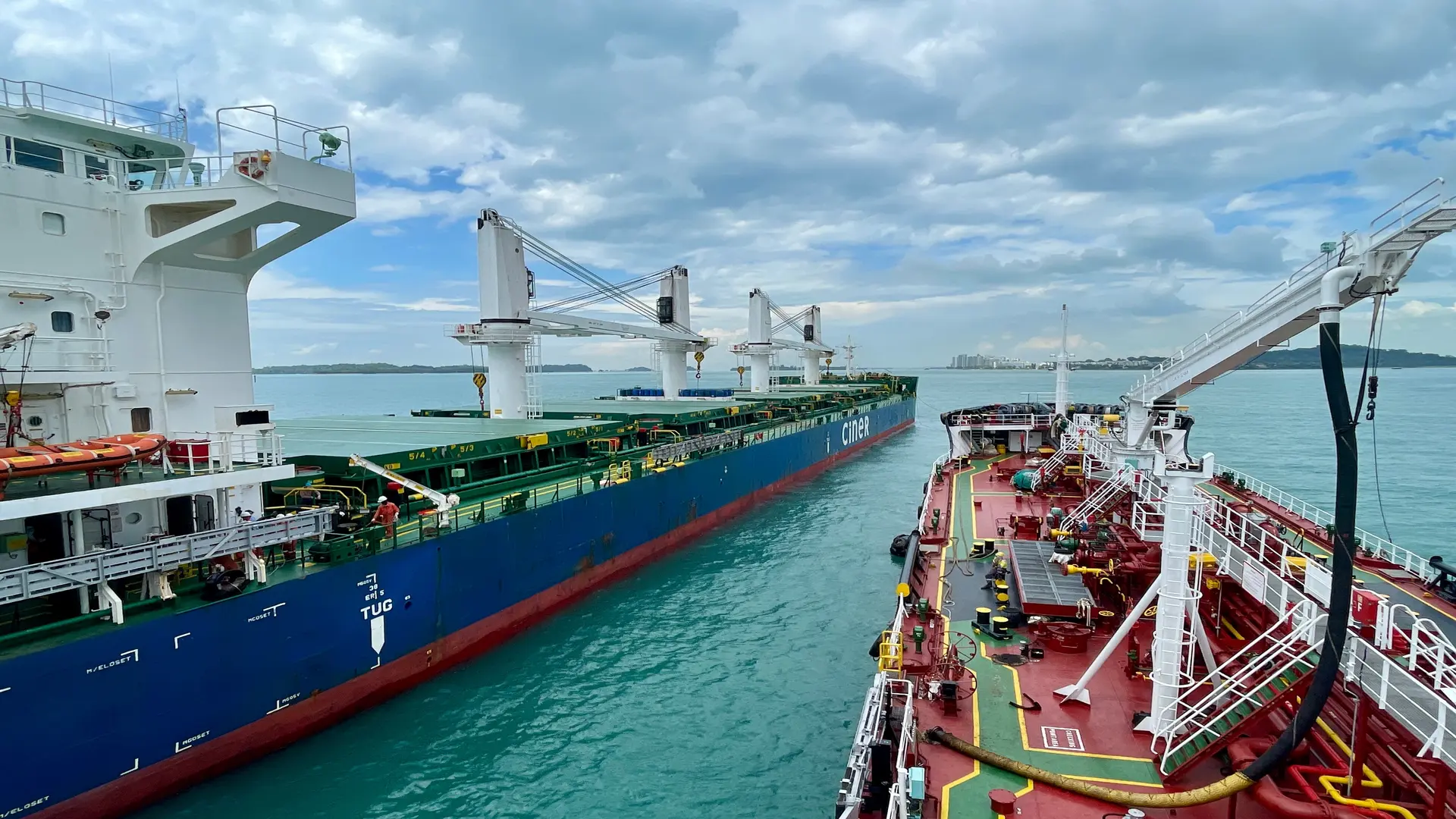
Offshore transfers have transcended their traditional use in crude oil and heavy derivatives. Maritime infrastructure is undergoing radical change, connecting ships, single buoys, and floating terminals to handle energy transition fluids such as Liquefied Natural Gas (LNG), ammonia, biofuels, and even CO₂ in capture projects.
Today, the performance of marine hoses is evaluated based on their dynamic behavior, fatigue resistance, chemical compatibility, and in-service monitoring capabilities. The reliability of these lines defines operational continuity, the transfer window, and the environmental risk associated with offshore operations.
The technological development of marine hoses is an improvement that integrates high mechanical reliability with digital intelligence. The new generation combines advanced materials, smart sensors, and optimized designs that strengthen offshore operations. This development details solutions that extend the operating window, reduce the risk of failure, and ensure industrial sustainability in the maritime supply chain.
Role of marine hoses in offshore transfer
In an offshore production or storage system, marine hoses are the flexible link connecting rigid assets: subsea lines, monobuoys, FSOs/FSRUs, and tankers. They are designed to absorb relative movements, waves, and draft changes without compromising the hydraulic seal, avoiding excessive loads on flanges, loading arms, and mooring structures. From an engineering standpoint, they act as dynamic energy dissipators in the offshore system.
When this component fails, the result is often a spill, an unplanned shutdown, or a much more restricted operating window.
Modern offshore transfers handle heavy crude oil, refined products, LNG, LPG, biofuel, and even fluids linked to CO₂ capture and storage. Each fluid imposes different requirements in terms of pressure, temperature, chemical compatibility, and fatigue behavior.
The selection of marine hoses is no longer limited to diameter and design pressure; it includes an analysis of offshore dynamics, estimated service life, maintenance strategy, and the possibility of future conversion to cleaner fuels.
Types of marine transfer hoses
In offshore systems, marine hoses are configured as integrated chains of floating and subsea sections. The transfer system design defines the layout of each section, and current engineering classifies and optimizes hose types according to their specific function:
- Floating hoses: Used in the surface section of the system to facilitate mooring and connection of the vessel. These hoses must ensure controlled buoyancy and high resistance to surface abrasion and UV radiation.
- Subsea hoses: These connect the seabed (PLEM or pipes) to the surface system. They require a robust design to withstand hydrostatic pressure and tensile loads.
- Ship-to-ship (STS) transfer hoses: These are flexible, lightweight lines, without an internal metal helix in many modern designs, which facilitate maneuvering and safe handling between two vessels. Their construction is optimized to withstand buckling and ensure controlled electrical properties to dissipate static charges.
In both cases, manufacturers apply controlled vulcanization, layer-oriented reinforcements, and dynamic testing to validate performance under combined pressure, bending, and tensile loads.
The specialized literature on marine hose technologies highlights that integrated configurations of floating and subsea sections, such as catenary and Lazy-S, are essential for managing hydrodynamic loads, relative movements, and system stability in operations with FPSOs, FSOs, and CALM-type monobuoys.
Advanced materials for longer service life and compatibility
Advanced marine hoses use multi-layer architectures where each element performs a specific mechanical or chemical function. The inner liner is made of low-permeation elastomers (NBR, HNBR, or FKM) selected according to the fluid and temperature, while the reinforcement casings use high-tenacity fabrics or metal cords at controlled angles; their orientation responds to dynamic calculations and multiaxial fatigue criteria.
In applications subject to vacuum or external collapse, a helical reinforcement is integrated to maintain geometry during maneuvers and operating pulses. The outer cover incorporates compounds resistant to abrasion, UV radiation, and marine aging; modern designs prioritize micro-cut resistance to reduce cumulative surface damage.
Under severe wave conditions, these hoses can accumulate millions of flexing cycles; therefore, advanced materials prioritize fatigue resistance, low delamination, and dimensional stability. This mechanical predictability improves numerical analysis and makes simulation and predictive maintenance models more reliable.
Globally, the evolution of offshore floating hoses is marked by compliance with OCIMF recommendations and the incorporation of lighter composite materials that improve buoyancy, chemical resistance, and dynamic performance. This transition responds to the growth of SPM systems, FPSOs, and offshore projects, where load reduction, longer service life, and the integration of smart sensors have become key factors in minimizing spill risks and optimizing deepwater operations.
Chemical and cryogenic resistance for LNG and new fuels
For LNG, cryogenic polymers are used that maintain flexibility at –162 °C and withstand differential contractions between layers without generating microcracks. In liquid ammonia, the priority is to limit permeation and prevent swelling or microcracking mechanisms, which is why fluorinated elastomers and specific chemical barriers are used.
These materials are validated through repeated thermal cycles and differential contraction tests between layers. In this context, it also applies to biofuels and fluids with variable compositions, allowing the same offshore transfer infrastructure to operate with different fuels without compromising integrity or service life.
Smart sensors and online diagnostics
The new generation of marine hoses incorporates instrumentation technologies that allow their mechanical and thermal behavior to be monitored under dynamic loads; this makes the hose an active component of the offshore integrity system.
Sensors applied in marine hoses
Fiber optic sensors based on Bragg Gratings (FBG) are the most commonly used for distributed strain and temperature measurement. Their advantage is their ability to detect micro-changes in the elongation of the inner and outer casing, revealing phenomena such as delamination, loss of local stiffness, or areas that are accumulating damage due to cyclic bending. By operating without electrical signals in the fiber itself, they eliminate risks associated with flammable atmospheres.
Piezoresistive internal pressure sensors allow transient variations caused by ship maneuvers, water hammer, and pumping fluctuations to be recorded. This information helps identify overpressure events that accelerate crack initiation or reinforcement fatigue. When combined with peak detection algorithms, it is possible to correlate dynamic pressure with wave-induced bending.
Curvature and minimum operating radius are measured using strain gauges or IMU (Inertial Measurement Units) sensors. In floating hose chains of SPM systems, this parameter is critical because a radius smaller than the allowable radius abruptly increases damage due to combined bending and torsion.
In addition, some configurations incorporate electrical continuity or resistivity sensors, which are useful for managing electrostatic charges in light hydrocarbon transfers. The accumulation of electrical potential in the inner casing can generate sparks, so this monitoring complements the grounding systems and dielectric properties of the elastomer.
Predictive maintenance based on actual condition
When smart sensors are integrated with structural behavior models, the hose is no longer managed by hours of service but by actual condition. Pressure, temperature, curvature, and deformation data become quantifiable indicators of accumulated damage, allowing for the estimation of remaining life and the definition of optimal windows for inspections or timely replacements.
In SPM systems, remote monitoring of the floating hose and mooring elements allows for the identification of variations in stiffness or dynamic changes associated with early fatigue. These records are used to validate and adjust dynamic simulation models, such as the analyses developed in Orcaflex®, which evaluate the behavior of hose chains under different operating scenarios.
The result is a more efficient predictive maintenance strategy that reduces unnecessary interventions, minimizes downtime, and improves the operational reliability of offshore transfers.
Engineering and services for marine hose systems
The reliability of a marine hose depends not only on its design or materials, but also on its correct integration into the complete transfer system: SPM systems, floating terminals, subsea lines, fenders, breakaway couplings, and monitoring schemes. Therefore, modern offshore transfers require an engineering approach that evaluates the combined behavior of all components under actual sea conditions. This approach avoids isolated decisions and prioritizes the integrity of the entire system.
This type of applied engineering includes static and dynamic analyses of floating and subsea hose chains, verification of permissible stresses, definition of minimum bend radii, and evaluation of safe operating windows in relation to waves, currents, and vessel maneuvers. The goal is to reduce uncertainty prior to installation and ensure that the system maintains its performance throughout its operational life.
Within this technical framework, specialized engineering firms such as IOCS Srl provide configuration studies and dynamic simulations of mooring systems and marine hose chains, using tools such as Orcaflex® and OPTIMOOR®. These analyses make it possible to validate the structural behavior of the system, as well as to define technical criteria for inspection, hydrostatic testing, and condition-based maintenance schedules, without treating the hose as an isolated element, but rather as an integral part of the offshore system.
In the following audiovisual presentation, Davide Contino, CEO of IOCS Srl, a company specializing in offshore systems, explains how the integration of dynamic analysis, real-time monitoring, and condition-based maintenance optimizes SPM systems, extends the service life of marine hoses, and reduces operational risks.

Conclusions
New-generation marine hoses are a strategic element in offshore transfers. They are no longer simple flexible conduits: they integrate advanced materials, smart sensors, and optimized floating hose designs that allow for safer and more stable operation with crude oil, LNG, and emerging fuels.
Condition-based maintenance models and the use of real-time data strengthen industrial sustainability, reducing spills, reprocessing, and premature replacements. The evolution toward hoses qualified for clean fuels and the growth of jettyless solutions demonstrate a sector that is moving toward more efficient transfer systems aligned with the energy transition.
Applied engineering demonstrates that reliability no longer depends solely on design; it also depends on behavior that is measured, monitored, and verified in the field.
References
- Amaechi, C. V., Wang, F., Ja’e, I. A., Aboshio, A., Odijie, A. C., & Ye, J. (2022). A literature review on the technologies of bonded hoses for marine applications. Ships and Offshore Structures, 17(12), 2819–2850.
- Rodríguez, J. (2025) Operaciones de suministro de combustible buque a buque. Universidad de la Laguna.
Frequently asked questions (FAQs)
What are marine hoses and what are they used for?
They are highly resistant flexible conduits used to transfer fluids between ships, single buoys, and offshore terminals, absorbing sea movements without losing their watertightness.
How do they improve safety in offshore operations?
They improve safety through robust designs, double casing, electrical control, breakaway couplings, and sensors that detect abnormal conditions before a failure occurs.
What innovations do modern hoses feature?
They incorporate advanced materials for LNG and ammonia, optimized designs, and smart sensors with real-time monitoring and digital traceability.
What is the function of smart offshore sensors?
They allow critical variables to be monitored in real time and feed predictive maintenance models, reducing unexpected failures and operational downtime.
How do marine hoses contribute to sustainability?
They reduce spills, extend service life, and minimize premature replacements through condition-based management and more durable materials.
Why innovate offshore marine hoses?
Because offshore transfers operate with higher dynamic loads, new fuels, and increasingly stringent environmental requirements.