
Table of Contents
- In-service visual inspection: Concept and technical value
- Technologies to enhance visual inspection in service
- Solutions and equipment available on the market
- Critical indicators in an in-service visual inspection
- How to perform an effective in-service visual inspection
- Limitations and common errors in visual inspection
- In-service visual inspection within the IBR approach
- Best practices for in-service visual inspection
- Conclusions
- References
- Frequently asked questions (FAQs)
In-service visual inspection is one of the most effective techniques for assessing the external condition of industrial assets and maintaining operational integrity. Its simplicity, even given current technological levels, does not limit its impact: when applied correctly and with the right knowledge, it allows early faults to be detected, risks to be anticipated, and more accurate maintenance decisions to be made.
In industries where asset integrity management and reliability depend on risk-based strategies, visual inspection in service has established itself as a decisive method for ensuring operational continuity, minimizing deviations, and preventing significant incidents. Its disciplined application makes the difference between operating with certainty and reacting to unexpected failures.
In-service visual inspection: Concept and technical value
To understand its scope within industrial integrity and reliability programs, it is necessary to start with the technical concept behind this practice.
Visual inspection, known internationally as Visual Inspection (VI) or Visual Testing (VT), is the oldest and most fundamental method in non-destructive testing. It consists of examining a component through direct observation or optical aids such as specialized lighting, mirrors, cameras, borescopes, or videoscopes, in order to identify visible discontinuities, surface deterioration, and modes of damage that evolve during operation.
In-service visual inspection applies these principles while the equipment remains in operation, allowing for the evaluation of actual conditions under load, pressure, temperature, vibration, and dynamic stresses. This condition makes it a critical technique for detecting early signs that other NDT methods only confirm at later stages, such as external corrosion, cracks, deformations, thermal fatigue, or incipient leaks.
In mechanical integrity and operational integrity programs, in-service visual assessment is strategic: it enables continuous monitoring without stopping the equipment, provides objective evidence to prioritize advanced techniques, validates risk-based inspection (RBI) assumptions, supports maintenance planning, and reduces the likelihood of undetected failures.
Likewise, in industries regulated by international standards such as API 510 (pressure vessels), API 570 (process piping), and API 653 (atmospheric tanks), visual inspection with the asset in operation is an explicit and recurring requirement to assess structural condition, identify early deterioration, and verify the suitability of equipment to continue operating throughout its life cycle. With these conceptual foundations, the following section describes the technologies that today strengthen in-service visual inspection in complex industrial environments.
Technologies to enhance visual inspection in service
The way in which assets in operation are visually assessed has advanced through the use of tools that extend their reach, accuracy, and safety, such as drones equipped with high-resolution cameras, optical zoom, and thermal sensors for infrared thermography. These allow for the inspection of elevated areas, such as towers, chimneys, tall structures, or flare systems, without exposing personnel, improving coverage and reducing operational risks.
Remote visual inspection (RVI) incorporates borescopes, videoscopes, robotic systems, and crawlers capable of accessing internal, confined, or geometrically complex areas without stopping operation. These technologies increase inspectability, reduce personnel exposure, and provide high-quality visual evidence in areas where direct observation is limited.
Artificial intelligence-assisted visual analysis complements these capabilities by identifying anomalous patterns, comparing historical trends, classifying defects, and reducing subjectivity in the process. Additionally, digital platforms and IDMS strengthen traceability by centralizing photographs, records, and comparative analyses, improving repeatability and supporting risk-based decisions.
Solutions and equipment available on the market
Globally, in-service visual inspection relies on technologies such as high-resolution industrial drones, high-resolution cameras, specialized lighting systems, borescopes, videoscopes, robotic crawlers, infrared thermography, and digital platforms that allow for the organization, comparison, and tracking of visual evidence on highly critical assets.
Among these solutions, our partner company TEAM, Inc. provides advanced capabilities through industrial drones, specialized robotics, PTZ cameras, submersible ROVs, and video probes designed to inspect hard-to-reach areas without operational interruptions. This technological combination allows for high-quality visual evidence to be obtained in elevated, confined, or hazardous areas, reducing personnel exposure and ensuring operational continuity. Its approach integrates visual accuracy, safe risk management, and criteria aligned with API standards.
Drone inspection in industrial facilities. Source: TEAM Inc.
Likewise, its OneInsight® platform integrates photographs, videos, and comparative records, strengthening technical traceability and improving the quality of visual data. These capabilities increase the accuracy of visual inspection and provide more consistent information for damage assessment, allowing in-service visual inspections to be performed with greater depth, consistency, and operational value in highly critical industries, where mechanical integrity and risk-based inspection programs are continuously developed.
Critical indicators in an in-service visual inspection
The effectiveness of an in-service visual assessment depends on the inspector’s ability to identify early signs of deterioration that could develop into major failures. These visible indications allow abnormal conditions to be recognized and modes of damage that compromise the mechanical integrity of the equipment to be anticipated.
Visible physical conditions
- Surface corrosion, pitting, or visible areas of thickness loss.
- Liquid or gas leaks at joints and gaskets.
- Discoloration, stains, burns, or overheated areas.
- Cracked, raised, or detached coatings.
- Deformations, obvious vibration, or displacement of lines.
- Wear on supports, trays, anchors, or secondary structures.
These signs help diagnose mechanisms such as generalized corrosion, corrosion under insulation (CUI), thermal fatigue, joint leaks, mechanical deformations, or damage associated with excessive vibration.
Visible operating conditions
- Condensation or moisture in unusual areas.
- Excessive temperature reflected in paint, insulation, or exposed metal.
- Noises, vibrations, or pulsations outside the normal pattern.
- Product or sediment buildup around joints or seals.
- Unusual changes in the color of the metal, coating, or local environment.
Correct interpretation of these visible signs directly strengthens industrial reliability, as it allows action to be taken before damage compromises the operation of the asset.
How to perform an effective in-service visual inspection
The scope and frequency of in-service inspections must be aligned with the equipment design criteria and the quality controls applied to materials, manufacturing, and installation. As established by API and ASME standards, these elements determine the acceptable operating limits and the severity of expected damage modes; therefore, they form the basis on which any visual inspection performed on operating equipment should be planned.
Preparation prior to work
- Review of equipment history and P&ID diagrams.
- Selection of approach according to ASME PCC-3, considering accessibility, risk, and criticality.
- Safety assessment (surface temperatures, pressurized lines, hazardous atmospheres).
- Definition of checklist and points of emphasis according to anticipated damage mechanisms.
Technical inspection steps
- Use adequate lighting and auxiliary tools.
- Observe the equipment from multiple angles and distances.
- Evaluate flanges, joints, supports, and areas subject to stress.
- Check for vibration, alignment, abnormal noise, and signs of overheating.
- Maintain communication with operators to validate operational changes or deviations.
Recording and technical documentation
- Clear photographs and, where applicable, georeferenced.
- Traceable and comparable technical annotations.
- Integration with IDMS/CMMS platforms.
- Digital records that are comparable over time.
These criteria also ensure compliance with the minimum inspection requirements established by API standards and mechanical integrity programs, strengthening the technical basis of the process.
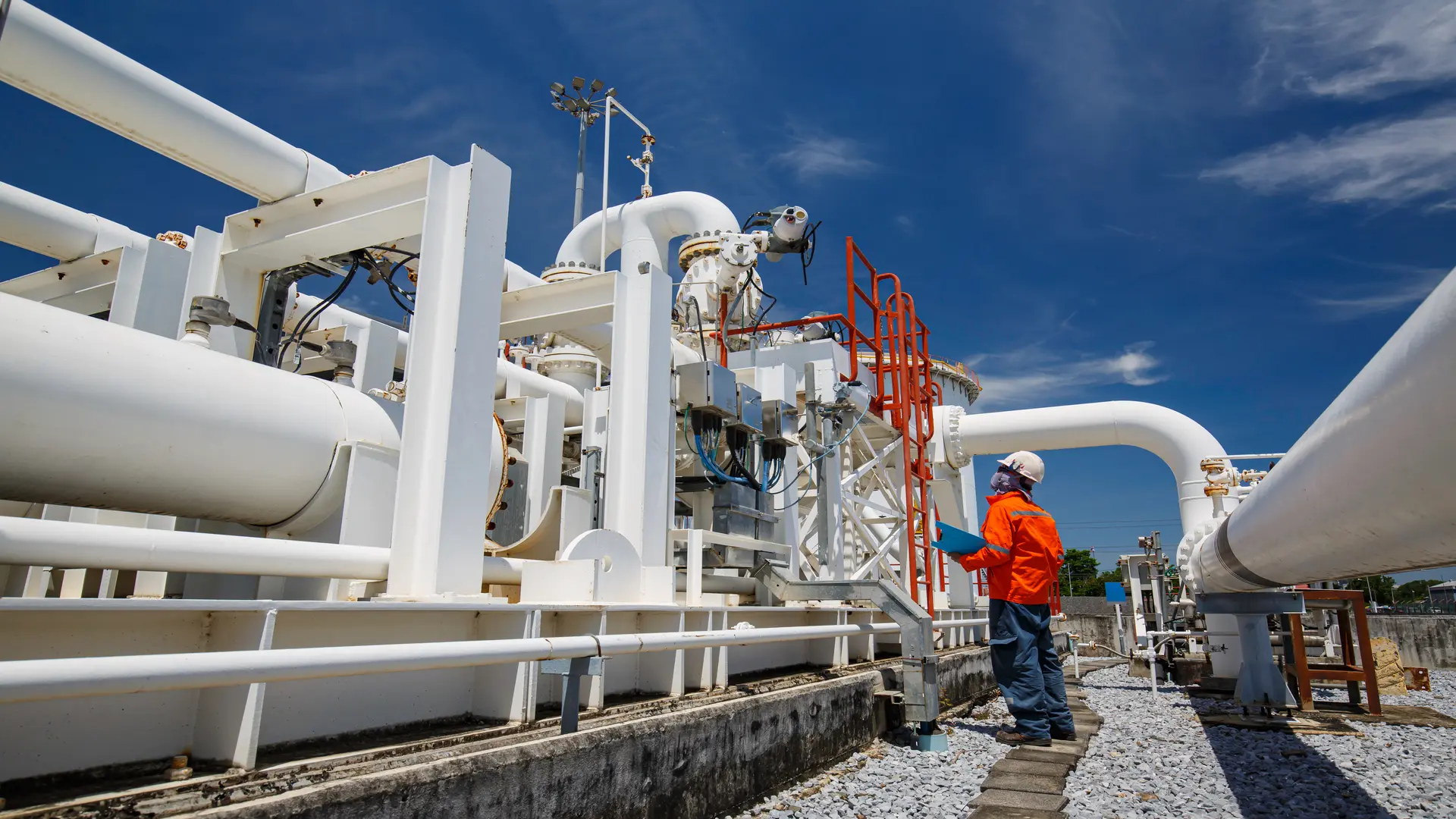
Professional performing visual inspection on a piping system. Source: TEAM Inc.
Limitations and common errors in visual inspection
Technical limitations
Visual inspection does not detect internal discontinuities, internal corrosion, early/subsurface cracks, or damage under coatings. Its accuracy depends on accessibility, lighting, distance, and environmental conditions. In complex assets, there may be blind spots that require complementary techniques such as UT, thermography, or RVI.
Common errors in the field
Operational errors reduce the reliability of visual inspection; among the most common are:
- Superficial inspections without a structured method or checklist.
- Lack of photographic records, preventing historical comparisons.
- Poor lighting that hides minor defects.
- Omitting hidden areas, shaded areas, or “dead spots” that are difficult to observe.
- Basing the diagnosis solely on subjective perception without technical correlation.
- Failure to verify changes after recent maintenance, adjustments, or interventions.
Faults detected by visual inspection during operation
This evaluation process allows for the identification of widely documented deterioration in standards such as API 570, API 510, API 653, and API RP 571. Among the most common failures are:
- Incipient leaks in flanged joints, welds, and connections.
- Surface corrosion or pitting, including signs associated with CUI.
- Degradation or detachment of coatings or insulation.
- Deformations, misalignment, and abnormal vibration.
- Visible thermal indicators, such as discoloration or hot spots.
- Product accumulation or irregular deposits associated with leaks, erosion, or active corrosion.
- Failures in valves and fittings, such as deteriorated gaskets, leaks, or external corrosion.
- Mechanical damage from impact or cyclic stresses, including dents, cracks, or cracked welds.
In-service visual inspection within the IBR approach
In-service visual inspection is necessary within risk-based programs, as it provides direct evidence of the current condition of the asset and reduces the uncertainty associated with the damage mechanisms considered in the analysis. Within the framework of API 580 and API 581, the quality, frequency, and accuracy of visual data directly influence the assessment of the probability of failure (PoF) and the verification of conditions that influence the consequence of failure (CoF).
Reliable visual data adjusts degradation curves, reduces model variability, and defines the accuracy of risk-based inspection (RBI) programs, as visual information reduces the uncertainty of the RBI model and allows the probability of failure to be recalibrated with actual data and not just theoretical estimates.
Visual findings allow for the validation of predicted damage mechanisms, the recalculation of degradation rates, and the adjustment of the required advanced inspection. This process increases the confidence level, reduces model variability, and guides decisions based on the actual condition of the asset.
Formally integrating visual inspection into the IBR process also allows resources to be prioritized for equipment with greater exposure to risk, inspection intervals to be redefined, maintenance to be optimized, and the integrity plan to be kept based on the operational behavior and actual condition of the equipment. In this way, visual inspection under operating conditions acts as the most direct bridge between theoretical risk analysis and the observable condition in the field.
Best practices for in-service visual inspection
- Keep up to date with API and ASME standards and NDT techniques.
- Use checklists structured according to the damage mechanisms expected in each piece of equipment.
- Combine with advanced methods when risk or criticality requires it.
- Record visual evidence in a traceable and organized manner.
- Prioritize inspector safety by considering access, temperatures, and operating conditions.
- Use technological tools such as HD cameras, borescopes, and remote visual inspection (RVI) systems.
- Integrate visual inspection into asset management, reliability, and risk analysis systems.
Conclusions
In-service visual inspection is the fundamental starting point within inspection methods to ensure operational integrity and industrial reliability. Its systematic application allows for the detection of early failures, validation of actual external conditions of the equipment, and support for evidence-based maintenance decisions, especially when it is part of a risk-based inspection strategy.
Combined with modern technologies and best practices, visual inspection is a strategic resource for reducing risks, optimizing interventions, and strengthening both mechanical integrity and operational reliability in industry. In industrial sectors where every decision must be based on reliable data, in-service visual inspection remains the first line of defense for asset integrity.
References
- https://www.asnt.org/what-is-nondestructive-testing/methods/visual-testing
Frequently asked questions (FAQs)
What is an in-service visual inspection?
It is the assessment of the condition of equipment while it is in operation, through direct observation or auxiliary optical tools.
What equipment can be inspected in service?
Pipes, vessels, tanks, furnaces, pumps, valves, and other static or dynamic assets.
Why is this inspection method important?
It detects early faults, reduces risks, and strengthens maintenance decisions.
How often should a visual inspection be performed?
The frequency depends on the type of asset, its risk level, and the requirements of the applicable standard. In general, it is performed routinely by operating personnel and, depending on criticality, by specialists at intervals defined by international standards.
What technologies improve an in-service visual inspection?
Drones, HD cameras, borescopes, robotic crawlers, and artificial intelligence.