
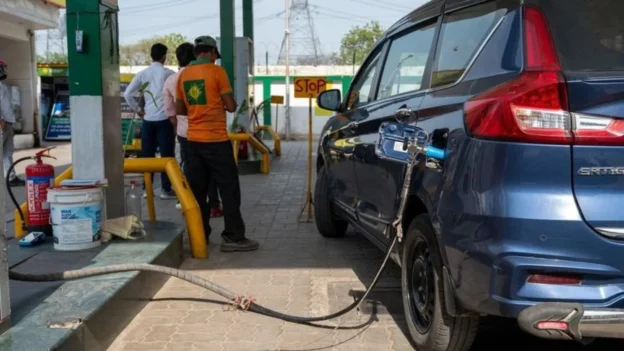
India’s commitment to natural gas as a transition fuel responds to a complex paradox.
New Delhi. The world’s third most populous economy has charted a pragmatic path to decarbonization. India aims to more than double its compressed natural gas (CNG) infrastructure over the next five years, taking it from 8,150 stations today to 18,000 by 2030.
This expansion is part of the “One Nation, One Gas Network” initiative, a government project that seeks to interconnect the entire territory through a unified gas distribution system.
Although the South Asian country is the third-largest global emitter of greenhouse gases greenhouse gas emissions, its per capitaemissions, its per capita emissions barely reach 2 tons of CO₂ per year, well below the global average of 4.7 tons. With 1.4 billion inhabitants and energy demand set to double by 2047, India faces the challenge of electrifying its economy without compromising its development.
Petroleum and Natural Gas Minister Hardeep Singh Puri stressed that this accelerated growth is in stark contrast to the 2014 scenario, when the country had just 738 CNG stations. “This is Prime Minister Narendra Modi’s Bharat vision plan,” said the official, emphasizing that clean CNG fuel already supplies buses, cabs and private vehicles in major cities.
The architecture of a silent transformation
The transformation is not limited to service stations. The urban gas distribution network went from 55 authorized geographic areas in 2014 to 307 areas in 2025, covering 99% of the population and 96% of the national territory. This capillarity has allowed 1.52 million households to currently access piped natural gas (PNG) connections, reducing dependence on coal and firewood for cooking.
The system is supported by a backbone of 25,429 kilometers of gas pipelines, a figure that is projected to reach 33,475 kilometers by 2030. This infrastructure supports the flow of fuel from coastal terminals to remote inland communities, democratizing access to cleaner energy.
Compressed Biogas: The strategic ally of CNG
In parallel to fossil gas, New Delhi is promoting compressed biogas (CBG) as a renewable alternative. Currently 113 CBG plants are operating and another 78 are under development. The official target is to increase the CBG mix from 1% in 2025 to 5% in 2028, enabling the conversion of organic waste into useful fuel.
The Petroleum and Natural Gas Regulatory Board (PNGRB) has set ambitious goals: to reach 126.3 million domestic piped gas connections and more than 18,000 CNG stations by 2034. To achieve this, the regulator is pushing states to harmonize their tax policies and reduce taxes on natural gas, thus incentivizing its mass adoption.
Between coal and the green future
Despite these advances, India remains critically dependent on coal, which accounts for more than 74% of its electricity generation and powers key sectors such as steel and cement. This reality positions natural gas (CNG) as a bridge fuel: less polluting than coal, but more economically accessible than large-scale renewables.
According to official data, India’s total installed electricity capacity reached 476 gigawatts in June 2025. Of that total, 240 GW came from thermal power (50.52%), while renewables contributed the other half. This distribution reflects the government’s strategy of diversifying the matrix without abruptly dismantling the existing infrastructure.
Energy infrastructure India
The gas expansion plan faces structural challenges. Renewable energy storage remains insufficient with just 505 MWh of current capacity, and large-scale battery construction is critically dependent on rare earths 70% controlled by China, India’s strategic rival.
In addition, the country must meet its commitment to reduce emissions by 45% by 2030 as its electricity demand continues to escalate. CNG natural gas, while cleaner than coal, is still a fossil fuel and its expansion must be carefully calibrated so as not to compromise long-term climate goals.
Source: The Tribune