
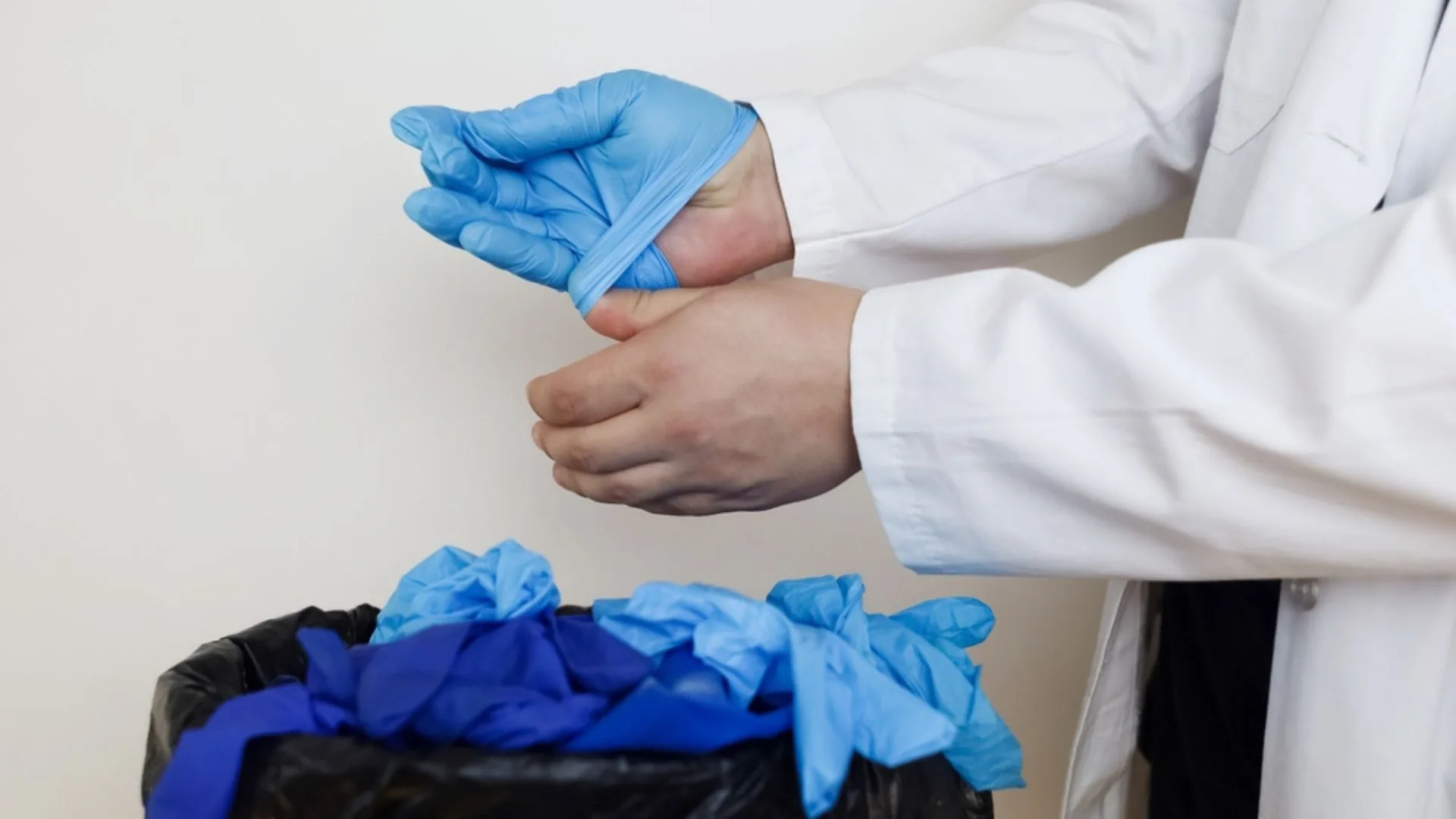
Recycled rubber gloves mark the start of a new breakthrough in climate technology that aims to turn sanitary waste into a useful tool for reducing emissions. Researchers at Aarhus University have developed a method to convert disposable rubber gloves into materials capable of capturing carbon dioxide.
Recycled rubber gloves with hidden potential
Each year, more than 100 billion nitrile gloves are produced worldwide, most of them for the healthcare sector. After a single use, these materials end up in incinerators or landfills, generating additional emissions.
In this context, the team led by researcher Simon Kildahl proposes an alternative based on the circular economy. Their proposal is to turn this waste into CO2 adsorbents, avoiding conventional disposal.
How does the chemical process work?
The procedure begins by shredding the gloves into small particles. The material then reacts with hydrogen and a ruthenium-based catalyst, which makes it possible to modify its chemical structure.
The result is a material capable of capturing CO2 from simulated flue gases. This approach opens up the possibility of integrating the technology into industrial settings such as power plants.
In addition, when heat is applied, the material releases the captured CO2 and regenerates for a new use cycle. This facilitates both carbon storage and its reuse in processes such as Power-to-X.
Advantages over current technologies
Unlike other carbon capture methods, this system starts from existing waste instead of requiring new petroleum-derived resources.
Likewise, the approach reduces the environmental impact associated with producing conventional materials for CO2 capture. It also helps address a growing challenge in managing complex plastic waste.
A step toward climate targets
The development aligns with IPCC targets, which point to the need to remove between 5 and 16 billion tonnes of CO2 per year by 2050.
To achieve this, it will be necessary to scale technologies capable of capturing carbon both from industrial sources and directly from the air. In this scenario, waste-based solutions could play a relevant role.
Current status and next challenges
The technology is currently in the experimental phase, with a maturity level between TRL 3 and 4. Testing is being carried out at laboratory scale, working with small amounts of material.
The main challenge is scaling the process and reducing costs, especially those associated with the catalyst. However, researchers have already demonstrated the technical feasibility of the concept.
As a result, if production parameters are optimized, this solution could move toward industrial applications in the coming years.
Source: Eurekalert
Photo: Shutterstock