
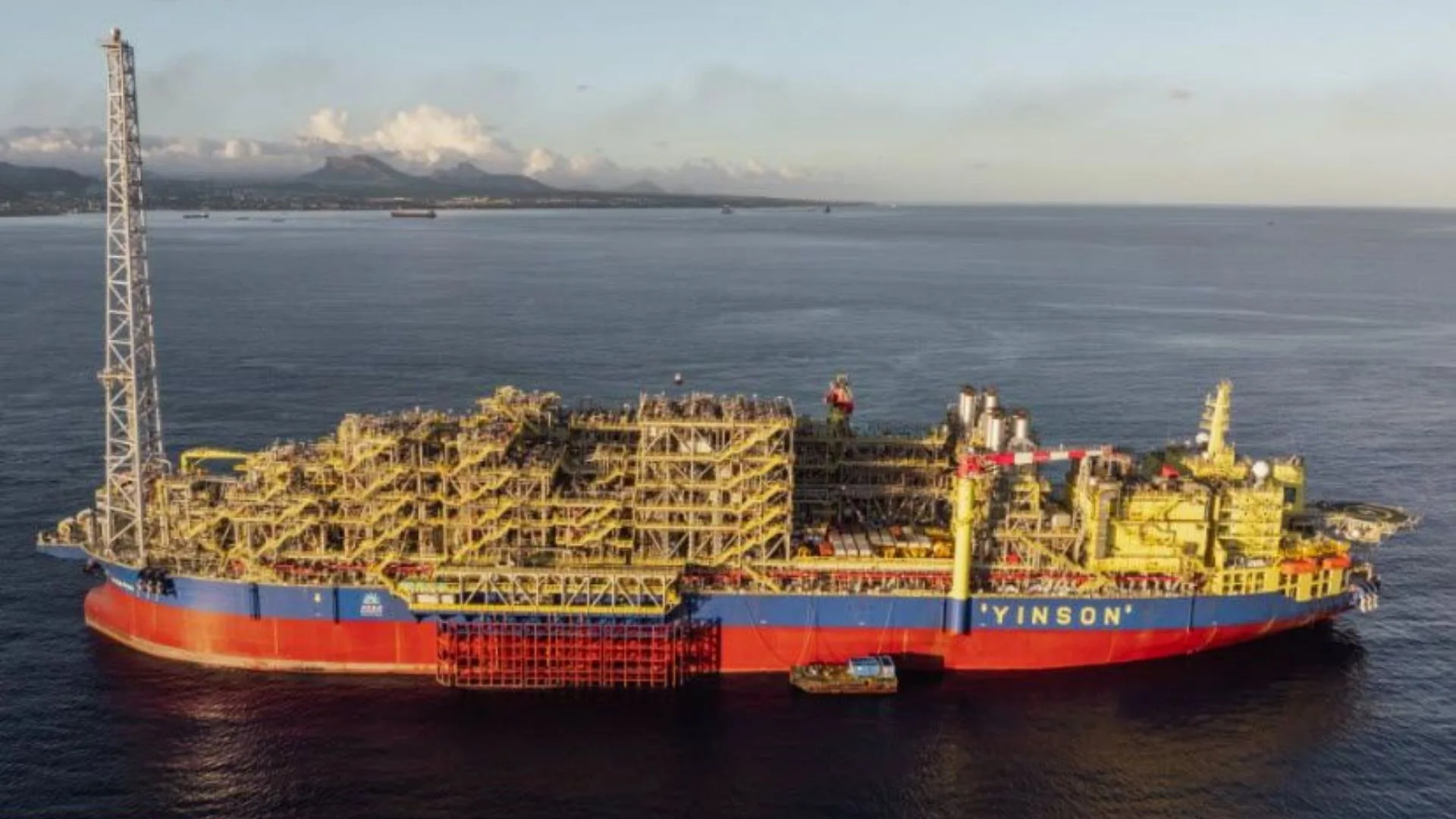
Yinson Production confirmed the startup of the carbon capture pilot unit installed on FPSO Agogo, located in block 15/06 offshore Angola.
According to the company, this is the first post-combustion carbon dioxide capture plant installed on an operating offshore facility. The system operates under real production conditions, a key point for measuring its performance outside the controlled environment of tests or simulations.
A Technical Step to Reduce Offshore Emissions
Beyond the symbolic value of the project, the CCS system’s entry into operation provides a concrete signal of how decarbonization of offshore production assets can advance. Integrating CO2 capture on an FPSO reduces part of the emissions generated by the vessel’s own operation, while providing data on performance, operability, and scalability.
Yinson Production framed this initiative within a broader low-emissions strategy for its fleet. The company has been driving energy efficiency improvements and solutions aimed at reducing the operational footprint of its units, making the Agogo project a logical extension of that roadmap.
Azule Energy and Carbon Circle Support the Pilot
Furthermore, the system’s development cannot be understood without the collaboration between Yinson Production, Azule Energy, and Carbon Circle. Azule Energy, the project’s client, participates as operator of the Agogo Integrated West Hub. Carbon Circle provides the technology linked to the offshore carbon capture system.
Likewise, one of the key technical highlights in the analyzed content is the use of CESAR1 solvent, an advanced amine blend designed for post-combustion capture processes. According to Azule Energy, this solvent offers a favorable combination of low regeneration energy and high reaction rate, two variables especially relevant when the goal is to adapt CCS to offshore environments with space, access, and operational flexibility constraints.
FPSO Agogo as a Field Validation Platform
The Agogo FPSO functions as a field validation case for a technology that remained in conceptual phase within the offshore sector for years. The unit is part of the Agogo Integrated West Hub project and has a production capacity of 120,000 barrels of oil per day.
Additionally, the vessel was designed with several elements aimed at reducing emissions, including electrical systems for topsides and marine services, as well as combined-cycle power generation. In this context, the carbon capture pilot unit does not appear as an isolated addition but as an integrated piece within a broader decarbonization architecture.
What Does This Startup Mean for the Offshore Industry?
Now, the greatest value of the announcement lies not only in capturing CO2 aboard an FPSO. It also lies in demonstrating that the technology can coexist with very specific constraints of the marine environment: compact layouts, limited access, safety requirements, and the need for modular startup without affecting operational continuity.
This learning may prove decisive for future offshore carbon capture projects. If the pilot maintains operational stability and generates solid performance data, the sector will have a practical reference for evaluating new offshore CCS applications on producing assets.
Thus, Yinson Production, Azule Energy, and Carbon Circle place FPSO Agogo at the center of a conversation that no longer revolves solely around the theoretical viability of offshore carbon capture, but around its actual execution on an in-service unit.
Source and photo: Yinson Production