During the AMPP Annual Conference + Expo 2026, the conversation centered on new ways to address material challenges in the industry. In that debate, explosion cladding stood out as an increasingly considered option given the limits of traditional solutions in demanding environments.
In this scenario, companies like NobelClad provide solutions based on metal bonding, a strategy that addresses the limitations of solid alloys. Estiban López, U.S. Territory Manager, and Olivier Sarrat, Business Development Manager for Oil & Gas, explain how this technology adapts to the sector's new challenges.
One of the major challenges in sectors such as oil & gas or chemical processing is material degradation; corrosion reduces equipment lifespan and increases operating costs. Added to this is the impact of high temperatures, which create stress in metal structures.
Traditionally, solid alloys have been the most widely used solution; however, their high cost and technical limitations open the door to more efficient alternatives. This is where explosion cladding gains relevance, allowing for a more flexible approach to material selection.
Explosion cladding consists of joining two dissimilar metals through a controlled process that creates a highly resistant interface. This technology allows for the utilization of each material's specific properties.
This combination offers clear advantages.
The properties of both materials can be used to select the best possible solution. Thus, costs are reduced without compromising performance.
Estiban López explained.
Furthermore, this approach allows for the optimization of more expensive materials, using them only where necessary. As a result, companies achieve a balance between economic efficiency and technical performance.
On the other hand, an important aspect of explosion cladding is its behavior under extreme conditions. Olivier Sarrat highlights that high temperatures generate significant stress at the bonding interface.
However, the explosion bonding process creates an interface with high strength and ductility. This characteristic allows it to absorb mechanical stress without compromising the material's integrity.
To ensure reliability, NobelClad performs mechanical tests that validate material behavior under real service conditions. This data is provided to customers to facilitate the design of equipment tailored to each application.
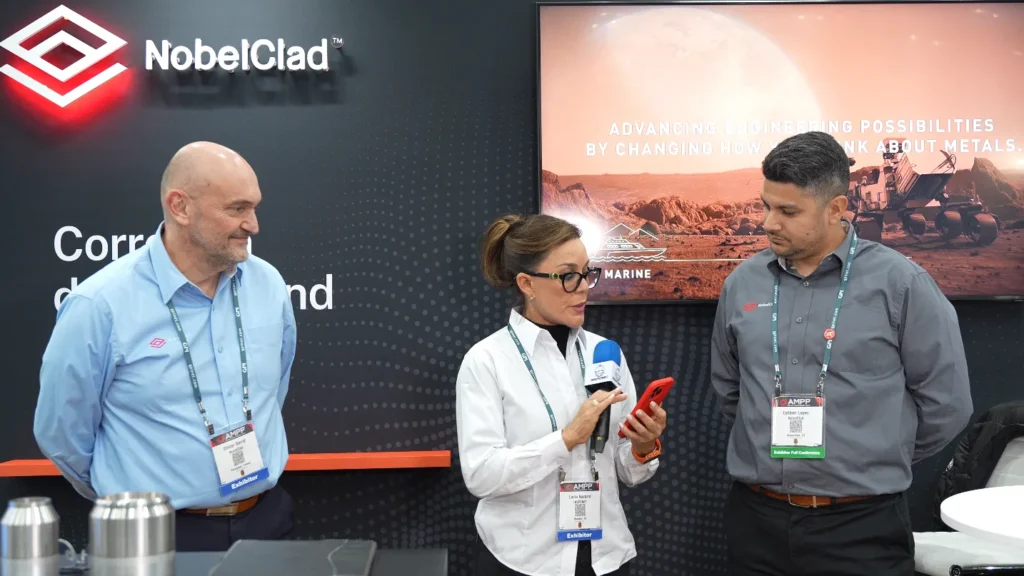
Likewise, the application of this technology is not limited to a standard approach; collaboration with manufacturers and suppliers allows for the development of specific configurations for each project.
In one of the recent cases mentioned during the interview, the company worked with its partner network to adjust the plate configuration to the customer's needs. This approach improved equipment performance during operation and optimized costs from the design phase.
In this way, explosion cladding is established as an adaptable solution for various industrial contexts, where each project presents unique conditions.
For its part, NobelClad combines its international reach with customer-focused operations. The company, headquartered in the United States with a presence in Europe, is part of DMC Global Inc. and has decades of experience in bonding dissimilar metals.
Although it has production facilities in two major regions, its activity extends to markets worldwide. According to Olivier Sarrat, this structure allows for global action while maintaining a direct relationship with customers in each region.
Thus, the company integrates technical knowledge, industrial capacity, and operational proximity—key elements in complex projects.
Ultimately, explosion cladding addresses the need to improve material performance in demanding conditions without disproportionately increasing costs.
Its ability to combine properties, withstand extreme environments, and adapt to different applications makes it a relevant option within the energy and industrial sectors. As technical demands continue to rise, these types of solutions are gaining prominence in the design of equipment and structures.
For more content about AMPP 2026, please visit our LinkedIn profile.
Source: Inspenet.