The AMPP Annual Conference + Expo 2026 once again brought to the forefront one of the energy industry’s biggest challenges: how to improve corrosion monitoring in critical infrastructure. In this context, Manlio Mercanti, Senior Sales Manager Americas & Iberian Peninsula at Automa, shared his perspective on the sector’s technological evolution.
The conversation therefore centers on a clear shift: moving from traditional models based on spot inspections to intelligent continuous monitoring systems that enable more precise, proactive action.
For decades, corrosion monitoring has relied on manual field inspections. This approach, while widespread, has clear limitations: late interventions, operational inefficiencies, and a lack of real-time visibility.
In this regard, many companies used to rely on operators’ physical presence as a guarantee of control. However, this practice has been shown to cause delays in fault detection and inefficient use of available resources.
Field interventions do not always ensure operational continuity, as systems can go unadjusted for long periods until the next review.
Mercanti explains.
By contrast, the adoption of remote monitoring technologies has transformed this landscape. With more than 39 years of experience, Automa has developed solutions that enable continuous monitoring of cathodic protection systems.
As a result, corrosion monitoring stops being a one-off activity and becomes a continuous process. This translates into clear operational optimization, as companies can reduce unnecessary travel and focus their resources on targeted actions.
In addition, access to real-time information makes it possible to detect incidents as they occur, reducing risk and improving decision-making.
One of Automa’s key differentiators is its ability to provide 24/7 remote monitoring. Unlike other systems that take periodic measurements, its technology generates up to 86,400 daily records per variable.
This volume of information could be overwhelming; however, the key lies in intelligent data processing. Field-installed devices filter and structure the information so the user receives clear, actionable indicators.
In this way, operations managers can analyze system performance without having to interpret large volumes of raw data. Likewise, this capability enables more accurate management of cathodic protection status.
The evolution of corrosion monitoring is moving toward the use of artificial intelligence; this trend responds to the need to anticipate failures before they occur.
According to Mercanti, European regulations (especially Italian) have been a major driver in the development of more advanced solutions. Thanks to these standards, Automa has been able to design technologies that make it possible to forecast system behavior well in advance.
As a result, companies can make decisions up to a year and a half in advance, such as replacing components or upgrading equipment. In this way, maintenance stops being reactive and becomes planned.
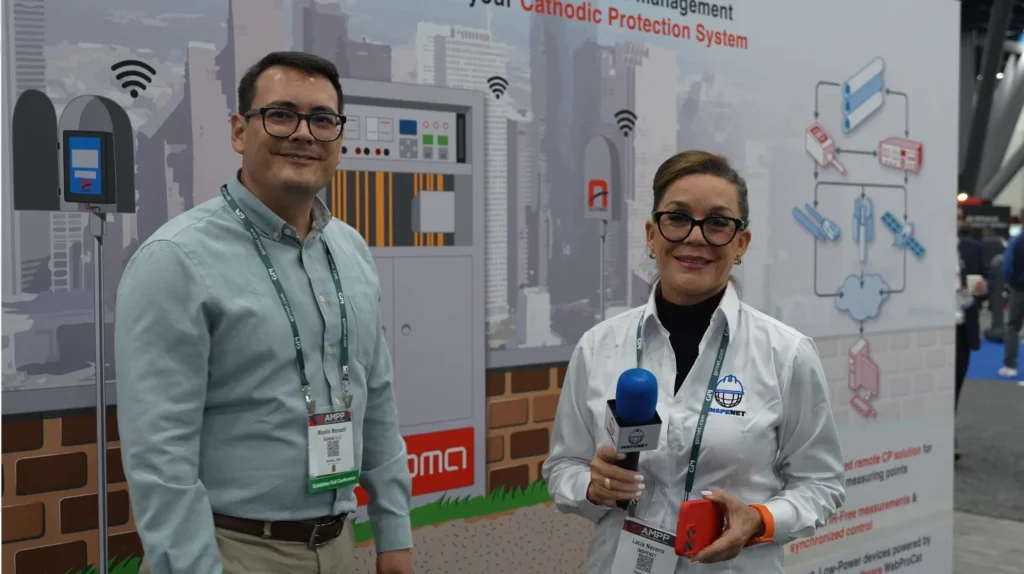
On the other hand, innovation also takes shape in concrete solutions. One example is the G-Power rectifier, developed by Automa, which introduces a new approach to cathodic protection system control.
Instead of focusing solely on injection points, this technology prioritizes the system’s critical points. This makes it possible to adjust currents more precisely, avoiding both underprotection and overprotection.
In this way, corrosion monitoring is complemented by remote intervention capabilities, strengthening operational control from the office and reducing reliance on physical interventions.
At the same time, Automa’s growth strategy includes key collaborations. The partnership with Boring Manufacturing responds to the need to offer integrated solutions that combine field hardware and monitoring technologies.
This collaboration brings together expertise in reference electrodes with advanced monitoring systems. As a result, both companies strengthen their positioning in markets such as North America, the Middle East, and Latin America.
Likewise, this synergy expands responsiveness to the needs of an increasingly demanding sector.
Finally, corrosion monitoring is undergoing a profound transformation. The integration of remote technologies, data analytics, and artificial intelligence is redefining how companies manage their assets.
In this scenario, the ability to anticipate problems and act with precision becomes a decisive factor. As reflected in Manlio Mercanti’s vision, the sector is moving toward more efficient models, where continuous information enables safer, faster decision-making.
In this way, corrosion control stops being a corrective task and becomes a strategy based on data and planning.
For more content on AMPP 2026, visit our LinkedIn profile.
Source: Inspenet.