
Table of Contents
- Hybrid architectures: from solar plants to energy systems
- Storage economics: cost decline and new business models
- Advanced operation: control, prediction, and real-time optimization
- Impact on electrical grids: flexibility as the new standard
- Technological outlook: beyond lithium-ion
- Solar with batteries: the new global energy standard
- Conclusions
- References
From this emerges the expanded concept of LCOE+S (Levelized Cost of Energy plus Storage), which completely redefines economic analysis solar power, by nature intermittent, has reached extremely low costs in pure generation. However, its real value within the electrical system depends on when it can be dispatched.
This is where electrochemical storage becomes a structural component, not a complementary one. Energy ceases to be an instantaneous commodity and becomes a manageable resource. In markets highly penetrated by renewables, the “duck curve” phenomenon has accelerated the adoption of batteries. The oversupply of solar energy at midday and the high nighttime demand force energy to be shifted over time.
Technically, this transforms the plant design paradigm: it is no longer only about optimizing production, but the energy delivery profile.
Hybrid architectures: from solar plants to energy systems
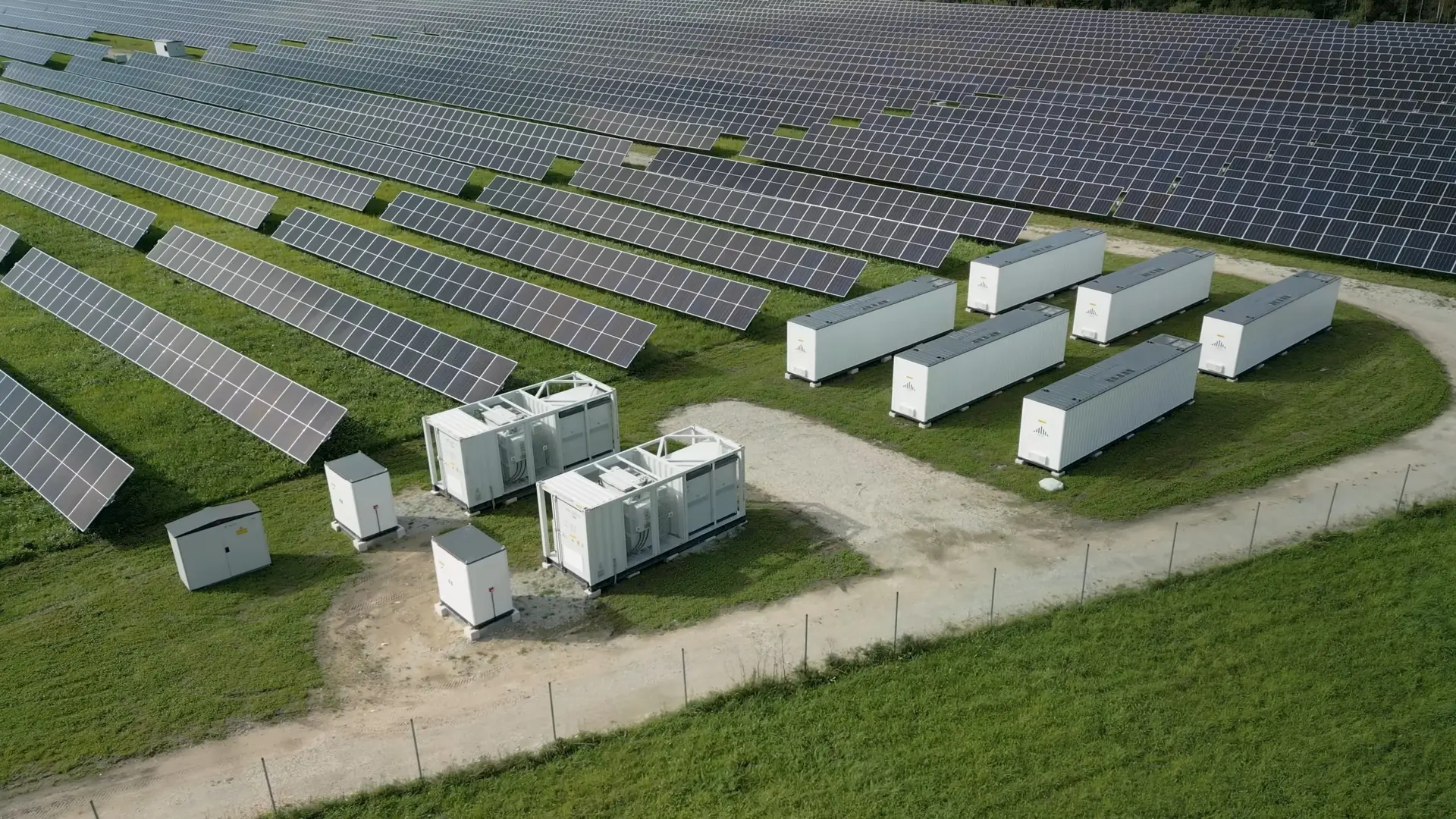
In 2026, standalone photovoltaic plants are being progressively replaced by integrated hybrid systems. The most dominant configuration is the AC-coupled or DC-coupled scheme with storage, depending on the operational strategy and load profile.
DC-coupled systems present efficiency advantages by reducing energy conversions, especially in industrial-scale applications. They allow excess energy to be captured directly from the solar field into batteries, maximizing resource utilization.
On the other hand, AC-coupled systems offer greater operational flexibility and ease of retrofitting in existing plants.
From an engineering perspective, battery integration introduces new critical variables: thermal management, charge/discharge cycles, degradation, EMS (Energy Management System) control, and coordination with hybrid inverters. The design shifts from being static to dynamic and based on predictive algorithms.
The result is a conceptual evolution: the solar plant is no longer just a generation facility, but an intelligent node within a distributed energy system. This is a determining factor in system performance and helps explain why the solar + storage model dominates in 2026.
Storage economics: cost decline and new business models
The most determining factor in this transition has been the drastic reduction in battery costs, particularly lithium-ion. The learning curve has followed a behavior similar to photovoltaic modules, driven by economies of scale, manufacturing improvements, and material optimization.
In 2026, storage costs already enable multiple profitable business cases without subsidies. Among the most relevant are energy arbitrage, participation in capacity markets, ancillary services (frequency, voltage), and peak demand reduction.
From a financial perspective, solar + battery hybridization significantly improves a project’s revenue profile. It reduces exposure to negative spot prices and allows capturing value during peak demand hours. This increases project bankability and reduces investor risk.
Additionally, new models such as “virtual power plants” (VPP) are emerging, where multiple distributed systems are aggregated to operate as a single entity in the market. This turns storage into a strategic asset within the digitalization of the electrical system.
Advanced operation: control, prediction, and real-time optimization
One of the least visible but most critical aspects of the dominant model in 2026 is operational sophistication. Battery integration requires advanced control systems capable of managing multiple variables in real time.
Modern EMS systems use artificial intelligence and machine learning to predict solar generation, demand, market prices, and battery state of charge. This allows optimization of operational decisions such as when to store, when to dispatch, and at what power level.
From a technical standpoint, the main challenge lies in maximizing battery lifespan without sacrificing profitability. This involves operational strategies that consider depth of discharge, temperature, equivalent cycles, and chemical degradation.
Likewise, interaction with the grid introduces additional complexities. Batteries must fulfill stability, fast response, and regulation functions, requiring precise coordination with SCADA systems and grid operators.
In this context, storage becomes a high-impact operational parameter for the resilience of the electrical system.
Impact on electrical grids: flexibility as the new standard
The massive penetration of solar systems with batteries is redefining grid architecture. In 2026, flexibility is no longer a desirable feature but a fundamental requirement.
Traditional grids, designed for centralized generation and unidirectional flow, face significant challenges with distributed generation.
The incorporation of storage helps mitigate these issues by acting as an energy buffer, smoothing variations and avoiding congestion.
From a planning perspective, utilities are integrating batteries as an alternative to investments in transmission infrastructure. This is known as non-wires alternatives (NWA), where storage replaces or defers the need for new power lines.
Additionally, storage improves power quality, reduces curtailment events, and allows greater renewable penetration without compromising system stability. This structural shift positions the solar + battery model as a cornerstone of the energy transition.
Technological outlook: beyond lithium-ion
Although lithium-ion batteries dominate the market in 2026, technological development continues advancing toward more efficient, safer, and more sustainable solutions. Emerging technologies include solid-state batteries, sodium-ion, and thermal and gravitational storage systems.
Sodium-ion, in particular, is gaining relevance due to the abundance of raw materials and lower dependence on critical minerals such as lithium and cobalt. Although its energy density is lower, its potentially lower cost makes it an attractive option for stationary applications.
On the other hand, long-duration energy storage (LDES) is emerging as the next major breakthrough. Technologies capable of storing energy for more than 8–12 hours will be key to achieving 100% renewable electrical systems. Current batteries face technical and economic limitations in this area.
Finally, sector coupling between electricity, heat, and transport expands the role of storage. Solar power with batteries is no longer an isolated solution but becomes a central component of a fully decarbonized energy system.
Solar with batteries: the new global energy standard
In this first quarter of the year, the combination of solar power with storage is not simply a trend but the new standard of the global energy system. Its dominance results from a convergence of technical, economic, and operational factors that have redefined how we generate, store, and consume energy.
From an engineering perspective, this model introduces greater complexity but also an unprecedented capacity for control and optimization. Energy is no longer just generated; it is strategically managed based on multiple variables.
For industry specialists, the challenge is no longer to understand whether storage is necessary, but how to integrate it optimally in each application. Competitive differentiation will lie in design, operation, and the intelligence applied to these systems.
The energy future is no longer just renewable. It is renewable, flexible, and stored. And in this scenario, solar power with batteries consolidates itself as the central axis of the global energy transition.
Conclusions
The integration of storage into solar power systems has evolved from an optional add-on to a core structural component, fundamentally redefining both the technical design and economic model of the energy sector.
The sharp decline in battery costs, combined with digitalization and advanced energy management systems (EMS), has enabled the solar + storage model to become not only viable but dominant across multiple markets without the need for subsidies.
The future of the global power system is based on flexibility, decentralization, and the ability to manage energy over time, where storage plays a central role in ensuring stability, efficiency, and higher penetration of renewable energy.
References
- Iberdrola. (2023). Energy storage and renewable integration. https://www.iberdrola.com
- International Energy Agency (IEA). (2022). Energy storage: Tracking report. https://www.iea.org
- Lazard. (2023). Levelized cost of energy and levelized cost of storage. Lazard Ltd. https://www.lazard.com