
Table of Contents
- The sustainability factor: Real energy efficiency
- Technical advantages: Why aluminum outperforms steel
- The geodesic dome as an engineering solution
- Technical insight: Geodesic dome and integration with IFR
- International standards: API 650 and API 653
- Checklist: What to review before a retrofit
- Evaporative emissions and operational safety
- Conclusions
- References
- Frequently Asked Questions (FAQs)
The roof of a storage tank is not a simple component; it is a strategic asset. Its design defines the structural load the equipment receives, conditions water ingress, directly influences internal corrosion, and determines maintenance frequency. Today, recycled aluminum presents itself as an effective solution that preserves the properties of the primary metal but requires 95% less energy in its production.
For operators of refineries, terminals, and tank farms, the use of aluminum geodesic domes enables much lighter coverings than steel, with natural high corrosion resistance and fewer periodic intervention needs. This solution helps modernize assets, reduce operating costs, and improve control of evaporative emissions without affecting the asset integrity of the storage system.
In addition, there is a recognized regulatory basis. API 650 incorporates Annex G, which is specific for structurally supported aluminum domes, while API 653 regulates the inspection, repair, alteration, and reconstruction of tanks already in service. This relationship between design and in‑service evaluation makes both new construction and retrofit viable, provided the modification is validated with engineering criteria.
The sustainability factor: Real energy efficiency
The first advantage of recycled aluminum is environmental, but the second is fully operational. The Aluminum Association indicates that recycled aluminum saves 95% of the energy needed to manufacture new aluminum. Meanwhile, the International Aluminium Institute reports a 95.5% energy saving when comparing the energy demand of secondary aluminum versus primary aluminum. These figures are significant in facilities where the pressure to decarbonize coexists with strict mechanical reliability requirements.
Added to this is a key quality of the material: aluminum can be recycled repeatedly without losing its fundamental properties, provided there is metallurgical control, proper selection of the material to be recycled, and alloy traceability.
In storage tank roofs, that combination of lower embodied energy and stable mechanical performance makes recycled aluminum an alternative with real technical value. It is not just about meeting industrial sustainability goals; it is also about reducing weight, lowering maintenance, and extending the service life of the roof.
Technical advantages: Why aluminum outperforms steel
In storage tanks, the discussion is not limited to initial cost. Behavior in the atmosphere, ease of assembly, load transmitted to the tank, and future intervention frequency also count; therefore, the comparison between aluminum and steel must be read from the asset life‑cycle perspective.
- Corrosion resistance: Aluminum forms a natural oxide film that improves its behavior against atmospheric corrosion, drastically reducing the need for surface protection (paint) compared to steel.
- Low structural weight: An aluminum roof transmits less load to the top ring, shell, and foundation. In retrofit projects, weight reduction can decrease the need for costly reinforcements and simplify assembly.
- Installation efficiency: Prefabrication, light component weight, and the possibility of joint lifting reduce installation times and use of heavy equipment. Some commercial systems are even designed for in‑service installation.
- Product protection: Aluminum domes are marketed as high‑sealing solutions against rain and dirt, with direct benefits on product condition and on the durability of internal seals and accessories.
In practical terms, three advantages summarize much of the system’s value: corrosion resistance, low structural weight, and emissions reduction when working with a floating roof. Other benefits such as lower maintenance, faster assembly, and better performance in retrofit rest on that foundation.
The geodesic dome as an engineering solution
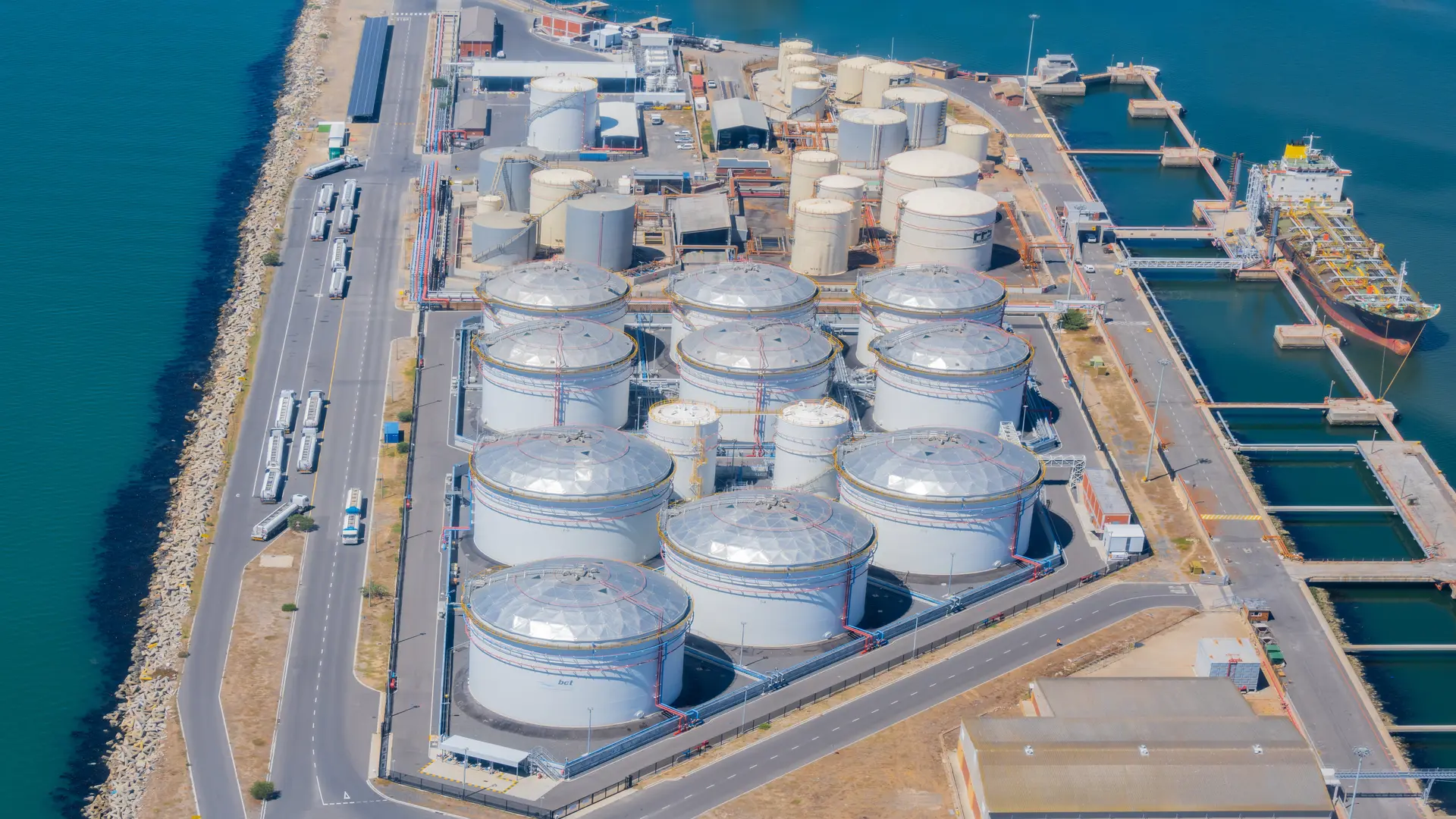
A geodesic dome is a triangulated space frame with a clear span. Unlike steel roofs that depend on radial beams and, in many cases, internal columns, the dome distributes stresses through a network of profiles and panels that work together and transmit loads to the perimeter. This configuration allows covering large diameters with lower dead weight and without internal interferences.
The absence of internal columns provides an additional advantage in tanks with floating systems because it avoids mechanical interferences, reduces potential water accumulation points, and helps preserve the operability of the floating roof. In addition, aluminum domes are described as clear‑span structures, lightweight, corrosion‑resistant, and suitable for both new tanks and retrofits.
From an asset integrity perspective, the geodesic dome is especially useful in three situations: tanks with external floating roofs exposed to the weather, steel covers deteriorated by corrosion, and terminals where water ingress and repetitive maintenance have become chronic problems. In these cases, recycled aluminum adds another advantage: lower embodied energy of the material without sacrificing the mechanical performance of the final system.
Technical insight: Geodesic dome and integration with IFR
It is important to be precise: the dome does not act by itself as an absolute vapor barrier. The EPA explains that, in tanks with a fixed roof over a floating roof system, the main function of the fixed roof is to block wind. For this reason, its primary contribution is reducing the portion of losses that depends on air velocity, not eliminating all sources of emissions.
The greatest benefit appears when the dome works together with an Internal Floating Roof (IFR) or when it covers an external floating roof with efficient seals. Under this configuration, and depending on the type of seals installed, evaporative emission reductions greater than 90% can be reported.
Technical Comparison: Aluminum vs. Steel Roofs
| Criterion | Aluminum Roof | Steel Roof |
|---|---|---|
| Self‑weight | Very low; ideal for retrofit and agile assembly | High; transmits greater loads to the tank |
| Atmospheric corrosion | High natural resistance due to oxide film | Requires frequent anti‑corrosive protection |
| Maintenance | Less need for repainting and intervention | Higher demand for periodic maintenance |
| Clear span | Highly suitable for large spans without columns | Usually requires heavier solutions |
| Emission control | Very effective with IFR or EFR and proper seals | Material alone does not provide direct advantage |
| Life cycle | Advantageous due to low weight and maintenance | Can be competitive in initial investment but tends to require higher operating costs |
The table summarizes material and roof system properties. In the case of recycled aluminum, these advantages remain and are complemented by a much lower energy footprint compared to primary aluminum.
International standards: API 650 and API 653
API 650 is the baseline reference for design and construction of welded atmospheric tanks, and it includes Annex G for structurally supported aluminum domes, confirming that the dome should not be seen as a minor accessory: it is part of the tank’s structural system and must be evaluated for loads, joints, supports, and compatibility with the equipment envelope.
API 653 becomes decisive when the dome is installed on an existing tank. The public description of the standard indicates that its scope covers foundation, bottom, shell, roof, accessories, and nozzles up to the first connection, and that in case of conflict, API 653 governs over API 650 for tanks in service; which means that the retrofit of the dome must be verified based on the actual condition of the tank, not just on the quality of the new roof.
Checklist: What to review before a retrofit
Before specifying a recycled aluminum dome, the technical package must validate at least the following points:
- Condition of the tank’s top and true circularity.
- Capacity of the top ring and wind girder.
- Condition of the existing roof and need for removal or adaptation.
- Compatibility with IFR, seals, nozzles, and emergency vents.
- Inspection, repairs, and previous alterations history under API 653.
This review prevents the retrofit from becoming a simple cover change and leads it to a technically validated modification within the asset integrity program.
Evaporative emissions and operational safety
From an environmental perspective, the geodesic dome protects the floating system against wind, rain, and other external conditions. The technical literature used by the EPA for this type of configuration treats a tank with an EF R covered by a dome as a case where wind speed ceases to be a dominant factor in certain seal and accessory losses, improving system behavior compared to an exposed roof.
The improvement does not eliminate all sources of emission, but it does reduce a relevant portion of evaporative emissions and helps preserve the condition of the floating roof. It also reduces problems derived from water ingress, such as premature corrosion, loss of tightness, and increased frequency of intervention on seals and system components.
As a reference, the case presented by Coteso on Inspenet TV shows how these coverings integrate into terminal modernization projects with aluminum that comes from more than 90% recycled sources, projecting a service life exceeding 20 years. To learn more about this practical application, we invite you to see the following audiovisual support:

Conclusions
The value of geodesic domes manufactured with recycled aluminum represents a quantitative leap in the management of industrial assets. It is not simply a choice of material for sustainability reasons; it is a technical decision that optimizes the structural integrity of the tank and drastically reduces total cost of ownership.
By integrating the requirements of Annex G of API 650 with integrity validation of API 653, operators can transform a conventional tank into a high‑performance storage system. This solution guarantees a cleaner, safer, and more efficient operation, aligned with modern demands for decarbonization and operational integrity in the global energy industry.
References
- Aluminum Association. Recycled Aluminum Energy Savings (2024).
- International Aluminium Institute. Primary vs Secondary Aluminum Energy Demand Report (2023).
- API Standard 650 & API Standard 653. Welded Tanks for Oil Storage & Inspection, Repair, Alteration, and Reconstruction of Steel Tanks (latest editions).
Frequently Asked Questions (FAQs)
Does recycled aluminum lose mechanical strength?
No, simply by being recycled. If alloy and purity are controlled, it maintains the fundamental properties of the material.
What energy savings does its use represent?
The most cited industrial references place the energy saving at around 95% compared to primary aluminum.
Is it compatible with all stored products?
Not always. Although it works in most petroleum services, chemical compatibility and pH must be verified to avoid galvanic attack or specific corrosion.
When is it advisable to install a dome in retrofit?
When there is recurrent water ingress, corrosion of the steel roof, a need to reduce maintenance, or stricter vapor control requirements.
What must be reviewed before installing it?
The tank’s circularity, the capacity of the upper ring, the condition of the current roof, IFR compliance, and the repair history in accordance with API 653.