
Table of Contents
- The Invisible Problem: Where VOC Emissions Escape
- Why Emissions Control Matters More Than Ever
- The Engineering Behind Stronger Solutions
- For Emissions Control – Materials Matter Most
- Permeation: The Physics Behind Vapor Emissions
- Chemical Resistance and Material Tradeoffs
- When Emissions Barriers Fail
- Durability: The Foundation of Effective Emissions Control
- Sustainability & End-of-Life Considerations
- The Regulatory Shift
- Emissions Control as a System
- Engineering the Future of Vapor Barriers
- Conclusion: Beyond Compliance
Volatile organic compound (VOC) emissions from aboveground storage tanks (ASTs) remain one of the most technically complex and operationally significant challenges in the petroleum and petrochemical industries. Despite decades of floating roof technology, measurable emissions persist.
The reason is simple:
Controlled does not mean eliminated.
As regulatory agencies raise expectations and monitoring technologies advance, tank owners and operators must move beyond theoretical compliance and toward systems that deliver verifiable, long-term emissions control.
At Mesa Engineered Tank Products (Mesa ETP), we approach emissions control as a materials science and systems engineering challenge – one that begins with each specific tank and extends through decades of field performance. This article explores where emissions escape, how vapor barriers succeed or fail, the tradeoffs in material selection, and why durability and permeability are the defining factors in next-generation emissions control.
The Invisible Problem: Where VOC Emissions Escape
Floating roof tanks are designed to minimize evaporative losses by eliminating vapor space above stored product. However, in real-world operating conditions, emissions escape through multiple pathways including rim space gaps and floating roof penetrations such as:
- Support legs
- Gauge poles and ladders
- Anti-rotation devices
- Level gauges
While floating roofs serve as the first line of defense, they often aren’t prioritized, or are given a one-size-fits-all solution. In fact, relatively small and often overlooked roof features are responsible for a disproportionate share of total tank emissions.
The common denominator across these emission pathways is the vapor barrier material.
Their performance ultimately determines the success (or failure) of the entire emissions control strategy.
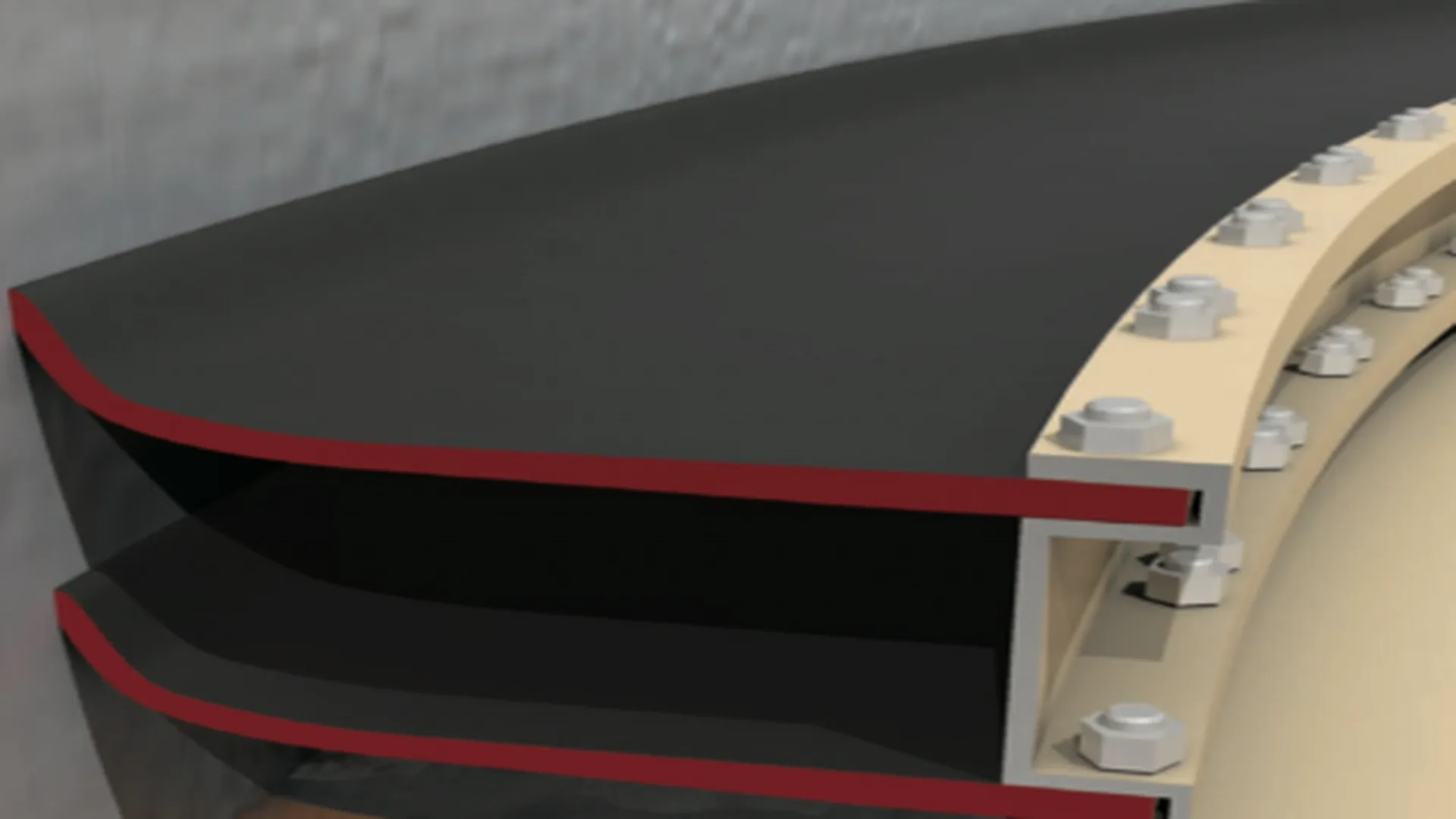
Fabrics are the first line of defense.
Why Emissions Control Matters More Than Ever
VOC emissions impact far more than regulatory compliance. They directly affect:
- Product and revenue loss
- Long-term liability
- Air quality and public health
- Worker safety
- Community relations
Regulatory bodies across North America are raising expectations. Agencies are tightening their guidelines and are more frequently requiring:
- Higher emission control goals
- Verifiable performance
- Reduced reliance on PFAS and forever chemicals
Regulations are evolving from emission estimation formulas toward performance-based verification. Real-time measurement technologies are supplementing traditional calculation methods.
The implication is clear:
Vapor barriers must perform in tank realities. Not just in laboratory conditions.
The Engineering Behind Stronger Solutions
Floating roof environments are dynamic and unforgiving. As tanks fill and empty, roofs rise and fall. Materials flex continuously. Wind induces additional stress. Temperature fluctuations cause expansion and contraction. UV radiation degrades surfaces. Hydrocarbon exposure challenges long term performance.Moisture-rich environments cause oxidation.
An emissions barrier must maintain integrity under all of these combined stresses simultaneously.
Performance specifications must include:
- Low permeability (vapor emissions)
- Chemical compatibility
- Superior flexibility and durability
- Resistance to UV and ozone
These properties are critical in material selection. Decisions made during the initial design determine system performance for decades.
Most material failures are predictable and preventable.
For Emissions Control – Materials Matter Most
The fabric used in a floating roof system plays a critical role in emissions control and long-term reliability. While several materials are used in the industry, their performance varies widely.
Teflon®(PTFE) offers broad chemical compatibility, but it comes with tradeoffs. Teflon® has significantly higher permeability, making it ineffective as a vapor barrier. It’s also stiff and fragile, which can make installation difficult and increase the risk of damage (raising product and labor costs). Additionally, PTFE contains PFAS (per- and polyfluoroalkyl substances), creating growing disposal and regulatory concerns.
Urethane-based fabrics are highly flexible and lower in upfront cost, which makes them easier to install. However, their chemical compatibility is limited, working with only about half of commonly stored tank products. Additionally, Urethane-based fabrics tend to have higher permeability rates than other vapor barrier fabrics.
Armor Fabric™ was engineered to bridge these gaps. It delivers exceptional abrasion resistance (26x better than Teflon®), low permeability (92% less vapor emissions than Teflon®), and compatibility with roughly 95% of commonly stored products – all while remaining incredibly cost-effective.
The result is a fabric designed for the realities of tank operations: durable, versatile, and built to perform where it matters most.
High Permeability = Emissions = Product Loss
Permeation: The Physics Behind Vapor Emissions
Permeation is the process by which vapor passes through a solid material. Even systems considered “sealed” allow vapor to move through materials at some measurable rate.
How quickly that happens depends on several factors, including:
- Fabric structure
- Chemical compatibility with the stored fluid
- Temperature
- Moisture Vapor Transmission Rate (MVTR)
MVTR, commonly measured using ASTM E96, quantifies how much vapor can pass through a material over time. The lower the MVTR, the more effective the material is as a vapor barrier and the better it performs at containing emissions.
Independent testing comparing Armor Fabric™ to Teflon® highlights the impact of this difference. Armor Fabric™ recorded an MVTR of 8, while Teflon® measured 98, making Armor Fabric™ roughly 12 times more effective at limiting vapor transmission.
However, vapor control is about more than permeability alone. To perform reliably in real-world tank environments, a vapor barrier must also maintain flexibility, chemical resistance, and long-term durability – ensuring it continues to contain emissions under demanding operating conditions.
The difference between emissions control and leaks is determined by the material you choose.
Chemical Resistance and Material Tradeoffs
Material selection often involves complex tradeoffs between performance, regulation, and sustainability.
Fluoropolymer-based materials such as Teflon® are well known for their chemical resistance. However, they can come with:
- Higher-than-expected permeation rates (i.e. increased emissions)
- Environmental scrutiny due to PFAS
- End-of-life disposal challenges
- Increasing regulatory oversight
PFAS offer chemical resistance but raise long-term environmental persistence concerns. As sustainability becomes part of performance evaluation, reliance on PFAS (also called ‘forever chemicals’) is increasingly scrutinized.
The industry must balance:
- Emissions performance
- Regulatory compliance
- Environmental impact
Selecting a material that performs well chemically but creates lifecycle liability may not be the optimal solution for the future.
Not all vapor barriers are built to survive real tank conditions.
When Emissions Barriers Fail
Barrier failures are rarely random events. They are typically predictable and preventable when material behavior is understood.
Common fabric failures include:
1. Chemical Deterioration
Hydrocarbon exposure can alter fabric compositions over time. Certain additives or contaminants may accelerate deterioration. Observable outcomes can include material stiffening and brittleness.
Once flexibility declines, sealing performance rapidly deteriorates.
2. Oxidative and UV Degradation
Light, oxygen, ozone, and elevated temperatures contribute to degradation and chain hardening. These reactions often cause embrittlement perpendicular to the direction of stress.
In floating roof systems, exposure to UV radiation and thermal cycling is constant and unavoidable.
3. Mechanical Fatigue
Floating roof vapor barriers experience continuous flexing and movement as product levels fluctuate. Over years of operation, cyclic stress adds up.
Abrasion and friction against steel components further accelerate fatigue, making abrasion resistance and durability of fabrics critical.
Emissions control is not only a materials problem – its a systems integration challenge.
Durability: The Foundation of Effective Emissions Control
Durability isn’t a feature. It’s the foundation. A vapor barrier that meets the minimum specifications but degrades within a few years does not provide meaningful emissions reduction over the life of the tank.
True durability means sustained performance under combined stresses like:
- Prolonged chemical exposure
- UV radiation & thermal cycling
- Abrasion & flexing
- Environmental aging
In real tanks, these stressors do not occur independently. They occur simultaneously. Designing for this environment requires:
- Materials engineered to handle long term abrasion
- Fabrics built to be chemically compatible
- Thoughtful fabric attachment designs
When vapor control must last – not just pass a test – the material makes the difference.
Degradation & Chain Hardening: A Closer Look
Fabric degradation occurs as the material’s internal structure begins to break down. Exposure to heat, light, and oxygen can break polymer chains and reduce flexibility.
The result is a loss of mobility and increased brittleness. Over time, materials that were once flexible enough to accommodate movement become rigid. When stressed, cracks form – often perpendicular to the direction of applied stress.
This process is gradual and is often only noticed after it’s too late.
Engineering for long-term emissions control requires anticipating these problems and designing materials that resist them.
Sustainability & End-of-Life Considerations
The emissions barrier lifecycle does not end at installation.
Increasingly, operators and regulators are evaluating:
- Disposal requirements
- Material composition
- Environmental impact
Responsible disposal and reduced reliance on forever chemicals are becoming central considerations.
Industry focus is shifting toward:
- Smarter material selection
- Reduced PFAS dependency
- Accountability beyond initial performance
The future of emissions control demands both containment and accountability.
The Regulatory Shift
Historically, emissions compliance relied heavily on theoretical calculation models. While still important, these models are increasingly supplemented by monitoring technologies capable of measuring real-time emissions performance.
As expectations rise, regulatory bodies require:
- Efficient emissions control
- Measurable reductions
- Environmentally sound systems
Products that barely meet minimum performance thresholds may struggle in this evolving environment.
Tomorrow’s vapor barrier solutions must demonstrate:
- Low permeability
- Long-term durability
- Abrasion resistance and flexibility
- Environmental responsibility
Performance must be sustainable and long term – not temporary.
Emissions Control as a System
No single component determines success. Effective vapor control requires:
- Advanced material science
- Practical designs
- Simplified field installation
- Lengthened lifecycles
Failure often occurs when material meets hardware, movement concentrates stress, or when environmental exposure accelerates degradation.
A full system design approach minimizes these risks.
From rim seal to leg boots to gauge pole covers, every design decision matters.
Engineering the Future of Vapor Barriers
The next generation of emissions barriers must combine:
- Materials with lower permeability
- Improved chemical compatibility
- Long-term flexibility
- Reduced environmental impact
- Thoughtful attachment design
- Verified performance metrics
As regulatory expectations rise and sustainability becomes inseparable from performance, emissions control technology must evolve accordingly.
Mesa ETP engineers solutions with a long-term perspective – recognizing that true emissions control is measured not in months, but in decades of reliable service.
Conclusion: Beyond Compliance
VOC emissions are invisible – but their consequences are measurable. Product loss. Regulatory compliance. Air quality. Environmental accountability.
Floating roof systems remain essential, but their effectiveness depends entirely on the integrity of the vapor barriers that seal them.
Engineering the next generation of emissions barriers requires:
- Innovative material science
- Product durability
- Full systems integration
- Lifecycle-long performance
- Disposal planning
The industry is moving from theoretical containment toward measurable, verifiable, and sustainable emissions control.
The future of emissions barriers belongs to systems that are built to last.