
Table of Contents
- What Is NDT Certification and Why Is It Critical in Industry?
- Global Presence and the Evolution of NDT Training
- NDT Certification Levels and Technical Responsibility
- Advanced NDT Methods and Their Relationship with Certification in Modern Industrial Environments
- How to Choose a Reliable NDT Training Center?
- Continuous Training and Professional Development in NDT
- Expansion of NDT Talent in Latin America
- Benefits of NDT Certification for Companies
- Conclusions
- References
- Frequently Asked Questions (FAQs)
In sectors such as Oil & Gas, power generation, and industrial infrastructure, asset integrity is not optional—it is a critical condition for safety, operational continuity, and business sustainability. In this context, Non-Destructive Testing (NDT) plays a decisive role, as it enables the assessment of materials, welds, and equipment without compromising their functionality. However, the effectiveness of these inspections depends directly on the technical competence of the personnel performing them, which is built through structured technical training.
Operating with non-certified inspectors or inadequately trained personnel introduces significant risks, including misinterpretation of indications, undetected failures, poorly supported technical decisions, and even incidents with human and economic consequences. For this reason, the industry has adopted internationally recognized certification schemes such as ISO 9712 and PCN, which establish clear criteria for validating knowledge, skills, and experience.
In this scenario, structured training is no longer a complementary element but becomes the foundation of professional performance in NDT. Having institutions that understand real field demands and operate under global standards is essential for developing reliable technical talent. In this regard, organizations such as Lavender International have established themselves as leading references in the training and certification of professionals, aligning technical education with the current demands of the industry.
What Is NDT Certification and Why Is It Critical in Industry?
Non-Destructive Testing (NDT) certification is the process by which an independent body verifies that a professional possesses the knowledge, practical skills, and experience required to perform and interpret inspections in accordance with recognized technical standards. Unlike basic academic training, certification validates competence under objective and measurable criteria, making it an essential requirement in high-risk industrial environments.
It is important to distinguish between concepts that are often confused. Training refers to the theoretical and practical instruction in a specific method. Qualification combines that training with documented field experience. Certification, on the other hand, is the formal validation granted by an external body that assesses such qualification. Finally, employer authorization is the internal approval that allows the technician to operate within a specific work environment, under the company’s procedures and responsibilities.
Regarding regulatory frameworks, ISO 9712 establishes an independent certification system widely accepted at the international level. The PCN (Personnel Certification in Non-Destructive Testing) scheme, administered by the British Institute of Non-Destructive Testing, is aligned with ISO 9712 and is one of the most globally recognized. In contrast, SNT-TC-1A is not an independent certification scheme, but a recommended practice that allows companies to develop their own internal qualification and certification programs.
The impact of proper personnel certification is direct and tangible. It enhances operational safety by reducing the risk of undetected failures, increases inspection quality and reliability by ensuring consistent evaluation criteria, and supports regulatory compliance, particularly in highly regulated industries where traceability and personnel competence are subject to audit. Ultimately, NDT certification not only validates the professional but also strengthens the integrity of the entire industrial operation.
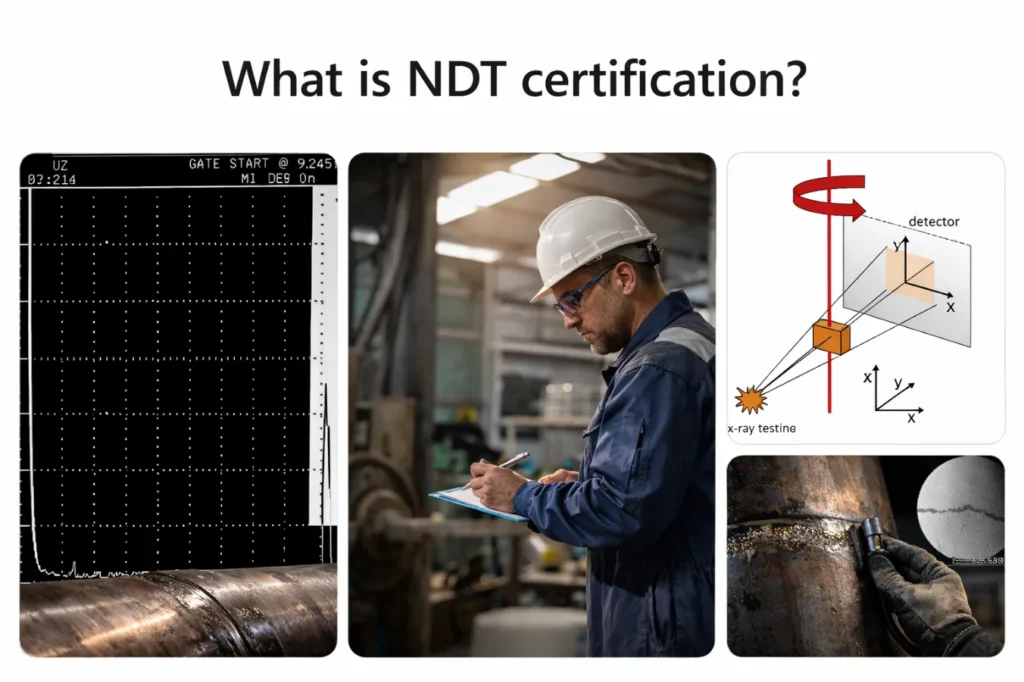
What is NDT certification: collage with industrial inspector, ultrasonic testing, and radiography in non-destructive testing.
Global Presence and the Evolution of NDT Training
Non-Destructive Testing training has evolved significantly over recent decades, driven by the need for more structured and standardized technical training, transitioning from largely empirical approaches dependent on local experience to structured models based on international standards. In its early stages, many technicians acquired their skills directly in the field through informal and non-standardized learning processes. However, as industry operations became more complex and globally interconnected, the need for consistent criteria to ensure personnel competence—regardless of country or sector—became evident.
Today, industries such as Oil & Gas, energy, aerospace, and advanced manufacturing operate under strict regulatory frameworks and within multicultural environments, where technical teams must share a common professional language. This has driven the adoption of global standards such as ISO 9712 and internationally recognized certification schemes, facilitating workforce mobility across international markets and ensuring consistent levels of inspection quality.
In this context, specialized training centers have taken on a strategic role, not only as providers of instruction but as key contributors to the development of technical talent. Institutions with international presence, such as Lavender International, have supported this evolution by delivering training models aligned with real industry demands. Their employee ownership approach reinforces a strong commitment to quality and continuous improvement, while their presence in the United Kingdom and the United States enables them to serve highly demanding markets and extend their reach globally. This combination of experience, structure, and international perspective directly aligns with the current needs of the sector.
NDT Certification Levels and Technical Responsibility
Level 1, 2, and 3: Functions and Decision-Making
The level structure in NDT certification is not merely an academic classification, but a system designed to precisely define the technical scope and responsibility of each professional within an inspection process. Each level implies a different degree of autonomy, judgment, and decision-making, directly impacting the reliability of results obtained in the field.
Level 1 represents the entry point into professional practice. Technicians at this level are qualified to perform inspections by following specific instructions and established procedures, always under the supervision of higher-level personnel. This stage often marks the beginning of a structured career path in the field, where professionals progressively develop their skills and advance toward higher levels of responsibility, as outlined in typical career paths in NDT. Their role is fundamental in data acquisition, but it does not include final result interpretation or critical decision-making.
Level 2 represents a significant step forward in terms of responsibility. At this level, professionals not only perform inspections but also interpret results, evaluate indications, and determine the acceptability of discontinuities in accordance with applicable codes and standards. In practice, many operational decisions rely directly on the judgment of a Level 2 inspector, requiring a high degree of technical knowledge and experience.
Level 3, in turn, represents the highest level of competence. These professionals are responsible for developing and validating procedures, selecting inspection techniques, supervising NDT programs, and ensuring technical compliance. Additionally, they serve as technical authorities within the organization for resolving complex issues and making critical decisions that may impact asset integrity.
Collectively, this structure ensures that each stage of the inspection process is supported by an appropriate level of competence, reducing uncertainty and strengthening the reliability of technical evaluations.
NDT certification levels: collage with industrial inspectors, equipment evaluation, and non-destructive testing processes
Advanced NDT Methods and Their Relationship with Certification in Modern Industrial Environments
The evolution of Non-Destructive Testing has been marked by the transition from conventional techniques to advanced NDT approaches capable of delivering higher resolution, traceability, and reliability, such as manual ultrasonic testing (UT), to advanced methodologies capable of delivering higher resolution, traceability, and reliability in discontinuity detection. This shift is driven not only by technological advancements but also by the increasing industry demand for more accurate data to support critical asset integrity decisions.
Advanced Ultrasonic Testing: PAUT, TOFD, and TFM
Technologies such as Phased Array Ultrasonic Testing (PAUT), Time of Flight Diffraction (TOFD), and the Total Focusing Method (TFM) have transformed the inspection of welds, fatigue-sensitive components, and critical areas of high responsibility. Unlike conventional UT, these techniques enable more detailed imaging of materials, improved defect characterization, and reduced reliance on subjective interpretation.
Their application is particularly relevant in the assessment of complex welds, detection of internal cracking, and monitoring of degradation mechanisms such as localized corrosion. However, the effective use of these technologies requires a high level of technical competence, as data acquisition and interpretation are significantly more complex.
Electromagnetic Techniques: Eddy Currents
On the other hand, eddy current testing is a key technique for detecting surface and near-surface discontinuities, and remains one of the most widely applied eddy current methods in industrial inspection, especially in conductive materials. It is widely used in the inspection of heat exchangers, aerospace components, and applications where access is limited or rapid, non-contact evaluation is required.
In both cases, method-specific certification is essential. General NDT training alone is not sufficient; each advanced technique, including eddy current inspection, demands specialized knowledge in physics, instrumentation, and signal interpretation. As the complexity of the method increases, so does the required level of certification, establishing a direct relationship between technical competence and the reliability of results. Ultimately, the correct application of these technologies depends as much on the equipment used as on the expertise of the professional operating it.
How to Choose a Reliable NDT Training Center?
Selecting a Non-Destructive Testing training center is a decision that can define the quality of technical education and, consequently, future professional opportunities. In a market where the range of available courses is broad and diverse, identifying truly reliable institutions requires evaluating beyond superficial factors.
One of the first criteria to consider is international accreditation, as it ensures that the training program is aligned with recognized standards such as ISO 9712. This should be complemented by the center’s proven experience, not only in terms of years of operation but also its direct involvement with industry practices. The presence of Level 3 certified instructors is another key indicator, as these professionals bring a deep, practical perspective grounded in real-world problem-solving.
Infrastructure and available equipment also play a decisive role. NDT training cannot be limited to theory; it requires hands-on practice under conditions that replicate real industrial scenarios. Therefore, a robust training approach must integrate practical instruction with up-to-date technology.
Among the most common mistakes when selecting a training center are prioritizing cost over quality, failing to verify the recognition of the certification in the job market, and choosing programs with limited practical exposure. These decisions can lead to short- and medium-term professional limitations.
An example of this approach can be seen in structured certification programs developed under ISO 9712, where the training process goes beyond theoretical instruction and incorporates supervised practice in environments that simulate real inspection conditions. In the case of Lavender International, its model combines Level 3 certified instructors, specialized technical infrastructure, and assessment schemes aligned with international standards, enabling professionals to develop competencies directly applicable in the field.
This type of training is particularly relevant for those seeking not only to obtain a certification, but to build a solid foundation of technical performance in advanced methods and in high-demand industrial environments.
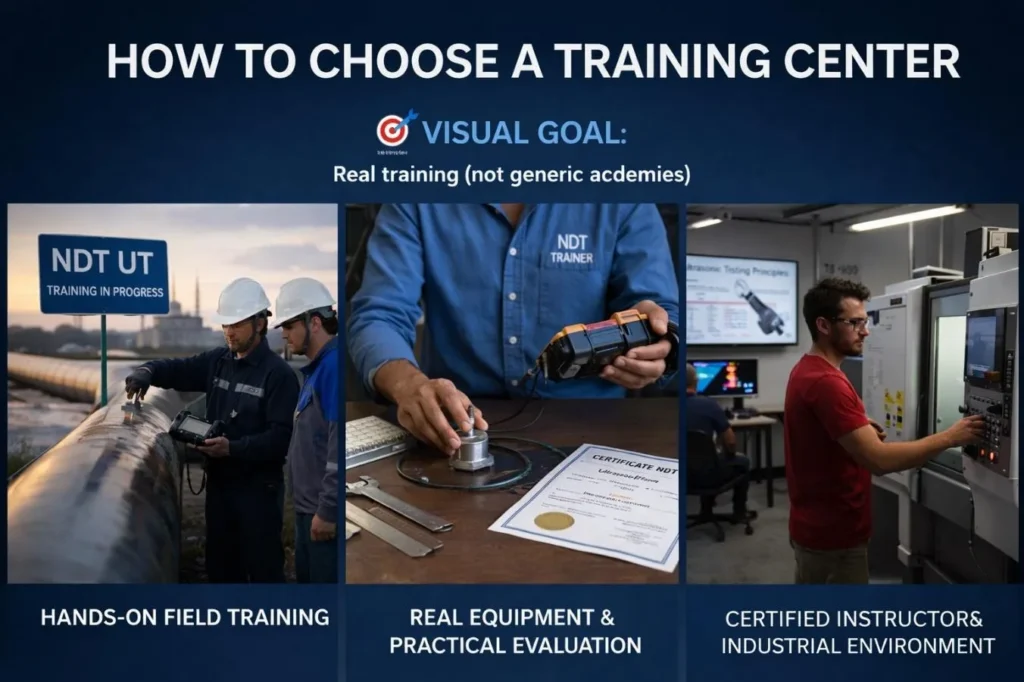
How to choose an NDT training center: hands-on field training, real ultrasonic testing equipment, and technical instruction in a certified industrial environment.
Continuous Training and Professional Development in NDT
In the field of Non-Destructive Testing, certification does not represent an endpoint but rather the beginning of a professional path that requires continuous updating. Technological advancements, the emergence of new inspection methodologies, and the periodic revision of standards and codes compel professionals to remain engaged in ongoing learning. Techniques such as PAUT, Total Focusing Method (TFM), and advanced electromagnetic methods such as eddy current have raised the level of technical demand, making progressive specialization essential.
Continuous training thus becomes a tangible competitive advantage. A professional who consistently updates their competencies not only enhances technical capability but also expands operational scope, employability, and credibility within multidisciplinary teams. In industrial environments where decisions are driven by inspection data, having up-to-date personnel directly impacts the quality and reliability of results.
In line with this continuous learning approach, structured digital training platforms have become an essential component of professional development in NDT. These environments allow inspectors to reinforce theoretical knowledge, stay updated with evolving standards, and complement hands-on experience with guided learning modules.
A practical example of this can be seen in specialized platforms developed by institutions such as Lavender International, where online learning is integrated with technical training pathways designed to support long-term professional growth.
The following video provides an overview of how digital learning environments are being applied in NDT training today:

Furthermore, specialization in advanced techniques enables inspectors to adapt to increasingly complex scenarios where conventional methods are no longer sufficient. The interpretation of digital data, integration with asset integrity systems, and the use of emerging technologies require technical profiles supported by strong and evolving expertise.
In this context, specialized training centers play a role that goes beyond initial instruction. They act as long-term partners in professional development, offering structured learning pathways, technical updates, and ongoing support throughout a technician’s career. This comprehensive approach transforms certification into a foundation upon which a sustainable and industry-aligned professional trajectory is built.
Expansion of NDT Talent in Latin America
Latin America is currently facing a significant challenge in developing certified technical talent in Non-Destructive Testing. Despite the sustained growth of strategic industrial sectors, there is a gap between the demand for qualified professionals and the availability of personnel with internationally recognized certifications. This situation is particularly evident in industries such as Oil & Gas, power generation, mining, and infrastructure, where asset integrity is a critical factor.
The growth of energy projects, the modernization of industrial plants, and increased investment in infrastructure have intensified the need for competent inspectors capable of working under global standards. However, limited access to structured training and international certification programs continues to constrain the development of this talent across the region.
In this context, certifications under schemes such as ISO 9712 and PCN gain strategic value, as they enable Latin American professionals to integrate into international markets and strengthen workforce mobility in global industrial sectors. The ability to operate in bilingual environments, particularly in English, further enhances this advantage, expanding career opportunities.
Institutions with a global presence, such as Lavender International, play a relevant role in this talent expansion by offering training programs aligned with international standards and tailored to market needs. Their contribution helps bridge knowledge gaps and strengthens the competitiveness of professionals in the region, connecting them with opportunities that extend beyond geographical boundaries.
Benefits of NDT Certification for Companies
For companies, certifying personnel in Non-Destructive Testing is not merely a technical requirement but a strategic investment in operational reliability. The primary benefit is reflected in improved inspection quality and the consistency of inspection results, as results produced by certified personnel tend to be more consistent, traceable, and aligned with regulatory criteria.
This improvement directly impacts the reduction of failures and rework. Early and accurate detection of discontinuities prevents unnecessary interventions, unplanned shutdowns, and costs associated with delayed repairs. As a result, asset life cycles are optimized, and operational risks are minimized.
Additionally, certification strengthens integrity-related decision-making, as data generated from reliable inspections allows for more accurate assessment of equipment and structural conditions. This is particularly relevant in approaches such as Risk-Based Inspection (RBI), where the quality of technical data is critical for prioritizing interventions.
From a regulatory standpoint, having certified personnel facilitates compliance with standards and audits, especially in industries where API standards and other international codes require documented evidence of technical competence. In this sense, certification not only supports the individual professional but also protects the organization against technical, legal, and reputational risks.
Conclusions
In modern industry, NDT certification has evolved from a differentiating attribute into an essential professional standard. The relationship between technical training and operational reliability is direct: the higher the competence of personnel, the greater the accuracy of inspections and the lower the uncertainty in decision-making.
This approach impacts not only the individual professional but the entire organization, which relies on reliable technical data to ensure asset integrity. In this context, having training institutions with international experience and alignment with global standards becomes a determining factor.
Organizations such as Lavender International represent this type of benchmark, offering structured programs that respond to real industry demands. Beyond certification itself, the true value lies in the ability to develop professionals who contribute tangibly to the safety, efficiency, and sustainability of industrial operations.
References
- International Organization for Standardization. (2021). ISO 9712:2021 Non-destructive testing — Qualification and certification of NDT personnel. International Organization for Standardization.
- The British Institute of Non-Destructive Testing. (2024). PCN24/GEN: General requirements for qualification and certification of NDT personnel. BINDT.
- The British Institute of Non-Destructive Testing. (n.d.). General information. BINDT Certification.
- American Society for Nondestructive Testing. (n.d.). ASNT standards: Setting global benchmarks for NDT excellence. ASNT.
- Lavender International. (n.d.). About us. Lavender International.
Frequently Asked Questions (FAQs)
Which NDT certification has the highest international recognition?
Certifications based on ISO 9712 are widely recognized worldwide, especially when issued by accredited certification bodies. The PCN scheme is among the most valued, as it complies with ISO 9712 and has strong acceptance across multiple industrial sectors.
What is the difference between ISO 9712 and PCN?
ISO 9712 is the international standard that defines the requirements for NDT personnel certification, while PCN is a specific certification scheme that operates under those guidelines. In other words, ISO 9712 establishes the standard, and PCN implements it.
What are the responsibilities of a Level 2 inspector?
A Level 2 inspector is qualified to perform inspections, interpret results, evaluate indications, and determine the acceptability of discontinuities in accordance with applicable codes and standards. Their role is critical in operational decision-making.
How long does it take to become certified in NDT?
The duration varies depending on the method and level, but generally includes formal training hours, documented practical experience, and passing both theoretical and practical examinations. It can take from several months to more than a year, depending on the level achieved.
Is it mandatory to certify all NDT methods?
Not necessarily, but it is highly recommended to certify each method used in critical operations. Certification ensures method-specific competence and reduces risks associated with incorrect interpretation.