
Table of Contents
- Frequency regulation: BESS as the grid’s first line of defense
- Synthetic inertia: BESS replaces physical inertia that no longer exists in the grid
- VPP and value stacking: the technology that powers battery energy storage systems (BESS)
- New battery chemistries: LFP, sodium-ion, and solid-state take center stage
- Innovative projects and the new paradigm in global storage
- References
The global energy transition has brought to light a major technical paradox: while installed renewable generation capacity is growing at a rapid pace, the inertia of the power system; that physical buffer that for decades ensured frequency stability; is diminishing proportionally.
Synchronous generators running at 3,000 or 3,600 rpm stored kinetic energy in their rotating masses, acting as natural dampers against sudden disturbances. With the widespread adoption of solar photovoltaic and wind power (technologies based on inverters with no rotating masses), this self-regulating mechanism disappears.
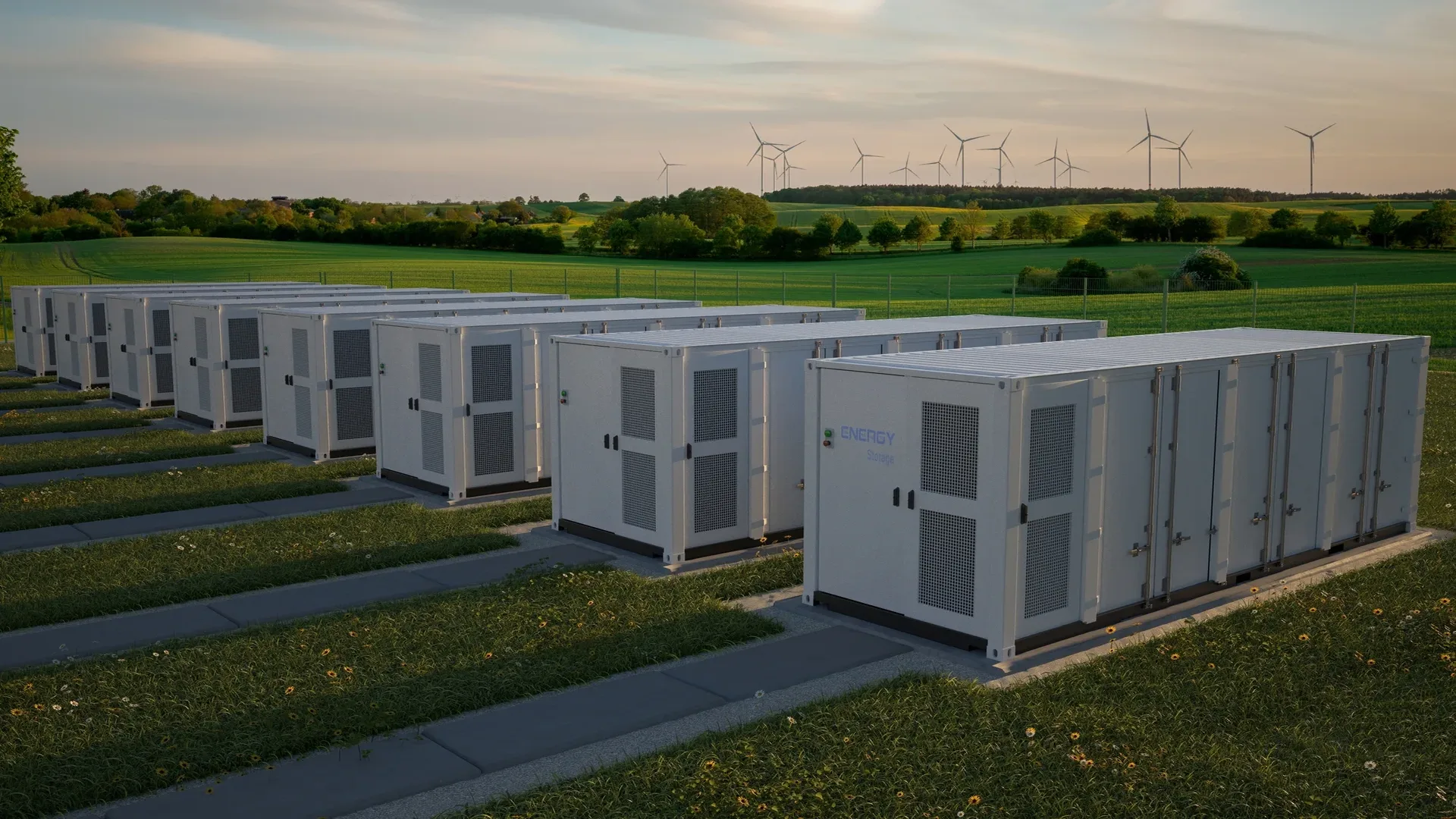
The Battery Energy Storage System (BESS) has emerged not only as a storage solution, but also as the most sophisticated asset for restoring lost flexibility and reconfiguring the operational architecture of the modern power grid.
In the U.S. alone, utility-scale storage capacity reached 37.4 GW in October 2025, with an additional 19 GW under construction and a projected portfolio of 187 GW by 2030. The average price of lithium-ion battery packs fell to $115/kWh in December 2024, a 20% decline from 2023, while the levelized cost of four-hour Li-ion storage has fallen below the equivalent cost of peak gas plants in most markets.
Frequency regulation: BESS as the grid’s first line of defense
Frequency stability in an AC power system depends on the instantaneous balance between generation and demand.
Any deviation from 50 Hz (Europe) or 60 Hz (America) triggers a series of automated responses: Frequency Fast Response (FFR) acts within the first second, Frequency Containment Reserve (FCR) stabilizes within seconds, Automatic Frequency Restoration (aFRR) normalizes within five minutes, and Manual Frequency Restoration (mFRR) completes the cycle in 12.5 minutes.
The BESS’s responsiveness—operating within 100 to 500 milliseconds to absorb or inject power—makes it the most efficient asset for FFR and FCR, far surpassing the response times of conventional gas turbines, whose load ramp can take several minutes to reach rated power.
The control mechanism governing this response is droop control, an algorithm that establishes a linear relationship between the frequency deviation (Δf) and the active power that the BESS must inject or absorb.
In advanced control schemes, the controller incorporates three input variables: frequency deviation (Δf), rate of change of frequency (ROCOF), and the state of charge (SoC) of the batteries.
Including the SoC as a feedback variable is critical: it allows the system to modulate its response based on available energy, preventing the battery from over-discharging or overcharging, which would accelerate its degradation. Recent research from 2025 incorporates fuzzy logic into this control loop, achieving an adaptive response that preserves the SoC while maximizing the contribution to frequency stabilization.
The case that proved these capabilities to the industry and system operators was the Hornsdale Power Reserve in South Australia (the world’s first large-scale utility-grade BESS), which demonstrated frequency responses of less than one second under protocols audited by the Australian Energy Market Operator (AEMO).
But the most recent data goes much further: the collapse of the Iberian grid on April 28, 2025, which disconnected the Iberian Peninsula from the European interconnected system in just five seconds, resulting in estimated economic losses of up to 4.5 billion euros, highlighted the fragility of systems with low storage capacity.
Synthetic inertia: BESS replaces physical inertia that no longer exists in the grid
The loss of rotational inertia is the most underestimated technical challenge of the energy transition. When a 500-MW synchronous generator unexpectedly goes offline, the kinetic energy stored in the rotor-turbine assembly slows the rate of frequency drop during the first few seconds—the so-called inertial interaction period—giving control systems time to activate reserves.
With 100% inverter-based generation, that damping disappears: the ROCOF can exceed 2 Hz/s, a threshold that triggers a cascade of protective relays and can lead to cascading blackouts.
The emulation of synthetic inertia using BESS is the technical solution to this gap: through control algorithms installed in the voltage-source inverter (VSI), the system detects ROCOF and injects or absorbs power on a sub-second timescale, mathematically replicating the behavior of the inertial mass of a synchronous generator.
The frontiers of knowledge in this field are being redefined by fractional-order control theory (FO-VPSC, Fractional-Order Virtual Primary-Secondary Control). Unlike conventional PI controllers, which operate with integer-order derivatives and integrals, fractional-order controllers introduce non-integer exponents (α, β) into the differential operators, providing greater mathematical flexibility for modeling and compensating for the complex dynamics of multi-area electrical systems with high renewable energy penetration.
Studies published in November 2025 in indexed scientific journals demonstrate that integrating the FO-VPSC with a BESS-VIDC (Virtual Inertia-Damping Control) scheme achieves a 35–45% reduction in frequency overshoot and an improvement in settling time of up to 42%, validated in simulations of two-area power systems with heterogeneous sources: thermal, solar, wind, and BESS.
Comparison table: battery chemistries in BESS
| Technical Parameter | LFP (LiFePO₄) | NMC (LiNiMnCoO₂) | Sodium-ion (Na-ion) | Redox Flow (VRFB) |
| Energy Density | Medium | High | Medium-Low | Low |
| Cycle Life | Very High (>6,000) | High (3,000–5,000) | High (Evolving) | Very High (>10,000) |
| Thermal Safety | Very High | Medium | High | Very High |
| Relative CAPEX | Low | Medium-High | Low (Potential) | High |
| Discharge Duration | 1–4 h (Typical) | 1–4 h | 2–6 h (Estimated) | 4–12 h |
| Degradation Rate | Low | Moderate | Under Study | Very Low |
| Energy Scalability | Limited | Limited | Moderate | Independent (Tanks) |
| Typical Application | Grid / Renewables | High Density / EV | Emerging Grid | Long Duration (LDES) |
VPP and value stacking: the technology that powers battery energy storage systems (BESS)
A Virtual Power Plant (VPP) is an architecture that enables a BESS to go beyond its individual function and operate as a smart node within a federated system of distributed energy resources (DER).
Using advanced optimization software and real-time two-way communication, a VPP aggregates the capacity of multiple BESS, along with solar and wind generation and flexible loads, and presents them to the electricity market as a single dispatchable entity.
This aggregation overcomes the barriers to entry in wholesale markets, where a single 5-MWh battery could never participate on its own.
The most recent study from February 2026, published in ScienceDirect, proposes coordination strategies based on a weighted bias factor—which takes into account the available margin, state of charge (SoC), and electrical proximity of each BESS—to optimize the collective frequency response exclusively, thereby surpassing traditional approaches focused on nominal capacities.
Value stacking is the economic principle that makes BESS financially viable: the ability to simultaneously monetize multiple grid services through a single asset.
A properly configured 100 MW/400 MWh BESS can participate in energy arbitrage—purchasing cheap energy during off-peak hours and selling it during peak demand periods—as well as primary frequency control, the capacity market, emergency demand response, and autonomous start-up services.
Models from 2026 for facilities of this size show that frequency, capacity, and emergency response services can account for more than 50% of the total value generated when dispatch optimization is performed using advanced algorithms.
The Tesla Autobidder system illustrates this logic: during the September 2022 heat wave in California, the VPP—comprising more than 50,000 residential Powerwall batteries—discharged 16 MWh during peak hours, equivalent to a small power plant, while owners received direct financial compensation.
The integration of artificial intelligence and large-scale language models (LLMs) into battery management systems (BMS) is redefining the predictive capabilities of BESS within the VPP architecture.
New battery chemistries: LFP, sodium-ion, and solid-state take center stage
LFP (lithium iron phosphate) chemistry currently dominates the utility-scale BESS market, displacing NMC (nickel manganese cobalt) chemistry in stationary applications due to its greater intrinsic safety against thermal runaway events, longer lifespan (3,000–6,000 cycles at 80% Depth of Discharge), and lower dependence on critical materials such as cobalt.
The LFP architecture operates within a nominal cell voltage range of 3.2–3.65 V, with energy densities ranging from 120–200 Wh/kg at the cell level; this is lower than that of NMC, but sufficient for stationary applications where weight and volume are secondary considerations compared to cost per cycle and safety.
CATL, the world’s largest battery cell manufacturer, has introduced its TENER Stack platform with advanced liquid cooling systems for industrial-scale facilities, while BYD has optimized its cell architecture to reduce the space required per installed MWh in large-scale plants.
Sodium-ion (Na-ion) batteries represent the next frontier in making stationary energy storage more accessible. By replacing lithium—a material subject to geopolitical concentration and price volatility—with sodium, which is abundant and widely available globally, this chemistry eliminates the supply chain vulnerabilities that affect LFP and NMC projects.
An additional advantage is that sodium-ion batteries can be manufactured using the same existing production infrastructure as lithium-ion batteries, thereby reducing the cost of industrial transition. Their current disadvantage is lower energy density (90–150 Wh/kg at the cell level), which means larger physical volumes per installed MWh.
However, for long-duration stationary energy storage (LDES) applications with time horizons ranging from 8 to 24 hours or more, this parameter becomes less significant compared to the total cost per kWh-cycle. CATL has announced small-scale production of sodium-ion batteries by 2026, and several Chinese manufacturers have pilot projects currently in operation.
Solid-state batteries (SSBs) represent the technological frontier with the greatest potential impact on BESS. By replacing the conventional liquid electrolyte with a solid electrolyte—ceramic, polymeric, or oxide—SSBs eliminate the primary mechanism of catastrophic failure in lithium-ion batteries: the leakage of flammable electrolyte that triggers thermal runaway events.
Innovative projects and the new paradigm in global storage
The BESS Supernode in Queensland, Australia; 500 MW/1,500 MWh in phases 1 and 2, with GE Vernova serving as the system integrator for this large-scale standalone BESS project on a global scale.
In Europe, TenneT’s Grid Booster project in Germany represents a conceptually different approach: two 100 MW/100 MWh facilities operate as virtual transmission lines, feeding power into or drawing power from grid congestion points to avoid costly investments in new physical transmission lines.
This architecture—in which BESS serves as a functional substitute for transmission infrastructure—is being codified within the Italian regulatory framework known as MACSE (Mercato per l’Approvvigionamento di Capacità di Stoccaggio Elettrico).
Europe’s first competitive mechanism specifically designed for the procurement of utility-scale storage capacity, which in September 2025 secured 10 GWh at an average price of less than €13,000/MWh-year for delivery starting in 2028 under 15-year contracts.
The link between BESS and AI data centers is redefining the logic of network planning on a global scale. Data centers already consume a significant portion of U.S. electricity, with projections from the Department of Energy estimating that they could account for up to 12% of the nation’s electricity demand within three years.
The outlook for 2030 points to an unprecedented transformation of the global electricity infrastructure. BloombergNEF projects that the U.S. will add 204 GW of battery storage over the next decade, an estimate 25% higher than projections made prior to the passage of the Clean Energy Act, while the global BESS market is on track to reach a value of between $120 billion and $150 billion by 2030, according to a McKinsey analysis.
The pressure from global energy demand—projected to grow by 130% between 2023 and 2050, from 31,000 to 66,000 terawatt-hours—means that BESS is no longer a niche technology but has become critical infrastructure on par with transmission lines or power transformers.
Clean energy engineers who master the technical fundamentals of BESS—from FO-VPSC control to system sizing based on LCOS (Levelized Cost of Storage) criteria—will be at the heart of designing the power grid of the future.
References
- https://about.bnef.com
- https://www.catl.com
- https://www.mckinsey.com
- https://info.fluenceenergy.com
- https://www.mase.gov.it/portale/mercato-elettrico