
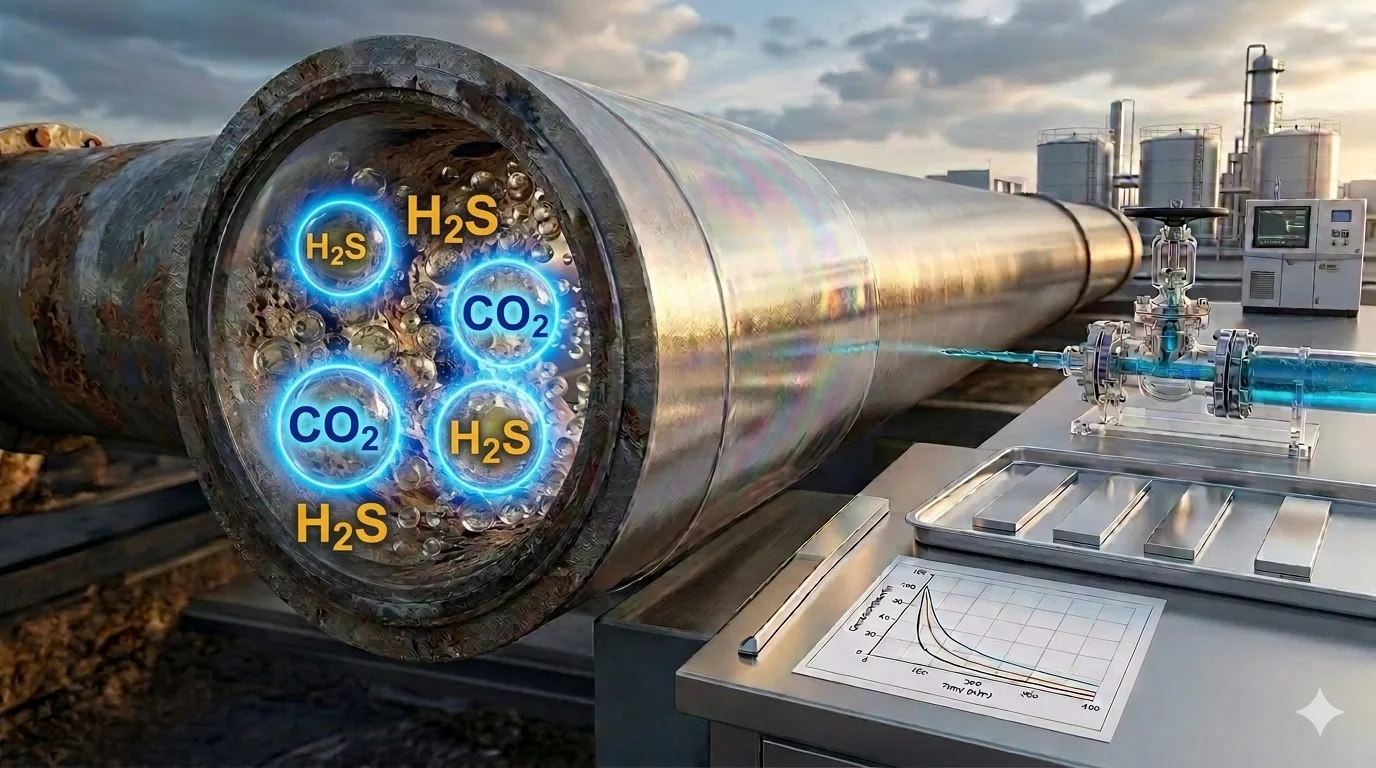
Corrosion induced by CO₂ and H₂S represents one of the most complex challenges in the oil and gas industry due to the simultaneous interaction of chemical, mechanical, and operational factors that affect pipelines, equipment, and metallic structures. Detailed understanding of the H₂S/CO₂ corrosion mechanism has enabled experts to develop more precise mitigation strategies, ranging from the selection of chemical inhibitors to the optimization of coatings and the choice of resistant alloys.
Recent advances published in journals such as Revista Latinoamericana de Metalurgia y Materiales, Corrosion Science, Electrochimica Acta, Corrosion Metals Performance, and Journal of Petroleum Science and Engineering have provided new experimental and predictive tools to analyze corrosion under real operational conditions, including the influence of multiphase fluids, temperature variations, presence of chlorides, and heavy crude oil.
Mechanisms by H₂S/CO₂ corrosion
Corrosion by CO₂ (sweet) occurs when carbon dioxide dissolves in water forming carbonic acid (H2CO3), causing pitting and uniform corrosion in carbon steels. CO₂ + H2S (acidic) is more severe; H2S forms an iron sulfide layer, generating localized corrosion (stress corrosion cracking, SSC) and rapid material destruction. Below is a representative image of these mechanisms.
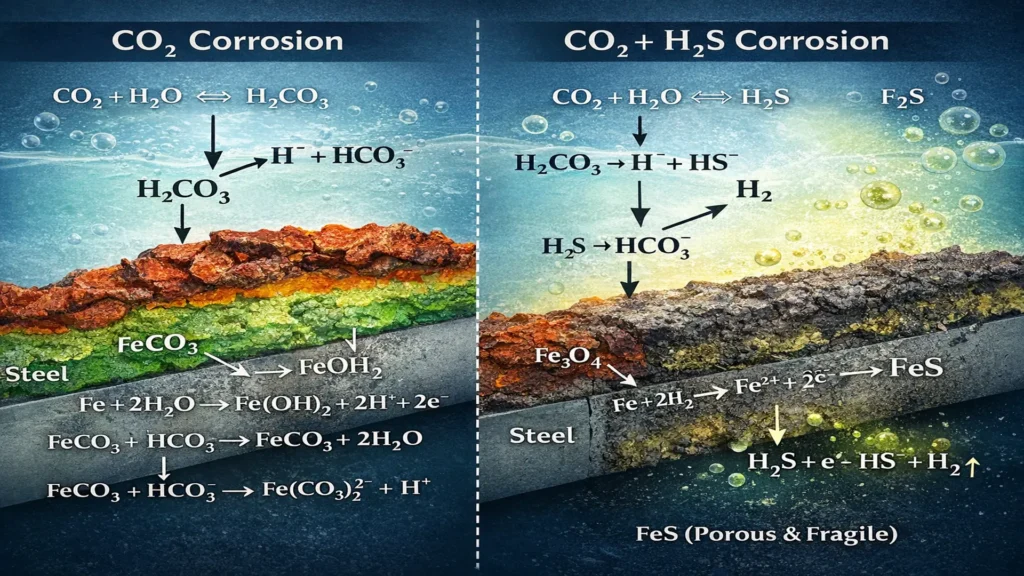
CO₂ Corrosion Mechanism (Sweet Corrosion)
The CO₂ corrosion mechanism begins when this gas dissolves in water and forms carbonic acid, leading to a decrease in pH and an increase in the medium’s conductivity. Although it is a weak acid, its dissociation generates protons (H⁺), which are primarily responsible for the corrosive process. In this environment, iron is oxidized in the anodic reaction, releasing electrons and passing into solution as Fe²⁺, implying the progressive loss of metallic material. Simultaneously, in the cathodic reaction, these electrons are mainly consumed in the reduction of protons, thus closing the electrochemical circuit.
As the process advances, dissolved iron can react with carbonate species to form iron carbonate (FeCO₃), which can deposit on the surface and act as a protective film that reduces the corrosion rate. However, this protection is not always stable, since FeCO₃ can dissolve depending on conditions such as pH, temperature, flow velocity, and CO₂ concentration, reactivating the corrosive process. Additionally, oxides such as Fe₃O₄ or FeOOH may form, whose protective capacity depends on their density and adhesion. In general terms, CO₂ corrosion is governed by the balance between the formation and destruction of these protective layers, which explains its potentially self-limiting nature or, under unfavorable conditions, its progressive behavior.
Combined Corrosion (H2S + CO2) (Acidic Corrosion)
On the other hand, when the system contains both CO₂ and H₂S, the mechanism becomes significantly more complex and aggressive. Both gases generate acidic species in solution, increasing proton concentration and creating a more corrosive environment. In this scenario, iron continues to dissolve in the anodic reaction, but the presence of H₂S accelerates the cathodic reactions, increasing the overall corrosion rate. Furthermore, different corrosion products are formed: while CO₂ tends to generate FeCO₃, H₂S favors the formation of iron sulfides (FeS).
The critical aspect of this system is the synergistic effect between both gases. H₂S tends to inhibit the formation of protective FeCO₃ films and promotes the formation of FeS, which in many cases is more porous, brittle, and less protective. As a result, the metallic surface is more exposed to the action of the electrolyte, favoring localized corrosion, such as pitting. Additionally, H₂S introduces more severe damage mechanisms, such as hydrogen embrittlement, where atomic hydrogen penetrates the metal generating internal cracks, and sulfide stress cracking (SSC), which can cause sudden failures under mechanical stress conditions.
Overall, while CO₂ corrosion can stabilize under certain conditions through the formation of protective films, the simultaneous presence of H₂S disrupts this balance and leads to a much more unstable and dangerous system, characterized by higher corrosion rates and an increased risk of structural damage.
The table below shows a summarized analysis of the characteristics of these two mechanisms.
| Characteristic | CO₂ | CO₂ + H₂S |
|---|---|---|
| Type of corrosion | General | Localized + cracking |
| Film | FeCO₃ (protective) | FeS (variable) |
| Rate | Moderate | High |
| Structural risk | Low–medium | High |
| Type of damage | Uniform | Pitting + cracks |
Recent advances in H₂S/CO₂ corrosion mechanism
Corrosion in the presence of CO₂ and H₂S is multifactorial and depends on a set of operational and chemical variables. CO₂, when dissolved in water, forms carbonic acid (H₂CO₃), which increases electrolyte conductivity and favors iron dissolution. H₂S contributes to the precipitation of iron sulfides (FeS), which can alter the effectiveness of traditional protective films such as FeCO₃.
In Venezuela, Biomorgi et al. (2012) conducted an in situ study on crude oil and gas production lines in the northeast of the country using tools designed to monitor corrosion under real operating conditions. They identified that under-deposit corrosion was dominant, generating pitting related to the presence of sand, carbonates, and sulfides. The location of the damage showed a strong relationship with hydrodynamic parameters such as flow patterns and superficial liquid and gas velocities.
Experimental studies by Dong et al. (2015) demonstrated that the presence of H₂S in CO₂–H₂O systems accelerates the corrosion of carbon steel and promotes greater formation of corrosion films, confirming the synergistic effect between both gases. Gao et al. (2014) investigated the behavior of X70 steel in CO₂–H₂S–Cl⁻ solutions, finding that corrosion increases with temperature and chloride concentration, leading to greater formation of pits and cracks.
Claveria, Díaz, and Valencia (2015) examined corrosion in the presence of heavy crude oils, observing that hydrocarbons intensify the corrosive process compared to systems containing only CO₂ and H₂S. Shahri et al. (2018) confirmed that increasing H₂S concentration accelerates carbon steel corrosion, while Kiani-Rashid et al. (2019) highlighted the role of temperature as a key factor.
Additionally, Marín-Velásquez (2018) employed Artificial Neural Networks (ANNs) to predict the corrosive tendency of natural gas based on its composition, pressure, and temperature, achieving corrosion classification with over 95% accuracy, opening new perspectives for advanced predictive modeling.
These combined studies not only deepen the understanding of the CO₂/H₂S mechanism but also provide a solid scientific basis for defining more precise and effective control methods.
Application of studies in control method selection
With recent advances in understanding the H₂S/CO₂ corrosion mechanism, integrity engineers and corrosion specialists have been able to develop more robust mitigation strategies tailored to specific operational conditions. The selection of the control method no longer relies solely on empirical experience but is based on experimental studies, predictive modeling, and real-time monitoring, enabling more precise, effective, and cost-efficient decisions.
a. Selection of chemical inhibitors
Characterization of the electrochemical profile of steel in the presence of CO₂ and H₂S has transformed the selection of chemical inhibitors. Recent advances allow identification of compounds that favor the formation of dense and adherent protective films, capable of significantly reducing metal dissolution and delaying localized corrosion.
Inhibitors can be adaptive according to multiphase fluid conditions (presence of hydrocarbons, salinity, and temperature), reducing pitting and internal cracking failures. For example, in natural gas production lines with high H₂S concentration, the application of inhibitors based on mercaptans and nitrogen compounds has reduced corrosion rates by up to 50%, while minimizing interference with downstream refining processes.
Moreover, the combination of inhibitors with real-time electrochemical monitoring allows dynamic dose adjustment, optimizing operational cost and treatment efficiency—something that was almost impossible a decade ago without stopping operations.
b. Optimization of protective coatings
Recent research using electron microscopy and spectroscopy has enabled the development of coatings with specific properties against CO₂/H₂S, including resistance to ionic penetration, mechanical adhesion, and compatibility with thermal expansion of metals.
Modern coatings are selected based on operational conditions and equipment geometry, such as straight and curved pipelines, valves, and tanks, and may combine organic layers with inorganic treatments to achieve double barriers against aggressive fluids. In midstream applications, these coatings have reduced inspection frequency from six months to eighteen months, generating direct maintenance savings and reducing leak risks.
Additionally, the use of non-destructive inspection techniques, such as ultrasound and infrared thermography, has allowed verification of coating integrity in real-time, ensuring that effectiveness is not compromised by application defects or premature wear.
c. Selection of resistant materials
Material selection is critical in CO₂/H₂S environments, where the combination of mechanical stress and aggressive chemistry can cause catastrophic failures. Recent advances have identified microalloyed steels with chromium, molybdenum, and nickel that show significantly superior performance compared to conventional carbon steel.
The selection of these materials considers not only general corrosion resistance but also pitting, cracking, and under-deposit corrosion, which are frequent in multiphase petroleum and gas systems. Implementation of these materials in distillation towers and pipelines has reduced replacement frequency of critical components, increasing operational availability and lowering costs associated with unplanned shutdowns.
Complementarily, predictive modeling based on electrochemical simulations and artificial intelligence allows estimating the remaining service life of materials under different operating scenarios, anticipating interventions before significant damage occurs.
Success cases in the refining industry
Upstream Pipelines – Northeast Venezuela
In an upstream production field in northeast Venezuela with significant CO₂ and H₂S presence, the implementation of specific inhibitors calibrated through real-time monitoring, inspired by Biomorgi et al. (2012), reduced internal corrosion rates by more than 40%. Combined electrochemical analysis and in situ monitoring allowed dose adjustments according to crude composition and operational temperature, optimizing pipeline protection and reducing operational costs.
The predominant corrosion type identified was under-deposit corrosion, associated with sands and iron sulfides, which enabled targeted strategies in these critical zones, improving asset integrity and extending scheduled maintenance intervals.
Crude Oil Transportation (Midstream) – Gulf of Mexico
In crude oil transportation systems in the Gulf of Mexico, where pipelines face multiphase conditions with CO₂/H₂S and chlorides, the implementation of advanced protective coatings combined with remote monitoring reduced inspection frequency and minimized operational interruptions.
Coatings were designed based on microscopic analysis of corrosion products and in situ verification of adhesion to metallic surfaces, enabling detection and correction of vulnerable points before severe pitting or cracking developed. This strategy resulted in greater operational continuity and lower risk of leaks, complying with international asset integrity standards.
Refining (Downstream) – Middle East Refineries
In refineries in the Middle East exposed to severely corrosive environments with CO₂/H₂S and heavy crude oil, microalloyed material selection was applied for distillation towers, heat exchangers, and storage tanks. Based on studies by Claveria et al. (2015) and Gao et al. (2014), a significant reduction in the frequency of critical component replacement was achieved.
Laboratory analyses and electrochemical tests guided the selection of chromium, nickel, and molybdenum alloys resistant to H₂S-induced pitting and cracking, ensuring process integrity, prolonging equipment lifespan, and increasing plant availability. Continuous monitoring integration allowed anticipating risk conditions and planning interventions without compromising operations.
Measurable benefits
Application of these studies produces clear and quantifiable impacts:
- Predictive and proactive management: Use of AI and predictive modeling enables risk anticipation, intervention planning, and avoidance of catastrophic failures.
- Reduction of localized corrosion failures: Fewer pits and cracks, decreasing unplanned shutdowns and increasing operational safety.
- Extended equipment lifespan: Pipelines, distillation towers, and tanks show greater durability due to comprehensive protection, allowing longer inspection intervals and reduced operational costs.
- Maintenance cost optimization: Reduced chemical inhibitor consumption and lower need for critical component replacement generate significant savings.
- Safety and regulatory compliance: Minimizes risks of leaks, accidents, and environmental damage, complying with international asset integrity standards.
Conclusions
Detailed knowledge of how CO₂ and H₂S interact with steels and alloys allows identification of critical corrosion zones, understanding synergistic effects of chlorides and heavy crude, and selection of inhibitors, coatings, and microalloyed materials specific to each operating condition. This understanding reduces risks of premature failures and improves maintenance planning.
The application of these studies has generated significant improvements in upstream, midstream, and downstream sectors: reduction of internal corrosion by more than 40%, optimized coatings, selection of resistant alloys, and extended equipment lifespan. These results demonstrate that a solid scientific basis optimizes costs, safety, and asset availability.
Integration of predictive modeling, artificial intelligence, and real-time monitoring allows anticipating risks, adjusting mitigation strategies, and ensuring operational continuity. This ensures asset integrity, reduces operational costs, and contributes to sustainability and compliance with environmental standards in aggressive CO₂/H₂S environments.
References
- Biomorgi, J., Hernández, S., Marín, J., Rodríguez, E., Lara, M., & Viloria, A. (2012). Evaluación de los mecanismos de corrosión presentes en las líneas de producción de crudo y gas ubicadas en el noreste de Venezuela. Revista Latinoamericana de Metalurgia y Materiales, 32(1).
- Dong, S., Liu, W., Cai, C., & Sun, Z. (2015). Corrosion behavior of carbon steel in CO₂–H₂O–H₂S systems: Electrochemical and EIS studies. Corrosion Science.
- Gao, X., Lu, J., Xu, Q., & Wu, S. (2014). Effect of temperature and chloride concentration on CO₂–H₂S corrosion of X70 steel. Electrochimica Acta.
- Claveria, J., Díaz, V., & Valencia, A. (2015). Corrosion mechanisms in heavy crude environments with CO₂ and H₂S. Journal of Materials Science.
- Shahri, E. K., Khaki, J. V., & Golbabaei, F. (2018). CO₂/H₂S corrosion of carbon steel: Electrochemical analysis. Journal of Corrosion Engineering.
- Kiani-Rashid, A. H., Ghoreishi, S. M., & Abbasi, M. H. (2019). Effect of temperature on CO₂/H₂S corrosion of mild steel. Corrosion Reviews.
- Marín-Velásquez, T. D. (2018). Corrosive tendency of natural gas based on composition using artificial neural networks. Revista FIG.