
Table of Contents
- Physical and operational foundations of firm clean energy
- BESS: Storage as a dynamic control element
- SMR: Recovery of inertia and decarbonized firm generation
- Artificial Intelligence: Optimization in complex energy systems
- Integration case: Hybrid architecture with high renewable penetration
- Sustainability with reliability: A complementary architecture
- The strategic importance of clean irfm energy in the energy transition
- Conclusions
- References
Firm clean energy is electricity generated from renewable sources (such as hydropower, geothermal, or biomass) that guarantees a continuous and stable supply, without depending on weather conditions and without emitting greenhouse gases. Unlike intermittent renewable energy (solar/wind), it provides reliability and stable baseload capacity to the electrical system.
The modern energy transition is not a problem of technological substitution, but of systemic redesign. The massive integration of renewable generation has introduced a critical variable that for decades was marginal: operational uncertainty. In traditional power systems, generation was controllable and predictable; today, with high penetration of solar and wind energy, system operators face a stochastic dynamic that compromises stability across multiple time scales.
In this new paradigm, the concept of firm clean energy is no longer a conceptual category but becomes a design condition. It is not only about generating energy without emissions, but about ensuring available power under strict criteria of reliability, system inertia, and response capacity to disturbances.
Physical and operational foundations of firm clean energy
From an electrical engineering perspective, system stability depends on the ability to maintain instantaneous balance between generation and demand. This balance is not merely energetic, but dynamic.
System frequency is a state variable that directly responds to active power imbalances, while voltage reflects reactive power conditions.
Variable renewable sources introduce a progressive loss of rotational inertia, as they replace synchronous machines with power electronic converters. This phenomenon has profound implications: the grid becomes more sensitive to disturbances, and the propagation speed of events increases significantly.
In this context, clean firm energy must simultaneously meet three conditions: dispatchability, dynamic stability, and independence from environmental conditions.
This completely redefines energy planning criteria, shifting the focus from levelized cost of energy toward metrics such as firm capacity, availability factor, and contribution to ancillary services.
Expanded technical comparison
| Parameter | BESS | SMR | Solar | Wind | Gas |
|---|---|---|---|---|---|
| Capacity factor | ~20–40% | ~90% | ~25% | ~35% | ~85% |
| Ramp rate | Very high | Low | N/A | N/A | High |
| Inertia contribution | Synthetic | High | None | None | High |
| Response time | ms | hours | instantaneous | variable | minutes |
| Lifecycle (years) | 10–15 | 40–60 | 25 | 25 | 30 |
BESS: Storage as a dynamic control element
Battery Energy Storage Systems have evolved into active control devices within the electrical system. Their relevance lies not only in energy storage, but in their extremely fast response capability, positioning them as partial substitutes for system inertia.
From an electrochemical perspective, BESS performance is determined by charge transfer kinetics and the stability of active materials. Degradation, associated with phenomena such as dendrite growth or capacity loss due to cycling, introduces an operational cost variable that must be considered in optimization models.
Operationally, a BESS allows decoupling generation and consumption over time, reducing the need for renewable energy curtailment. However, its fundamental limitation is storage duration.
Typical lithium-ion systems operate within 2 to 4-hour windows, making them effective for intraday regulation but insufficient for long-duration events or seasonal variability. This implies that storage alone cannot solve the firm energy problem, but must be integrated within a hybrid architecture.
SMR: Recovery of inertia and decarbonized firm generation
Small Modular Reactors (SMRs) represent one of the few technologies capable of providing firm generation with high energy density and no direct carbon emissions. Their technical relevance extends beyond baseload generation to their ability to stabilize systems with high renewable penetration.
Unlike conventional nuclear plants, SMRs incorporate passive safety systems based on fundamental physical principles such as natural convection and gravity. This reduces dependence on active systems and significantly improves the risk profile.
From a system dynamics perspective, SMRs provide rotational inertia, helping to dampen frequency variations. This feature is particularly valuable in grids dominated by power electronics.
Additionally, their modularity enables progressive integration aligned with demand growth or fossil asset retirement. However, their economic viability depends on regulatory frameworks, industrial scalability, and design standardization.
Artificial Intelligence: Optimization in complex energy systems
The operational complexity of hybrid systems exceeds the capabilities of traditional deterministic approaches. The uncertainty associated with renewable generation, demand variability, and multi-asset interaction requires tools capable of learning and adapting in real time.
Artificial intelligence introduces a paradigm shift in energy operation. Through machine learning models, renewable generation can be predicted with accuracy levels that significantly reduce the need for operating reserves.
The operation of hybrid systems requires predictive and optimization capabilities beyond traditional approaches. Artificial intelligence enables modeling uncertainty associated with renewable resources and optimizing dispatch in real time.
Machine learning algorithms can significantly reduce prediction error and improve overall system efficiency.
Beyond prediction, AI enables solving multi-objective optimization problems in real time, considering physical, economic, and regulatory constraints. This includes optimal BESS dispatch, coordination with firm generation, and demand management.
From an engineering standpoint, this implies a transition toward cyber-physical systems where the digital layer is not a complement, but a structural component of the energy system.
Integration case: Hybrid architecture with high renewable penetration
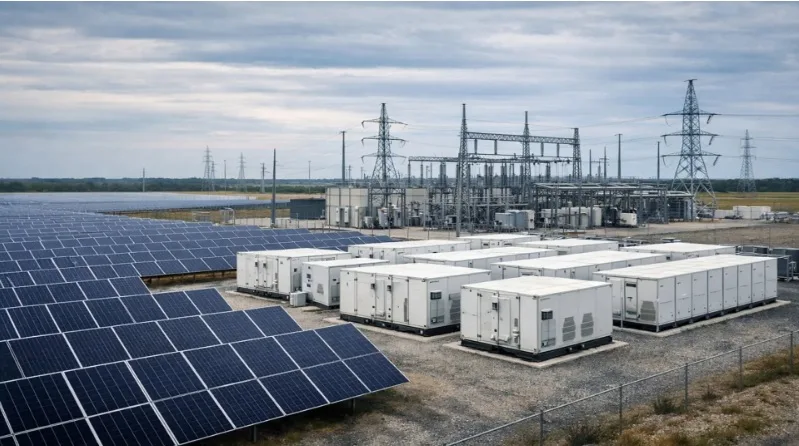
Consider an electrical system with high solar penetration. During peak irradiance hours, generation exceeds demand, leading to curtailment if storage capacity is unavailable. A BESS can capture this surplus and shift it to nighttime hours, reducing intraday variability.
However, in prolonged low-irradiance scenarios, storage becomes insufficient. This is where firm generation, such as an SMR, acts as structural backup. The combination of both systems allows coverage of both short-term variability and long-duration events.
Artificial intelligence acts as a coordination layer, optimizing resource use based on dynamic conditions. The result is a system with high renewable penetration, minimal fossil dependence, and operational stability.
Sustainability with reliability: A complementary architecture
An effective energy transition does not depend on a single technology, but on the coherent integration of multiple solutions under system engineering principles.
Firm clean energy emerges as the fundamental criterion that reconciles sustainability with reliability. BESS, SMRs, and artificial intelligence do not compete; they form part of a complementary architecture that defines the future of the electrical system. Ignoring this integration leads to incomplete and often technically unfeasible solutions.
From a power system operation perspective, this implies meeting strict criteria for frequency stability, voltage regulation, and disturbance response capability.
The inherent intermittency of solar and wind generation introduces fluctuations that must be compensated through firm generation, storage, or advanced demand management.
The convergence of storage, firm generation, and intelligent systems defines the future energy architecture. Modern engineering must focus on integrating these technologies under criteria of reliability, efficiency, and sustainability.
The strategic importance of clean irfm energy in the energy transition
The integration of clean energy into global power systems represents one of the greatest advances toward decarbonization; however, its real value is only realized when its availability is guaranteed in a continuous and reliable manner. In this sense, firm clean energy emerges as the key element that enables sustainability to become an operational reality.
The importance of this concept lies in its ability to bridge the gap between renewable generation and system stability. Without mechanisms that ensure energy firmness, high penetration of intermittent sources can create imbalances that compromise the quality of electricity supply. Therefore, integrating technologies that provide firm capacity is not only a technical decision, but a strategic necessity for the evolution of the energy sector.
Moreover, the development of energy systems based on Firm Clean Energydrives technological innovation, promotes digitalization, and strengthens the resilience of critical infrastructures. This approach enables the design of more robust grids, capable of adapting to scenarios of high uncertainty and variability without relying on fossil fuels.
Ultimately, adopting this paradigm not only contributes to emission reduction, but also ensures energy security, optimizes system operation, and lays the foundation for a more efficient, reliable, and sustainable energy model.
Conclusions
The evolution of power systems toward configurations with high penetration of renewable energy has made it evident that sustainability alone does not guarantee operational reliability. In this context, the concept of Firm Clean Energy takes on a central role as a design criterion, as it enables the integration of emission-free generation with real capabilities for response, stability, and continuity of supply. This approach goes beyond the traditional view focused solely on emission reduction, incorporating critical variables such as system inertia, dispatchability, and resilience to disturbances.
Likewise, the combination of technologies such as Battery Energy Storage Systems (BESS), Small Modular Reactors (SMRs), and artificial intelligence-based tools demonstrates that the future of energy does not depend on isolated solutions, but on highly integrated hybrid architectures. Each technology provides specific functions within the system: storage manages short-term variability, firm generation ensures structural backup, and artificial intelligence optimizes operation under dynamic and uncertain conditions. This synergy not only improves overall system efficiency but also reduces operational and economic risks.
Finally, the transition toward more advanced energy systems implies a profound change in how electrical assets are planned, operated, and managed. Modern engineering must adopt a systemic approach, where digitalization, predictive modeling, and technological integration become fundamental pillars. In this scenario, Firm Clean Energy is not an option, but a technical necessity to ensure stability, energy security, and long-term sustainability.operational risk.
References
- International Energy Agency (IEA). (2023). Electricity market report: Outlook for 2023 and 2024. IEA Publications.
- U.S. Department of Energy. (2022). Grid energy storage technology cost and performance assessment. Office of Electricity.
- GE Vernova. (2023). BWRX-300 small modular reactor. Retrieved from https://www.gevernova.com/nuclear/carbon-free-power/bwrx-300-small-modular-reactor