

Table of Contents
- The organizational challenge
- The evolution of asset integrity and the role of software
- Software for pipeline and equipment integrity: Key functions
- What software is used to manage RBI inspections?
- Integration of NDT and CMMS in inspection management
- How to choose an integrity platform
- Conclusions
- References
In industries such as oil and gas, petrochemicals, energy, manufacturing, and mining, equipment reliability is not merely an operational concern—it is a matter of safety, business continuity, and sustainability. Pipelines, pressure vessels, storage tanks, and steel structures often operate under demanding conditions—high temperatures, pressure, corrosion, or mechanical fatigue—and any failure can lead to significant economic, environmental, and human consequences.
For this reason, asset integrity has become a central discipline in modern industrial management. Its objective is to ensure that each asset operates within its design limits throughout its entire lifecycle.
The organizational challenge
Over time, technological evolution has shown how we can achieve greater precision in our evaluations, allowing us to better understand what truly matters. In this context, digitalization has profoundly transformed how organizations approach this challenge. Today, Asset Integrity Management Systems (AIMS) and specialized inspection software centralize information, analyze risks, and plan interventions with far greater accuracy than traditional methods based on spreadsheets or scattered records.
These digital tools in modern integrity management—especially in inspection management, the integration of methodologies such as RBI, NDT, and CMMS, and the use of key performance indicators in advanced integrity programs—play a crucial role in improving inspection efficiency and effectiveness.
The evolution of asset integrity and the role of software
When discussing Asset Integrity Management (AIM), we refer to the set of processes, tools, and practices that ensure physical equipment operates safely and reliably throughout its useful life (API NDT, 2024). In general terms, it represents an organizational framework to guarantee efficiency and effectiveness in integrity processes.
Traditionally, many organizations reacted to problems only after they occurred. Inspections were scheduled at fixed intervals, and decisions were primarily based on the experience of technical personnel. While this approach worked for decades, it had significant limitations: it did not always allow for failure prediction or proper prioritization of resources.
Today, the approach has shifted. Companies now pursue predictive, risk-based models where historical data, inspection results, and operating conditions are analyzed together to anticipate problems before they occur. This is where specialized software becomes essential.
Modern integrity platforms enable organizations to:
- Centralize technical data.
- automate degradation calculations.
- atandardize inspection methodologies.
- maintain full traceability of decisions.
Within this ecosystem, Inspection Data Management Systems (IDMS) have become the core of many integrity programs. These systems integrate inspection results, corrosion models, risk assessments, and maintenance plans into a single digital environment.
Software for pipeline and equipment integrity: Key functions
Today, technology drives nearly every aspect of industry—and in this case, software plays a central role. Asset integrity software is not limited to storing information; its true value lies in transforming data into actionable knowledge for decision-making.
Among the most important features are the following.
Centralized information management
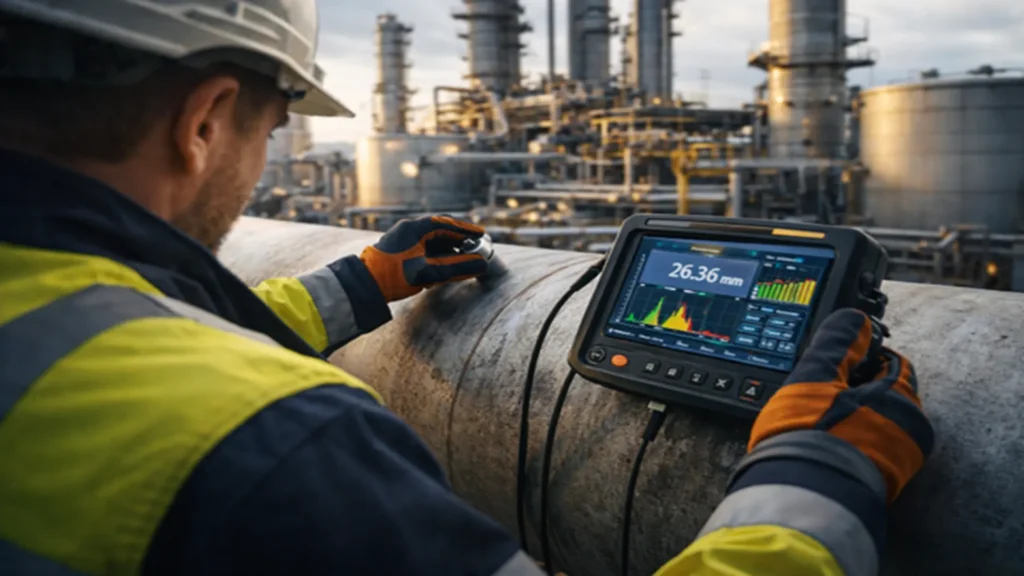
Inspections generate large volumes of data from multiple sources: ultrasonic measurements, industrial radiography, visual inspections, drones, IoT sensors, and historical maintenance records.
When this data is stored in separate systems, obtaining a complete view of equipment condition becomes difficult. Integrity software consolidates all this information into a single environment, facilitating analysis and reducing data loss.
Degradation models and prediction
Advanced systems include mathematical models capable of estimating the progression of deterioration mechanisms such as:
- Corrosion.
- Fatigue.
- Creep (temperature-induced deformation).
- Erosion.
Based on these models, software can project the remaining life of an asset and recommend when the next inspection or intervention should take place. This enables a shift from reactive to predictive management.
Integration with Risk-Based Inspection (RBI)
Risk-Based Inspection (RBI) is one of the most widely used approaches for prioritizing inspections. Formalized in API 580 and API 581 standards, this methodology evaluates both the probability of failure and its potential consequences.
The result is a risk ranking that allows inspection resources to be focused on truly critical equipment.
Some commercial tools, such as iRiS and Bureau Veritas solutions, include RBI modules that automate these calculations and help generate optimized inspection plans (Steinbeis R-Tech, 2025; Bureau Veritas, 2025).
Regulatory compliance
Another important benefit of specialized software is its ability to support compliance with industrial standards and regulations.
These systems can record inspections, store technical evidence, and generate reports aligned with international standards, facilitating regulatory audits and internal reviews.
Visualization and reporting
Modern software also incorporates visualization tools that transform large volumes of data into understandable insights.
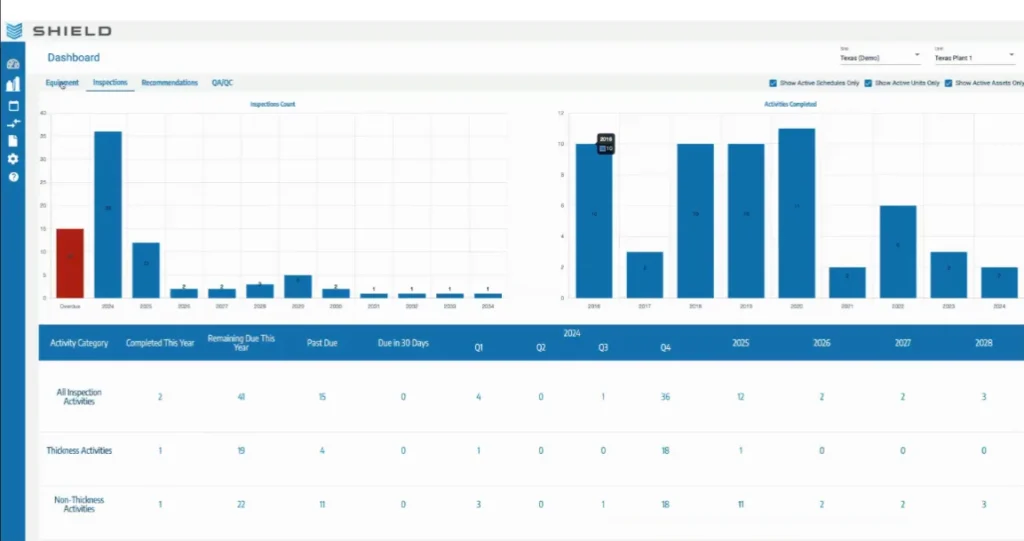
Through interactive dashboards, risk maps, and automated reports, engineers, supervisors, and managers can quickly understand the overall condition of assets and make informed decisions.
What software is used to manage RBI inspections?
There are several solutions on the market designed to support risk-based inspection programs.
Among the most recognized are:
- iRiS RBI: A comprehensive system that includes modules for RBI, RCM, and HAZOP, along with integration with NDT and CMMS (Steinbeis R-Tech, 2025).
- Soffia and other Bureau Veritas platforms: Used for both qualitative and quantitative risk analysis (Bureau Veritas, 2025). SoffIA is an AI-powered assistant described as a private GPT designed to integrate within enterprise infrastructure.
- Antea AIM: An advanced platform for managing physical asset integrity in critical industries such as oil, gas, chemicals, and power generation, incorporating digital twins and predictive analytics (Antea, 2024).
- Specialized niche platforms, such as SHIELD by PROtect LLC, focused on inspection management, anomaly tracking, and corrective action control.
Choosing the right tool depends on several factors, including company size, asset complexity, program maturity, and integration requirements with other systems.
In practice, companies achieve the best results when the selected software aligns with their processes and the technical team is properly trained to interpret the generated data. This balance is key to achieving the improvements the industry expects.
Integration of NDT and CMMS in inspection management
As work environments become more dynamic, the integration of different tools becomes essential. One of the most common challenges in integrity programs is connecting systems that manage complementary information. In particular, integrating Non-Destructive Testing (NDT) results with Computerized Maintenance Management Systems (CMMS) is critical.
Integration of NDT results
NDT methods provide essential information about the actual condition of equipment.
When this data is directly integrated into integrity systems, organizations can:
- update corrosion models with recent measurements,
- detect deterioration trends,
- identify critical anomalies,
- and feed RBI analyses with real field data.
Connection with CMMS systems
CMMS platforms—such as SAP PM or IBM Maximo—contain information about work orders, maintenance interventions, and equipment availability.
When integrated with integrity platforms, they enable better coordination of inspection and maintenance activities, helping to:
- Avoid task duplication.
- Optimize resource allocation.
- Prioritize interventions based on risk level.
Workflow automation
In integrated digital environments, an anomaly detected during an inspection can automatically trigger a sequence of actions:
- Criticality assessment.
- Work order generation.
- Tracking until resolution.
This type of automation improves traceability and reduces response times to potential failures.
How to choose an integrity platform
Given the growing number of available tools, selecting integrity software requires evaluating several technical and operational aspects.
Key criteria include:
- Ease of use and configuration.
- Integration capabilities with NDT and CMMS systems.
- Robustness of RBI modules.
- Document management and inspection traceability.
- Strong technical support.
In recent years, niche companies have gained ground over larger solutions by developing platforms specifically designed for industrial inspection practices.
One example is PROtect LLC, whose SHIELD platform focuses on field-oriented functionality, including anomaly tracking, critical date management, and regulatory compliance.
In many cases, organizations adopt hybrid models that combine software with specialized engineering services—an approach particularly useful for companies in the early stages of building their integrity programs.
Conclusions
Asset integrity management has become an essential component of modern industrial operations. Specialized software—particularly IDMS systems—is enabling the integration of data from inspections, maintenance, and risk analysis. When used effectively, these tools significantly improve inspection planning, resource prioritization, and operational safety.
However, the success of an integrity program also depends on the technical knowledge of the team managing it. Software is a powerful tool, but its true value emerges when data is transformed into informed decisions and concrete actions.
References
- Antea. (2024). Asset Integrity Management Software with Digital Twin. https://antea.tech
- API NDT. (2024). Servicios de Gestión de Integridad de Activos. https://api-ndt.com
- Bureau Veritas. (2025). Inspección basada en el riesgo (RBI). https://bureauveritas.com
- PROtect LLC. (2025). SHIELD Asset Integrity Management Platform. https://protectllc.com
- Steinbeis R-Tech. (2025). iRiS RBI – Integrated Risk Management System. https://risk-technologies.com
- Zavarce, A. (2025). Integridad de activos: RBI y FFS en la industria. Inspenet.