Table of Contents
Piping systems are critical infrastructure in the oil and gas industry. Pipelines are the preferred method for transporting crude oil and natural gas because they provide the most cost-effective, energy-efficient, and safest means of moving massive volumes of product over long distances. Operating continuously, pipelines are largely protected from severe weather and traffic disruptions, making them highly reliable.
Compared to transportation by truck, rail, or ship, pipelines offer significantly lower operating costs and a smaller carbon footprint because they rely on electrically driven booster pumps to maintain pressure rather than fuel-powered engines for each shipment. Additionally, since most pipelines are buried underground and located away from populated areas, they generally result in fewer injuries, fatalities, and environmental incidents than alternative transportation methods. Modern pipeline systems also incorporate advanced flow-control technology capable of automatically shutting down valves in response to pressure drops or leak detection.
Despite their excellent safety record, piping systems are not immune to failure. Internal corrosion can occur when transported fluids contain chemicals or contaminants that chemically attack the pipe wall. For example, carbon dioxide (CO₂) can react with water to form carbonic acid, resulting in “sweet corrosion,” while hydrogen sulfide (H₂S) can cause the more aggressive “sour corrosion.” Crude oil may also contain sand and other abrasive particles that, when transported at high velocities, repeatedly impact the pipe wall at directional changes. This can lead to severe erosion at the outer radius (extrados) of elbows and tees. In refinery environments, erosion-corrosion may occur when high-velocity fluids continuously remove the protective oxide layer from the inside surface of the pipe, exposing fresh metal to corrosive agents.
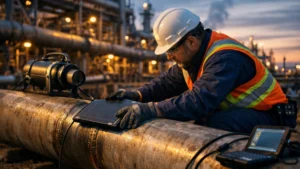
To identify these degradation mechanisms before they lead to failure, operators rely on a variety of non-destructive testing (NDT) methods. These techniques allow inspectors to measure wall thickness, detect cracks, and monitor corrosion without interrupting operations or damaging the asset. Two of the most widely used methods for pipeline corrosion assessment are Ultrasonic Testing (UT) and Radiographic Testing (RT).
Radiographic Testing offers several significant advantages over Ultrasonic Testing for erosion and corrosion inspections, particularly when examining insulated piping. Because radiography can image through insulation, it eliminates the need to remove expensive insulation or high-temperature coatings, reducing both inspection costs and downtime. It also requires minimal surface preparation while providing permanent visual documentation of wall loss, pitting, and other degradation mechanisms. This capability makes RT especially effective for detecting Corrosion Under Insulation (CUI), whereas UT requires direct contact with the pipe surface, necessitating insulation removal before inspection.

Radiography also performs exceptionally well when inspecting small-bore piping, valves, and complex weld geometries, where, irregular surfaces make ultrasonic probe placement and acoustic coupling challenging.
Advances in digital radiography software have further enhanced the effectiveness of RT inspections. Software solutions such as D-Tect X from Duerr NDT incorporate sophisticated wall thickness measurement tools that enable technicians to obtain accurate measurements with a single click. These automated capabilities not only improve measurement consistency and reduce inspection time but also allow comprehensive inspection reports to be generated quickly based on the collected data.

As pipeline operators continue to prioritize safety, reliability, and cost-effective asset management, advanced radiographic inspection technologies are becoming increasingly valuable. By combining high-quality digital imaging with automated analysis and reporting tools, modern RT solutions enable faster detection of corrosion and wall loss, support informed maintenance decisions, and help prevent costly failures before they occur.
References
- Advanced FRP Systems. (2022, April 28). Internal pipe corrosion. https://www.advancedfrpsystems.com/internal-pipe-corrosion/ DÜRR NDT.
- (n.d.). D-Tect X NDT X-ray inspection software. https://www.duerr-ndt.com/products/ndt-software/d-tect-xray-inspection-software.html.
- Premier NDT Resources. (2026, January 7). Ultrasonic vs. radiographic testing: Which is right for your project? https://www.premierndtresources.com/ultrasonic-vs-radiographic-testing-w.
- hich-is-right-for-your-project/ ScienceDirect. (n.d.). Article S0950061819300765. https://www.sciencedirect.com/science/article/abs/pii/S0950061819300765).