Table of Contents
- What can be missed between periodic inspections
- What continuous asset monitoring means in an industrial facility
- Autonomous inspection: Repeating the same observation
- Automated anomaly detection: Learning what normal looks like
- From an isolated alert to a condition trend
- Historical and current data on the same asset
- Offshore case study: From 15% to more than 95% coverage
- Abyss Solutions: Sentinel and Fabric for prioritizing findings
- When continuous asset monitoring adds value
- From a finding to a maintenance decision
- Conclusions
- References
- Frequently Asked Questions (FAQs)
An inspection can confirm that equipment is in acceptable condition today while leaving several weeks with little information about what happens afterward. That interval is where continuous asset monitoring begins to provide value, particularly when degradation can develop between scheduled inspection campaigns.
Autonomous inspection, inspection robotics, and artificial intelligence in inspection make it possible to repeat observations, compare current conditions with previous records, and identify changes that warrant further review. The objective is not to replace engineering judgment, but to shorten the time between the appearance of a visible change and the decision to investigate it.
What can be missed between periodic inspections
A periodic inspection provides a snapshot of asset condition at a specific point in time. If the next campaign takes place several months later, the integrity team may know what the asset looked like at two different dates without necessarily knowing when the change began or how it progressed during the interval.
At large facilities, thousands of components compete for inspection resources. External corrosion, coating degradation, leaks, displaced objects, or changes in appearance can develop after the most recent walkdown and remain undocumented until the next inspection.
Condition monitoring helps close that gap when data acquisition is repeated frequently enough and under comparable conditions. For machinery, ISO 17359:2018 provides general guidelines for establishing condition monitoring programs. Acquisition frequency and inspection methods should be selected according to the asset and the type of change that needs to be detected.
What continuous asset monitoring means in an industrial facility
Continuous asset monitoring does not mean that every component must be measured 24/7. In visual inspection and robotics, it can refer to autonomous or recurring inspection rounds that generate comparable information frequently enough to track changes between conventional inspection campaigns.
This differs from permanent wall-thickness monitoring using fixed sensors. Permanently installed ultrasonic sensors are useful when wall loss must be tracked at selected locations. Image-based autonomous inspection addresses a different need: screening large areas, identifying out-of-normal conditions, and directing technical review toward locations that might otherwise go weeks without observation.
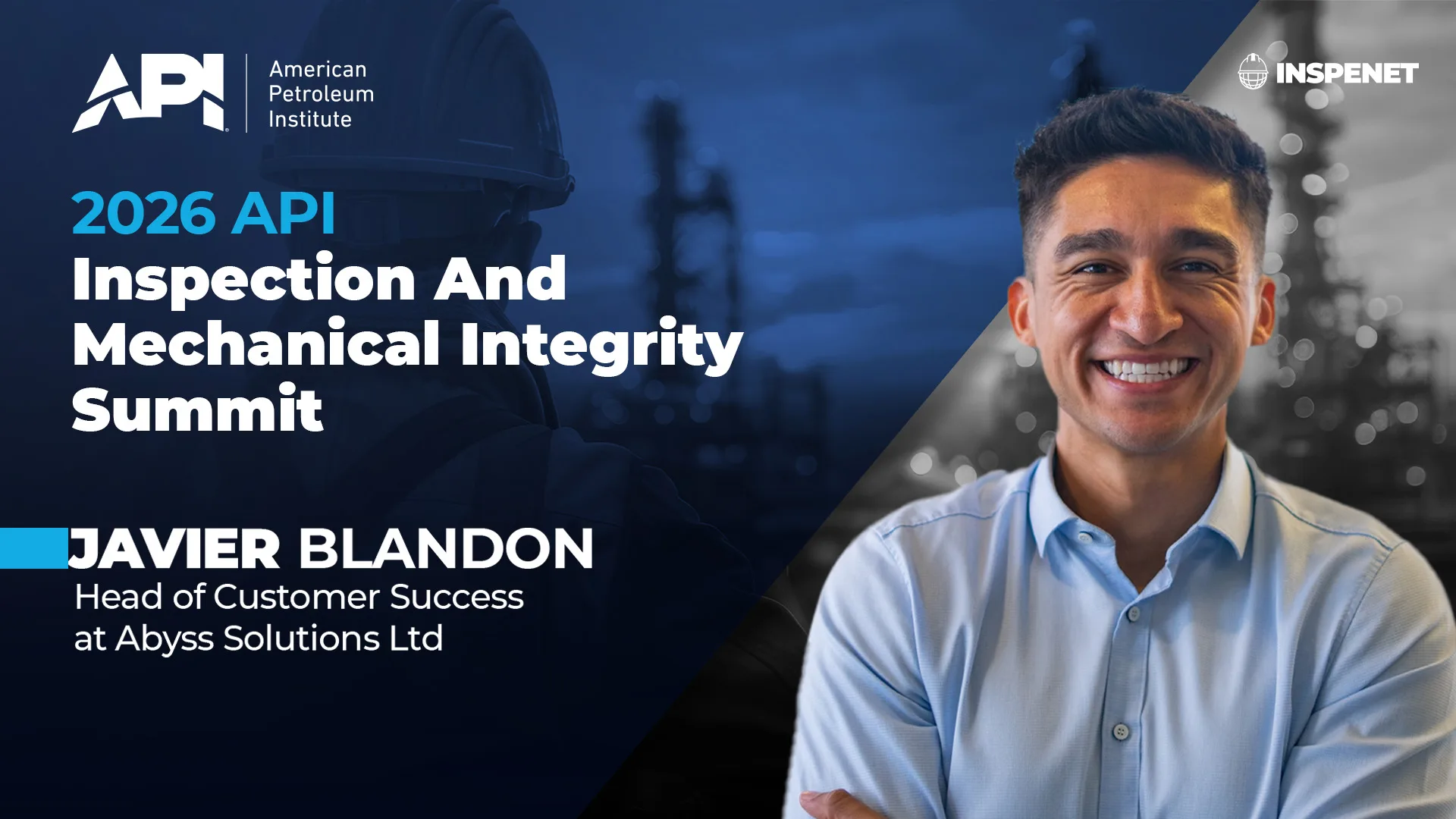
In an Inspenet TV interview on continuous asset monitoring, Javier Blandón of Abyss Solutions discusses this transition toward more frequent surveillance supported by artificial intelligence, robotics, and data analytics. Blandón describes a Gulf Coast operator that uses automated inspections to identify approximately three significant findings per quarter and uses that information to support maintenance planning.
Autonomous inspection: Repeating the same observation
The advantage of deploying a robot, fixed camera, or mobile inspection platform goes beyond removing personnel from hazardous areas. A properly designed autonomous inspection program can repeat routes, camera positions, and capture sequences more consistently, making comparisons over time more reliable.
Abyss states that its anomaly-detection technology can be deployed through CCTV cameras, IoT devices, or robots such as Spot. Across large facilities, these platforms can perform recurring operator rounds and increase inspection frequency without relying exclusively on manual walkdowns.
Repeatability still requires control. Major changes in lighting, condensation on a lens, temporary obstructions, or variations in camera position can produce differences that do not originate from the asset itself. Inspection procedures therefore need to define routes, minimum image-quality requirements, and criteria for repeating a capture when the data cannot be reliably compared.
Automated anomaly detection: Learning what normal looks like
Automated anomaly detection does not necessarily depend on a predefined catalog of known defects. Industrial facilities can experience leaks, displaced objects, or unusual visual changes that occur too infrequently for every possible variation to be represented in a conventional training dataset.
Abyss has developed unsupervised-learning methods for anomaly detection that learn from normal operating conditions and identify subsequent deviations. The technology is designed to tolerate natural environmental changes, such as lighting variations or movement, so that every visual difference does not automatically become an alert.
Within Abyss’ product ecosystem, Abyss Sentinel analyzes field imagery and raises alerts when it identifies something outside the expected condition. Sentinel learns what normal looks like and flags deviations for human review.
An alert may correspond to corrosion, a leak, a tool left behind, or an unexpected change in a component. Artificial intelligence in inspection helps identify these observations, but an integrity professional must determine their significance and decide whether additional inspection is required.
From an isolated alert to a condition trend
An anomaly detected once does not demonstrate progressive degradation. Establishing a trend requires preserving the component’s history, comparing equivalent inspection campaigns, and determining whether the extent, severity, or frequency of the observed condition is changing.
This is where condition monitoring becomes more valuable. If a surface shows increasing deterioration over successive inspection rounds, the evidence may justify a targeted inspection before the next scheduled campaign. If the indication remains stable, the technical team has a documented baseline to support its decision.
Time-based comparison requires traceability. Capture date, equipment used, camera position, image quality, associated component, and classification criteria should all be recorded so that differences between inspection campaigns can be explained rather than relying on the memory of the person reviewing the images.
Historical and current data on the same asset
Data volumes increase rapidly when cameras, robots, scanners, and recurring inspection rounds are involved. Without an asset-based structure, automated anomaly detection can simply create another large repository of images that is difficult to associate with specific piping, vessels, or outstanding work.
Abyss Fabric™ organizes inspection data at the component level and provides capabilities including tagging, point-cloud segmentation, and condition assessment while layering historical and current information. Detection data can be visualized in both 2D imagery and 3D point-cloud environments so that findings retain their physical context within the facility.
When findings are incorporated into asset integrity and inspection management systems, historical records can be connected with previous inspections, maintenance activities, and outstanding work. This preserves the traceability behind each decision.
Offshore case study: From 15% to more than 95% coverage
A case study published by Abyss evaluated an Automated Condition Assessment System across four deepwater offshore oil and gas facilities in the Gulf of Mexico. Compared with General Visual Inspection campaigns conducted the previous year, Abyss reported inspection coverage increasing from approximately 15% to more than 95%, while also reducing personnel on board and inspection costs.
The methodology combined 360° panoramic imagery with laser scanning. Machine-learning and computer-vision algorithms detected corrosion and coating degradation, and individual equipment items were linked to piping line numbers, fixed equipment tags, or unique asset identification numbers. The degree of rusting was assessed using the Ri scale defined in ISO 4628-3.

According to the case study, the Automated Condition Assessment System required approximately 6% of the PoB used during the conventional physical GVI campaign and reduced inspection costs by approximately 50%. These figures correspond specifically to the facilities evaluated by Abyss. They illustrate how broader asset coverage and component-level condition assessment can influence maintenance prioritization, rather than representing universal performance values for every facility.
Abyss Solutions: Sentinel and Fabric for prioritizing findings
Within the Abyss ecosystem, Sentinel supports automated anomaly detection from inspection imagery and raises alerts for operator rounds. Fabric serves a different purpose: it organizes and contextualizes inspection information so asset integrity, inspection, and maintenance teams can evaluate condition and prioritize actions.
An alert becomes more useful when it is associated with the correct component, can be compared with historical information, and leads to a traceable decision. Abyss Fabric™ provides capabilities such as component-level tagging, corrosion detection and categorization, coating condition assessment, and inspection prioritization.
This distinction is important. Detection identifies that something has changed. Contextualization determines where the change occurred, what equipment it affects, how it compares with previous conditions, and how it should influence inspection or maintenance planning.
When continuous asset monitoring adds value
Not every asset requires the same observation frequency. Continuous asset monitoring is most valuable when conditions can change between inspection campaigns, conventional access is expensive or hazardous, large numbers of inspection points must be reviewed, or delayed detection could increase operational consequences.
There also needs to be a defined response to alerts. If automated anomaly detection generates notifications that no one reviews, increasing inspection frequency simply increases the volume of data. Each alert category should therefore have an assigned owner, validation criteria, and a defined path toward supplemental inspection, maintenance, or technical disposition.
Technology selection depends on the variable that needs to be observed. Inspection robotics and computer vision can identify visible changes, while sensors, NDE methods, and other inspection techniques remain necessary for measuring variables such as wall thickness, temperature, vibration, or pressure. The method should match both the degradation mechanism of interest and the rate at which the condition may change.
From a finding to a maintenance decision
An alert adds value only when it leads to a traceable decision. It may justify a targeted inspection, change a maintenance priority, or bring an intervention forward. For equipment covered by a Risk-Based Inspection program, API RP 580 establishes the basic elements for developing and maintaining an RBI program. New condition information should therefore be evaluated before inspection priorities are changed.
Abyss Fabric™ converts observations and condition data into information that integrity and maintenance teams can use, with capabilities that include corrosion detection and categorization, coating condition assessment, component-level tagging, and prioritization of inspection and maintenance campaigns.
When the system detects an out-of-normal condition, the next step is to verify the affected component, review its inspection history, and determine the potential damage mechanism before deciding whether supplemental inspection, remediation, or continued monitoring is appropriate.
Need to evaluate how autonomous inspection, Abyss Sentinel, or Abyss Fabric™ could be incorporated into an asset integrity program? Connect with Abyss Solutions through Corporate Inspenet to learn more about its capabilities and establish direct technical contact with the company.
Conclusions
Changes can develop between inspections that a fixed inspection schedule may not identify soon enough. Continuous asset monitoring helps reduce that information gap by combining recurring data capture, autonomous inspection, and comparable condition data from the same components.
Artificial intelligence in inspection and automated anomaly detection help screen large volumes of inspection imagery, while historical condition data make it possible to recognize trends. Engineering judgment remains essential: an alert must be validated, associated with a potential damage mechanism, and translated into an inspection or maintenance action that is proportional to the risk.
References
- ISO. ISO 17359:2018, Condition monitoring and diagnostics of machines: General guidelines.
- ISO. ISO 4628-3:2024, Paints and varnishes: Evaluation of quantity and size of defects, Part 3: Assessment of degree of rusting.
- American Petroleum Institute. API RP 580, Elements of a Risk-Based Inspection Program, Fourth Edition, 2023; Addendum 1, 2025.
- Abyss Solutions. Detecting anomalies using robots with a new method of unsupervised learning AI. December 4, 2021.
- Abyss Solutions. Impacts of an Automated Condition Assessment System. December 14, 2022.
Frequently Asked Questions (FAQs)
Does continuous asset monitoring require permanently installed sensors?
Not always. It can rely on sensors, fixed cameras, robots, or recurring autonomous inspection rounds, depending on the variable being monitored and the required observation frequency.
What is the difference between anomaly detection and classification?
Classification identifies conditions that match previously defined categories. Anomaly detection can identify deviations from a learned normal condition even when they do not correspond to a previously labeled defect.
Does Abyss Sentinel replace the inspector?
No. Sentinel raises alerts when it detects out-of-normal conditions. An integrity professional must review the finding, determine its significance, and decide whether additional inspection or maintenance is required.
Why maintain historical records for each component?
Component-level history makes it possible to compare inspection campaigns, distinguish stable conditions from progressive changes, and better support inspection and remediation priorities.