Table of Contents
- What is AMPP and how is it related to NACE and SSPC?
- Why are corrosion standards important for industrial assets?
- How are AMPP standards developed?
- How to apply AMPP standards to industrial assets?
- Main application areas of AMPP, NACE, and SSPC standards
- SSPC standards and their importance in industrial coatings
- Updates and evolution of corrosion protection standards
- Conclusions
- References
Corrosion standards play a fundamental role in the protection, preservation, and maintenance of industrial assets. Their application makes it possible to establish technical criteria to prevent material deterioration, select appropriate protection systems, and ensure the integrity of metal structures, pipelines, tanks, and equipment operating under demanding conditions.
Among the leading organizations in this field is the Association for Materials Protection and Performance (AMPP), an organization formed through the merger of NACE International and SSPC: The Society for Protective Coatings, announced in January 2021. This integration brought together the expertise of two internationally recognized organizations in corrosion engineering, cathodic protection, surface preparation, and protective coating application.
Today, AMPP develops and maintains standards, recommended practices, test methods, and technical guides that help establish common criteria for the oil and gas, energy, infrastructure, manufacturing, and transportation industries. Understanding these standards and knowing how to apply them enables engineering, inspection, and maintenance professionals to develop more effective strategies for controlling corrosion, extending asset service life, and reducing the risk of operational failures.
What is AMPP and how is it related to NACE and SSPC?
The Association for Materials Protection and Performance (AMPP) is an international organization dedicated to advancing materials protection and industrial asset performance through the development of standards, certifications, training programs, and specialized knowledge.
Its creation resulted from the integration of two long-established organizations:
- NACE International: Founded in 1943, it built an extensive track record in corrosion engineering, cathodic protection, materials selection, and the prevention of metal structure deterioration.
- SSPC: Founded in 1950, it specialized in surface preparation, protective coatings, inspection, and the protection of steel structures.
The integration of both organizations made it possible to consolidate their standardization programs into a single AMPP standards program, with the formal integration process beginning on June 2, 2021.
It is important to note that the historical NACE and SSPC designations continue to be used to identify numerous technical documents. Their integration into AMPP does not mean that all previous standards have disappeared or automatically changed their names.
Why are corrosion standards important for industrial assets?
Corrosion is one of the main deterioration mechanisms affecting the reliability and availability of industrial assets. It can cause wall thinning, perforations, cracking, leaks, and structural failures, with economic, environmental, and operational consequences.
In this context, AMPP, NACE, and SSPC standards provide technical criteria for establishing prevention, inspection, protection, and maintenance measures.
Their application makes it possible to:
- Prevent internal and external corrosion in pipelines, tanks, and industrial equipment.
- Select appropriate materials for corrosive environments.
- Establish surface preparation requirements before applying coatings.
- Define procedures for implementing cathodic protection systems.
- Evaluate the quality and performance of protective coatings.
- Improve corrosion inspection and monitoring processes.
- Reduce costs associated with repairs and unplanned shutdowns.
- Help extend the service life of industrial facilities.
In addition, these standards provide a common technical reference for manufacturers, operators, inspectors, engineers, and contractors.
How are AMPP standards developed?
The AMPP standards program brings together professionals, specialists, researchers, and representatives from different industrial sectors who participate in the development, review, and maintenance of technical documents through consensus-based processes.
Its Standards Committees (SCs) work on developing publications related to different areas of materials protection.
Their main document types include:
- Standards: Establish requirements and technical criteria for specific activities, materials, and processes.
- Recommended practices: Provide procedures and recommendations for designing, installing, operating, or maintaining corrosion protection systems.
- Test methods: Describe procedures for evaluating the properties and behavior of materials, coatings, and corrosion protection systems.
- Technical guides: Provide guidance for selecting, implementing, and evaluating materials protection solutions.
- Qualification documents: Establish criteria for evaluating competencies, processes, and capabilities in specific industrial activities.
These documents cover different stages of the asset life cycle, from materials selection and design to inspection, maintenance, and rehabilitation.
How to apply AMPP standards to industrial assets?
The application of AMPP standards must take into account the characteristics of each asset, environmental conditions, deterioration mechanisms, and facility operating requirements.
There is no single standard that addresses every corrosion problem. Therefore, technical documents must be selected according to the material type, exposure environment, and required protection system.
The main stages of application include the following:
1. Identification of corrosion mechanisms
The first step is to evaluate operating conditions and the factors that may cause material deterioration.
Different corrosion mechanisms may occur in industrial facilities, including:
- Uniform corrosion.
- Localized corrosion or pitting.
- Stress corrosion cracking.
- Galvanic corrosion.
- Microbiologically influenced corrosion (MIC).
- Hydrogen-induced cracking.
- Corrosion under insulation (CUI).
Identifying the deterioration mechanism makes it possible to establish appropriate criteria for selecting materials, inspection methods, and protection systems.
2. Selection of materials resistant to corrosive environments
Materials selection is a fundamental decision during the design and maintenance of industrial assets.
In oil and gas facilities, for example, certain equipment and pipelines may be exposed to environments containing hydrogen sulfide (H₂S), increasing the risk of cracking and other deterioration mechanisms.
In these cases, ANSI/NACE MR0175/ISO 15156 establishes requirements for the selection and qualification of materials intended for H₂S-containing environments in oil and gas production.
Proper application of these criteria helps reduce the risks associated with inappropriate materials selection and improve equipment reliability.
3. Surface preparation and coating application
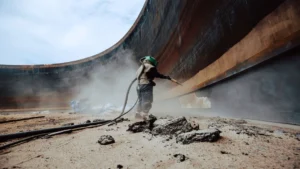
Surface preparation is a determining factor in the performance of corrosion protection systems.
Before applying a coating, it is necessary to assess substrate conditions, remove contaminants, and establish the required degree of cleanliness.
Historical NACE and SSPC standards commonly used as references include:
- SSPC-SP 5/NACE No. 1: White metal blast cleaning.
- SSPC-SP 10/NACE No. 2: Near-white metal blast cleaning.
- SSPC-SP 6/NACE No. 3: Commercial blast cleaning.
- SSPC-SP 7/NACE No. 4: Brush-off blast cleaning.
- SSPC-SP 13/NACE No. 6: Surface preparation of concrete.
- SSPC-SP 14/NACE No. 8: Industrial blast cleaning.
These documents establish criteria for evaluating surface cleanliness before applying protective coatings.
The selected degree of surface preparation must comply with project specifications, coating type, and service conditions.
4. Implementation of cathodic protection systems
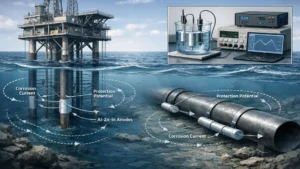
Cathodic protection is one of the most widely used techniques for controlling corrosion in buried or submerged metal structures.
Its application is particularly important for pipelines, storage tanks, marine facilities, and water distribution systems.
Reference documents include:
- NACE SP0169: Control of external corrosion on underground or submerged metallic piping systems.
- NACE SP0193: External cathodic protection of on-grade carbon steel storage tank bottoms.
- NACE SP0285: Corrosion control of underground storage tank systems by cathodic protection.
- NACE TM0497: Measurement techniques related to criteria for cathodic protection on underground or submerged metallic piping systems.
Applying these standards makes it possible to establish criteria for the design, evaluation, inspection, and maintenance of cathodic protection systems.
5. Corrosion inspection and monitoring
Periodic inspection makes it possible to identify changes in material condition and evaluate the performance of protection systems.
Common techniques include visual inspection, thickness measurements, coating evaluations, corrosion coupon monitoring, and cathodic protection surveys.
Some historical reference documents include:
- NACE SP0102: In-line inspection of pipelines.
- NACE TM0177: Laboratory testing to evaluate the resistance of metals to sulfide stress cracking and stress corrosion cracking in H₂S environments.
- NACE TM0284: Evaluation of pipeline and pressure vessel steels for resistance to hydrogen-induced cracking.
- SSPC-PA 2: Procedure for determining conformance to dry coating thickness requirements.
The selection of inspection techniques must consider the damage mechanism, operating conditions, and integrity requirements of each asset.
Main application areas of AMPP, NACE, and SSPC standards
Documents developed by these organizations are applicable across different industrial sectors.
Oil and gas industry
They are used to control corrosion in hydrocarbon production, refining, transportation, and storage facilities. Include criteria for materials selection, cathodic protection, pipeline assessment, and coating application.
Infrastructure and construction
They help protect bridges, metal structures, reinforced concrete elements, and other facilities exposed to aggressive environmental conditions.
Power generation
They are applied to protect equipment, pipelines, cooling systems, metal structures, and components subjected to demanding temperatures and operating conditions.
Water and wastewater
They provide criteria for controlling corrosion in tanks, pipelines, treatment structures, and distribution systems.
Marine and offshore facilities
They are essential for protecting platforms, submerged structures, subsea pipelines, and equipment exposed to seawater and high-salinity environments.
SSPC standards and their importance in industrial coatings
SSPC developed an extensive collection of standards focused on surface preparation, coating selection, and the protection of metal structures. One of its main contributions is the definition of criteria for evaluating surface conditions before applying protection systems.
Industrial coatings are designed to act as barriers between the material and the corrosive environment. Their performance depends on factors such as surface preparation, compatibility between coating layers, applied thickness, and exposure conditions.
A conventional coating system may include three components:
- Primer: Provides adhesion to the substrate and contributes to corrosion protection.
- Intermediate coat: Adds thickness and additional barrier properties.
- Topcoat: Provides protection against environmental conditions as well as functional or aesthetic characteristics.
Compatibility between these components and their suitability for the service environment are essential to achieving the expected performance.
Coating selection according to the exposure environment
Industrial coating systems must be selected by considering several factors:
- Humidity and temperature.
- Exposure to chemical agents.
- Presence of salts and contaminants.
- Water immersion or marine exposure.
- Solar radiation and atmospheric conditions.
- Operating conditions and maintenance requirements.
An inappropriate selection can lead to loss of adhesion, blistering, cracking, and premature coating deterioration. For this reason, technical specifications must establish requirements for surface preparation, application, inspection, and acceptance of the protective system.
Updates and evolution of corrosion protection standards
Advances in technologies, materials, and industrial processes make it necessary to periodically review corrosion protection standards.
AMPP maintains a collection of documents that incorporates historical NACE and SSPC standards, as well as new documents and revisions developed under its standardization program.
Topics of interest to the industry include:
- Cathodic protection of metal structures.
- Advanced surface preparation.
- Coating inspection and evaluation.
- Materials selection for corrosive environments.
- Control of deterioration mechanisms.
- Protection of concrete structures.
- Integrity assessment of industrial pipelines and equipment.
Professionals should consult official AMPP publications to identify the versions applicable to each project, their amendments, and any possible replacements.
Historical NACE and SSPC references remain useful for identifying technical documents, but it should not be assumed that all older editions are still current.
Conclusions
AMPP, NACE, and SSPC corrosion standards are fundamental references for materials protection, asset integrity, and industrial facility maintenance. The integration of NACE International and SSPC into AMPP made it possible to consolidate knowledge and experience in corrosion engineering, cathodic protection, surface preparation, and industrial coatings.
Their application to industrial assets should begin with the identification of deterioration mechanisms, continue with the selection of appropriate materials and protection systems, and be complemented by inspection and monitoring procedures. For engineers, inspectors, and maintenance professionals, understanding and correctly applying these standards helps improve equipment reliability, extend the service life of structures, and reduce risks associated with material degradation.
In an increasingly demanding industrial environment, staying up to date with AMPP publications and revisions is essential for developing appropriate technical specifications and establishing effective corrosion prevention and control strategies.
References
- AMPP. Association for Materials Protection and Performance. AMPP Standards Program.
- AMPP. Information on historical NACE standards.
- AMPP. Publications and technical documents related to corrosion protection, surface preparation, and industrial coatings.